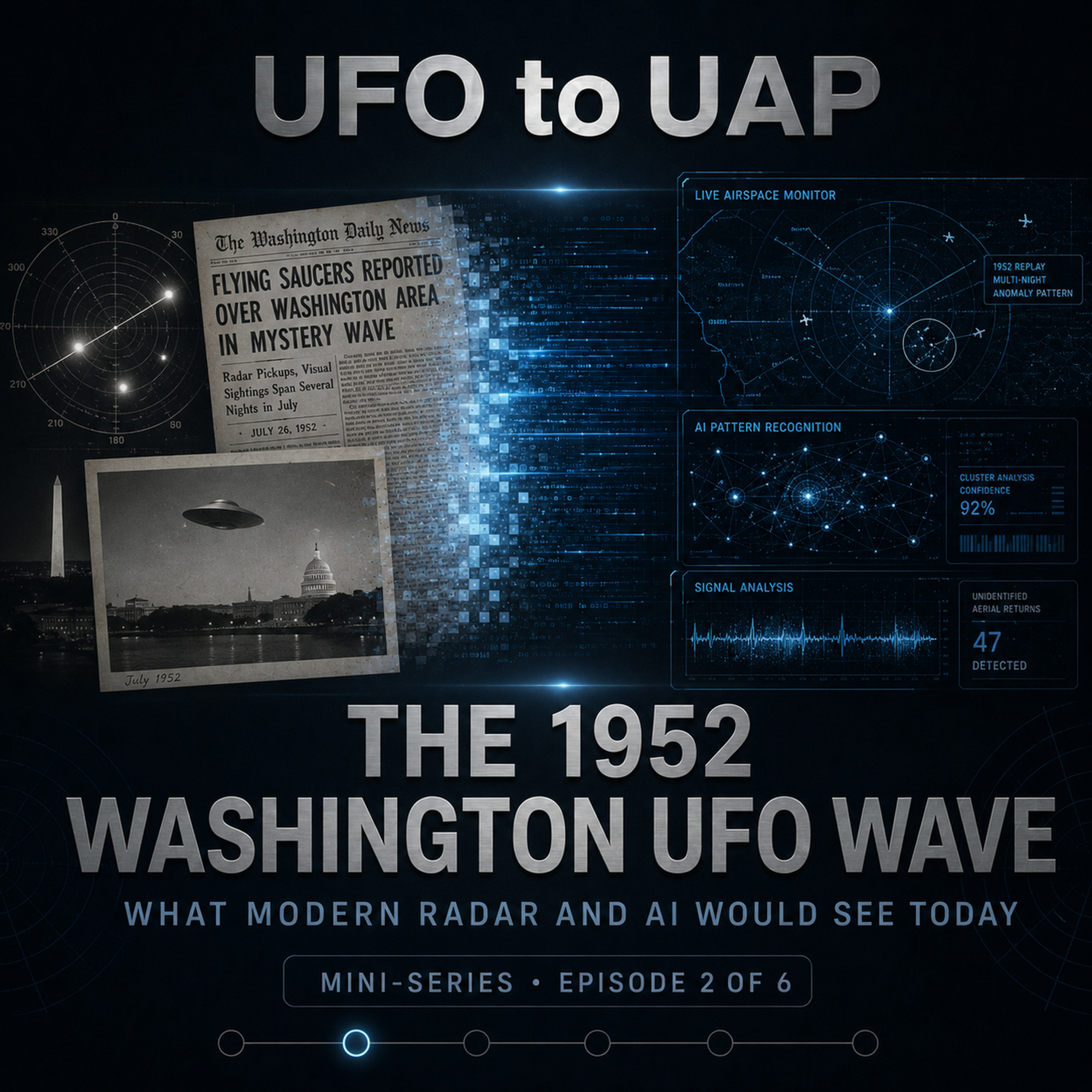
The 1952 Washington UFO Wave: What Modern Radar and AI Would See Today
Tonight's Episode
Imagine July 1952. The Cold War is intensifying, the public is anxious, and radar is rapidly becoming the ultimate tool for national defense. Suddenly, unidentified objects appear directly over Washington, D.C.—not a remote desert or a quiet rural highway, but right above the political heart of the most powerful nation on Earth. Radar operators see unusual returns, jet pilots are scrambled, and the government is thrown into institutional uncertainty.
In Episode 2 of our six-part miniseries, "From UFO Files to UAP Science," host Matt Tones investigates the legendary 1952 Washington D.C. UFO wave. Instead of just retelling history, we ask a cutting-edge question: If this massive airspace intrusion happened today, what would modern radar, artificial intelligence, satellite tracking, sensor fusion, and open-source intelligence databases actually see?
We break down the limits of 1950s instruments versus today's technology, dive deep into how radar anomalies and atmospheric conditions can mislead operators, and look at how modern agencies like AARO build a robust data picture. Discover why the Washington wave became an early blueprint for the modern UAP disclosure problem, and how today's machine learning anomaly detection would change the final verdict.
Episode Timestamps:
- (00:00) - Introduction: The Night Blips Appeared Over the Capital
- (00:50) - Miniseries Roadmap: Transitioning from Project Blue Book to AARO
- (01:26) - The Core Question: How Would Modern Technology Filter the 1952 Wave?
- (02:05) - The Strategic Cold War Domain: Washington D.C. as a Target Symbol
- (03:04) - Why the Washington Case Defines the UAP Disclosure Problem
- (04:10) - 1952 Technology vs. Modern Data Saturated Airspace
- (05:00) - Avoiding the Two Major Mistakes of Judging Historical UFO Cases
- (05:38) - Demystifying Radar: Objective Mechanical Evidence or Atmospheric Illusion?
- (06:26) - The Modern Interrogation: The Checklist for Verifying Radar Returns
- (07:44) - Interactive Listener Poll: Is Radar Alone Enough for Credibility?
- (08:01) - Historical Context: The Psychological Space of the Early 1950s
- (09:00) - Airspace Protection: How National Security Concerns Haven't Changed
- (09:58) - The Sensor Fusion Model: Combining Radar, Infrared, and Satellites
- (11:50) - AI & Machine Learning: Automating Anomaly Detection in Protected Skies
If you love diving past the surface mythology of famous UFO encounters to explore the strict data and science behind modern UAP investigations, make sure to hit the Follow button on Spotify, leave us a 5-star review, and drop your thoughts in the comment section below!
Sources:
National Archives — “Saucers Over Washington” and Project Blue Book records;
National Archives — Project Blue Book UFO files;
NASA — UAP Independent Study Team Report;
NASA Science — UAP research overview;
All-domain Anomaly Resolution Office (AARO);
arXiv research on UAP sensor systems, metadata, radar analysis, and multimodal observatories.
Keywords:
UFO, UAP, Washington UFO wave, 1952 UFO wave, Project Blue Book, AARO, sensor fusion, military radar, artificial intelligence, temperature inversion, anomalous propagation, jet intercept, Matt Tones, national security, restricted airspace, open source intelligence, flying saucers.
 Amazon Music
 Apple Podcasts
 Castbox
 Castro
 Goodpods
 iHeartRadio
 Overcast
 Pocket Casts
 Podbean
 Podcast Addict
 Spotify
 YouTube