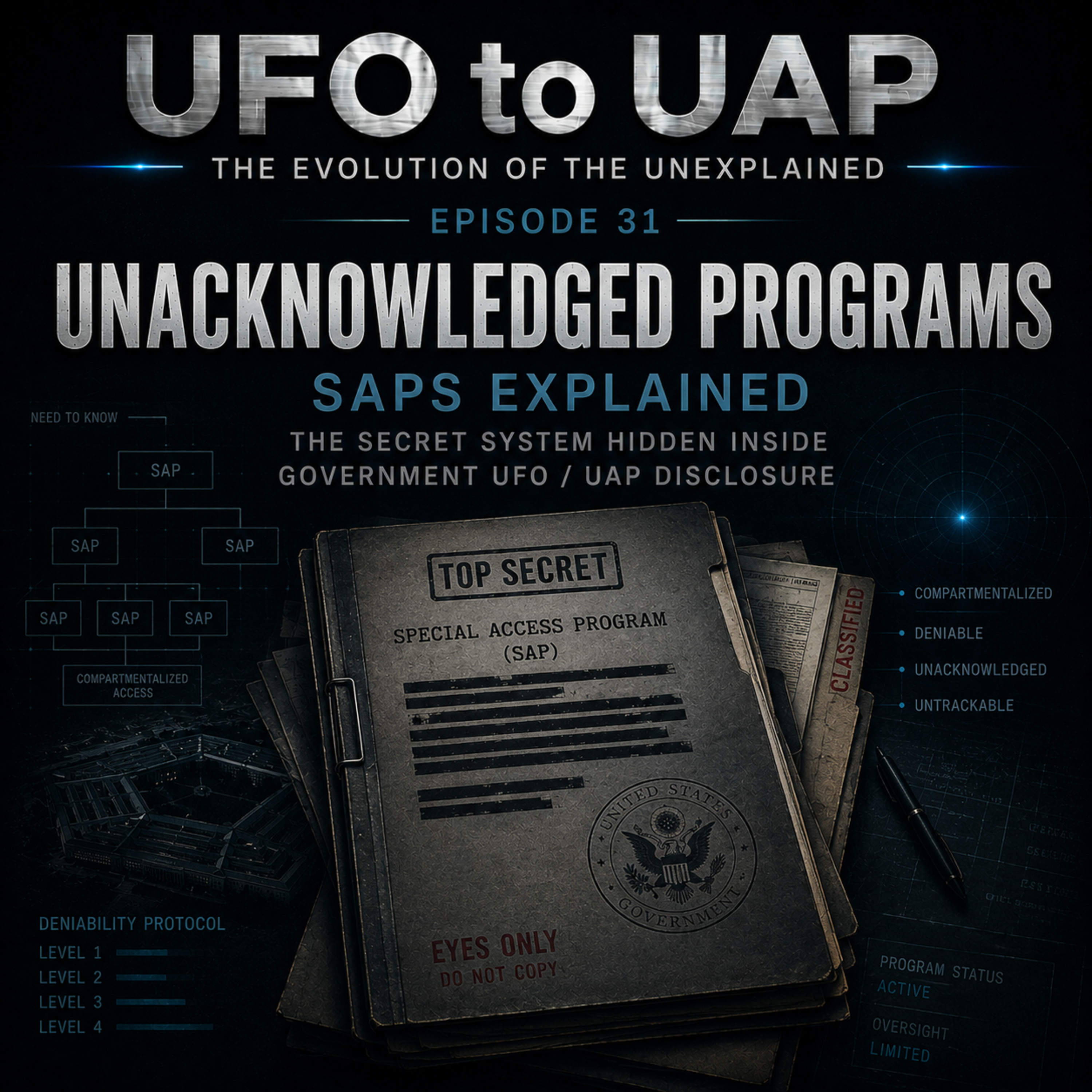
Unacknowledged Programs: Inside Secret Government Projects
Tonight's Episode
Could secret government UFO programs exist beyond normal oversight—and how would unacknowledged special access programs keep them hidden?
In this episode of UFO to UAP Explained, host Matt Tones investigates the real architecture of classified government projects and the claims that sensitive UAP information may be buried inside deeply compartmentalised programs.
The episode explains acknowledged, unacknowledged and waived special access programs, where access depends not only on security clearance but on being formally “read in.” It examines congressional oversight, the Gang of Eight, black-budget funding and the way information can be divided across agencies, defence contractors and restricted compartments.
David Grusch’s testimony is also explored, including allegations that UAP-related crash retrieval and reverse-engineering programs operate outside normal reporting channels. The discussion separates documented secrecy structures from unverified claims involving recovered technology, anomalous materials and non-human intelligence.
Could private contractors shield programs from audits and Freedom of Information requests? Has legitimate national-security secrecy expanded beyond accountability? From the Manhattan Project to modern black programs, discover how large operations can remain hidden—and why the most important UFO question may be where the answers would be stored.
Episode Timestamps
(0:00) Unacknowledged programs hidden inside government
(1:42) Special access programs explained
(2:32) The three categories of SAPs
(3:18) Classified versus unacknowledged programs
(3:48) UFO programs and whistleblower claims
(4:06) David Grusch and denied access
(4:35) Who controls secret programs?
(5:14) Compartmentalisation and limited oversight
(5:39) Contractors, agencies and the hidden ecosystem
(6:44) Black budgets and concealed funding
(7:31) What could be hidden inside SAPs?
(8:00) Patterns across decades of UAP testimony
(9:06) Secrecy within secrecy
(10:01) Private defence contractors
(11:53) Legitimate secrecy versus accountability
(12:58) The Manhattan Project comparison
(14:32) Where would definitive UAP evidence be kept?(15:08) Separating confirmed structures from speculation
(15:47) Three explanations for the secret system
(16:46) Information control and the unanswered question
Sources:
AARO Historical Record Report;
U.S. Department of Defense statements on alleged hidden UAP programs;
U.S. House Oversight Committee — 2023 UAP hearing and David Grusch testimony;
UAP Disclosure Act / NDAA records on recovered technologies, SAPs, and contractor oversight;
National Archives UAP records collection;
NASA UAP Independent Study Team Report.
Keywords:
unacknowledged special access programs, secret government programs, SAPs explained, black budget programs, classified UFO programs, hidden UAP programs, David Grusch testimony, crash retrieval programs, reverse engineering UFO technology, defence contractor secrecy, congressional UAP oversight, Gang of Eight, government compartmentalisation, waived special access programs, private aerospace contractors, non-human intelligence claims, Pentagon UFO investigation, UAP disclosure, classified aerospace technology, UFO to UAP Explained.
There are programmes inside government that don't officially
exist, that don't appear in public budgets, they aren't
acknowledged in congressional hearings, and in many cases even
senior officials don't know they exist.
These are not just classified programmes, they're
unacknowledged programmes. And if the claims are true, they
may represent a hidden system of power, funding and control,
operating alongside the visible government, completely out of
public view. Because when whistleblowers
speak about UFOs, they don't just describe objects in the
sky. They describe something else,
something deeper. A structure, a system, a
compartment so tightly controlled that access isn't
determined by rank, but by invitation.
And once you're inside, you don't talk about it.
Not because it's illegal, but because it's designed so that no
one outside can even prove it exists.
So tonight we're asking a different question.
Not just what are you, a PS? But where would the truth be
hidden if it was never meant to be found?
Welcome back to UFODUAP, the disclosure project.
This is Matt Tones, your host. Thank you for joining in.
Today's episode is titled Unacknowledged programmes, the
secret system hidden inside government, special access
programmes explained. To understand this conversation,
we need to start with something real, something documented,
something official. Because despite all the
speculation, special access programmes or SA PS are not
conspiracy theory. They are recognised part of the
US national security system. Special access programmes exist
to protect the most sensitive operations in government.
Programmes involving advanced weapons, intelligence
capabilities and technologies that, if exposed, could
compromise national security. These programmes go beyond
standard classification. They don't just require
clearance, they require specific access.
Even if you hold the highest levels of clearance top secret,
you still don't automatically gain entry.
You must be read into the programme and if you're not, the
programme doesn't exist to you. At a basic level, special access
programmes fall into 3 categories.
Acknowledged SA. PS These exist publicly, but
details are restricted. People know the programme exists
but not what it does and acknowledged SA.
PS These are different. Their existence is classified,
not just the details, the entire programme.
If you're not ready and you're told nothing waived Special
access programmes, the most restricted categories.
These are so sensitive that even congressional oversight is
limited. Only a small group of
individuals, often referred to as the Gang of Eight, are
briefed, and even then information can be tightly
controlled. Now here's the key distinction,
the critical point. A classified programme protects
information. An unacknowledged programme
protects existence itself. And that changes everything.
Because if a programme is unacknowledged, you can't
request information about it, you can't audit it, you can't
investigate it because officially it's not there.
Now this is where the conversation shifts, because in
recent years multiple whistleblowers have pointed to
one specific claim that UFO related programmes are not just
classified, they are hidden within unacknowledged special
access programmes. This isn't a fringe idea
anymore, it's been stated underoath, most notably by David
Grusch, a former intelligence officer who worked within the
UAP task force. Grusch didn't just claim the
existence of UFO programmes, he claims something more
significant. That these claims operate
outside normal oversight channels, but they are
compartmentalised to the point where even those tasked with
investigating Uaps couldn't access them.
And that raises a serious question, if true, who controls
these programmes? In theory, special access
programmes are still accountable.
They are funded through government budgets.
They are overseen by select members of Congress.
They operate within legal frameworks.
But unacknowledged programmes introduce a problem because the
fewer people who know about something, the harder it is to
oversee. And oversight relies on
visibility. So what happens when visibility
is removed? The answers lie in one word,
compartmentalization. Information is broken into
pieces. Each piece is held by a
different group. No single person sees the entire
system. This structure is intentional.
It protects against leaks. It protects against espionage.
But it also creates a situation where no one fully understands
what exists. And that's where concerns begin.
Some insiders have described something beyond special access
programmes. Not just programmes, but an
entire ecosystem, A network of private contractors,
intelligence agencies and defence organisations operating
in coordination, funded through mechanisms that are difficult to
trace, shielded by classification layers that
prevent scrutiny. This is often referred to as the
non unacknowledged system and within that system, according to
claims, are programmes focused on reverse engineering unknown
technologies, studying anomalous materials and investigating non
human intelligence possibilities.
Now, to be clear, there is no publicly verified evidence that
confirms these specific activities, but the structure
that could support them does exist.
If such a programme were real, they would require funding.
And this brings us back to something we explored
previously, the black budget. Because unacknowledged
programmes don't appear as line items, they are buried within
larger allocations, distributed across departments, hidden
inside legitimate programmes, which makes tracking them almost
impossible. Now here's where this becomes
important. Even without UFOs, this system
makes sense because governments need a way to protect
breakthrough technologies, intelligence capabilities, and
strategic advantages. And the more advantage, sorry,
the more advanced the technology, the greater the need
for secrecy. So the structure exists for a
reason. The question is not whether SA
P's exist. They do.
The question is what has been placed inside them?
Because once you understand the structure, the funding and the
lack of visibility, the next question becomes unavoidable.
If something extraordinary was discovered, would this be the
place to hide it? And more importantly, would
anyone outside ever know? When you step back and look at
the broader UAP conversation, a pattern begins to emerge.
Not a single claim, not a single source, but a consistent
structure of testimony. Different individuals, different
agencies, different decades. And yet they describe something
remarkably similar. Restricted access,
compartmentalised information, programmes hidden within
programmes, and most importantly, a system that
prevents full visibility even from within.
The most significant modern example of this comes from David
Grusch, a former intelligence officer assigned to investigate
UE UAP programmes at an official level.
Grusch wasn't an outsider. He wasn't speculating.
He was operating inside the system with the authority to
access classified information. And according to his testimony,
he encountered something unexpected, not just resistance,
but denial of access. Grush stated that when he
attempted to investigate certain programmes, he was told he did
not have the clearance, not because his clearance was too
low, but because the programmes were compartmentalised beyond
his reach. This is a critical distinction
because it suggests something unusual.
Not just secrecy, but lay in secrecy within secrecy, a
structure where even authorised investigators cannot see the
full picture. If true, this creates a paradox,
a government task force assigned to investigate Uaps unable to
access the very programmes where the most sensitive information
may exist. And that leads to a fundamental
question. Is the system designed to
protect information or to prevent discovery?
Now we move into even more complex territory because
multiple claims, not just from Grouche but from others, point
to something else. But certain programmes are not
held directly by government agencies, but by private
contractors. At first glance, this might not
seem unusual. Governments frequently outsource
work. Defence contractors develop
technology, they build aircraft, they manage advanced systems.
But in the context of SA PS this creates a unique situation
because private entities operate under different rules, different
oversight structures, different disclosure requirements and,
critically, different levels of accountability.
If a programme is housed within a private contractor, it becomes
even harder to access, even harder to audit, even harder to
expose, because now the information isn't just
classified, it's contractually protected and that adds another
layer of insulation. According to whistleblower
allegations, some of the most sensitive UAP related programmes
are held within these contractor environments, shielded from
traditional oversight, protected by legal frameworks and
accessible only to those with both clearance and direct
programme inclusion. Now again, this is where we need
to remain precise. There is no publicly verified
evidence that confirms specific UFO related programmes exist
within contractors, but the structure that would allow it
absolutely does exist. And that's the critical point.
Now we reach one of the most important questions in this
entire discussion. Where is the line between
legitimate secrecy and something else?
Governments have the right to protect sensitive information.
This includes National Defence systems, intelligence,
operations, emergence, emerging technologies.
Special access programmes exist for this reason.
They are legal. They are structured, they are
necessary. But concerns begin when secrecy
avoids oversight, circumvents reporting requirements and
operates without accountability. Because at that point the system
is no longer just protecting information, it may be
protecting itself. And this is the real tension,
not whether secrecy exists, but whether it has expanded beyond
its intended boundaries. To understand how this could
happen, we need to look at history, because none of this is
entirely new. During World War 2, the United
States developed the atomic bomb under extreme secrecy.
The Manhattan Project involved over 100,000 personnel, multiple
locations, total compartmentalization, and yet
most people involved had no idea what they were working on.
This demonstrates something critical.
A system can exist at massive scale without widespread
awareness because information is controlled at every level.
Now apply that logic to modern systems, more advanced
technology, more sophisticated compartmentalization, greater
reliance on contractors. It becomes easier, not harder,
to maintain secrecy. And this brings us to where we
are today. Because despite decades of
sightings, despite military encounters, despite official
acknowledgments that Uaps exist, there is still a gap, a
significant gap between what is observed and what is explained.
We know that Uaps have been tracked on radar, pilots have
encountered them, governments have investigated them, and yet
no definitive explanation has been publicly confirmed.
We don't know what these objects are, where they originate, or
how they operate. And more importantly, we don't
know what information may exist inside restricted systems.
So now we arrive at the central question of this episode not Are
UFOs real? But if definitive information
existed, where would it be? Based on everything we've
explored, it would not be in public records or reports.
It would not be widely accessible.
It would be highly classified, deeply compartmentalised and
restricted to a very small group.
In other words, exactly where special access programmes
operate. And this is where we need to
draw a clear line because beyond this point we move from
structure into speculation. We can confirm special access
programmes exist and acknowledged programmes exist.
Compartmentalisation is real. Oversight is limited.
In certain cases we cannot confirm that UFO technologies
are being reverse engineered, that non human intelligence has
been recovered, that hidden programmes contain definitive
answers. These remain claims, not
established facts. So what does all of this
actually mean? There are three realistic
interpretations. 1 The system is functioning as intended.
Everything we've discussed exists, but it's being used
correctly to protect national security, to maintain strategic
advantage, and the lack of transparency is simply the cost
of that protection #2 the system has expanded beyond control.
Secrecy has grown, compartmentalization has
increased, oversight has weakened, and certain programmes
now operate with limited accountability #3 the system
contains something significant, not proven, but possible, that
within these structures there are discoveries that have not
been disclosed. And this is the real takeaway.
Now, here's the most important point.
Regardless of which possibility is true, the structure itself is
real and it is designed to do one thing extremely well,
control information. So when we ask why don't we have
answers about UFOs, we may be asking the wrong question.
Because the better question is, where would those answers be
kept if they were never meant to be public?
And until that question is resolved, the gap between what
we see and what we know will remain.
Thank you for listening. I'm your host, Matt Tones.
Please subscribe, share and tell your mum about the episode.
Music.
 Amazon Music
 Apple Podcasts
 Castbox
 Castro
 Goodpods
 iHeartRadio
 Overcast
 Pocket Casts
 Podbean
 Podcast Addict
 Spotify
 YouTube