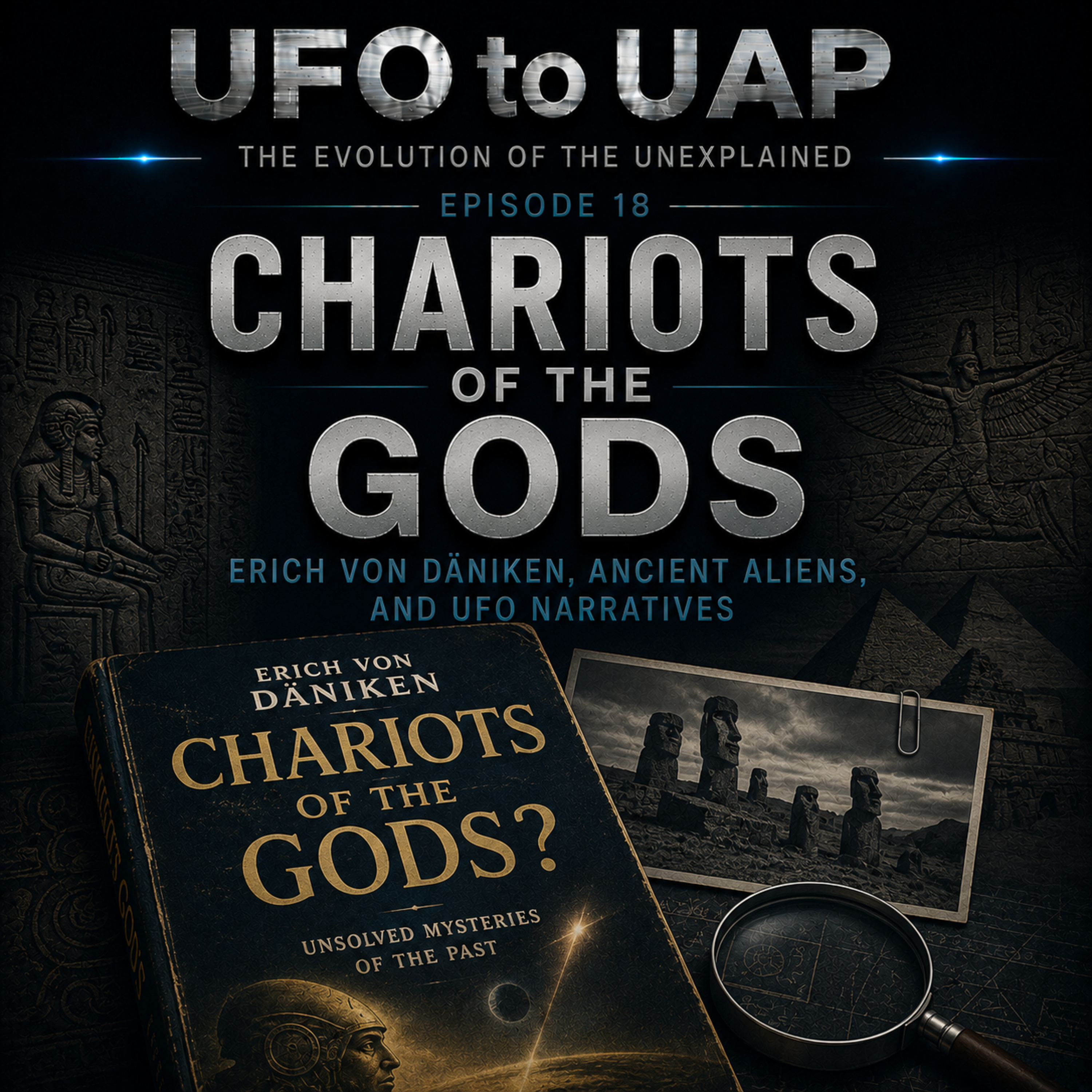
Exploring 'Chariots of the Gods': Ancient Aliens and Archaeological Mysteries
Tonight's Episode
What made Chariots of the Gods one of the most influential ancient-alien books ever published—and why does Erich von Däniken’s theory still shape UFO, UAP and archaeological debate?
In this episode of UFO to UAP Explained, host Matt Tones investigates the 1968 bestseller that connected the Great Pyramid of Giza, Peru’s Nazca Lines, Easter Island, ancient carvings and religious stories into one radical theory: early civilisations received help from extraterrestrial visitors remembered as gods.
The episode examines how von Däniken transformed separate archaeological mysteries into a single ancient-astronaut narrative. It explores claims about advanced construction, aerial landing markers, sky beings and misunderstood technology—while weighing mainstream explanations based on human engineering, surveying methods, ritual symbolism, cultural context and gradual technological development.
Did ancient aliens influence human civilisation, or are modern readers projecting spacecraft and advanced technology onto mythology and archaeology? Discover why Chariots of the Gods became so persuasive, how pattern recognition can outpace evidence and why its interpretive lens continues through Ancient Aliens, online communities and modern UAP culture.
Episode Timestamps
(0:04) What if history was interpreted differently?
(0:32) Chariots of the Gods introduces a radical answer
(1:17) Erich von Däniken and the 1968 bestseller
(1:38) Connecting ancient mysteries worldwide
(2:17) The ancient-astronaut theory takes shape
(2:29) The Great Pyramid of Giza
(3:27) The Nazca Lines as alleged landing markers
(4:03) Ancient carvings and sky beings
(4:27) Religious texts as technological encounters
(4:55) How the book changed interpretation
(5:18) Archaeological criticism of von Däniken
(5:31) Human engineering and pyramid construction
(5:51) Mainstream explanations for the Nazca Lines
(6:05) Symbolism, culture and modern projection
(6:27) From human ingenuity to outside intervention
(6:50) How global narratives are created
(7:23) Pattern recognition versus reality
(7:40) Technology shapes how we interpret the past
(7:53) Why a coherent story can overpower evidence
(8:09) Chariots of the Gods as an enduring lens
(8:22) Ancient Aliens and modern UAP narratives
(8:33) Why are we ready to believe ancient aliens?
Sources:
Erich von Däniken — Chariots of the Gods?;
UNESCO World Heritage Centre — Nazca Lines and Geoglyphs;
UNESCO World Heritage Centre — Stonehenge, Avebury and Associated Sites;
National Geographic / Smithsonian archaeological material on ancient monuments and pseudoarchaeology;
NASA Astrobiology / SETI background research;
academic criticism of ancient astronaut theory and pseudoarchaeology.
Keywords:
Chariots of the Gods, Erich von Däniken, ancient aliens, ancient astronaut theory, archaeological mysteries, Great Pyramid of Giza, Nazca Lines, Easter Island, ancient flying gods, extraterrestrial visitors, lost ancient technology, ancient civilisations, UFO archaeology, religious texts and aliens, ancient carvings, pyramid construction, Nazca Lines theory, ancient alien evidence, mythology and technology, pattern recognition, Ancient Aliens, UAP culture, UFO to UAP Explained.
What if the past isn't what we think it is?
Not because the truth is hidden, but because the story was
changed? Across the world, there are
structures that don't fit comfortably into the timeline
we've been given massive stone monuments, precise alignments,
engineering that seems, at first glance, beyond the tools of the
time. And for centuries, the question
lingered. How did they do it?
Then, in 1968, one book offered an answer.
Not evolution, not human ingenuity, but something far
more radical. They had help.
Help from the sky, from beings remembered as gods, but
understood today as something else entirely.
That book was Chariots of the Gods and once it entered the
world, history was never seen the same way again.
Welcome to UFO to UAP, the disclosure report.
I'm your host, Matt Tones. Thank you for joining.
Please subscribe and share this episode, which is titled
Chariots of the Gods, The book that rewrote history.
In 1968, a relatively unknown author named Erich von Daniken
published a book that would go on to sell millions of copies
worldwide. It didn't emerge from academia,
it didn't follow traditional archaeological method, but it
did something far more powerful. It connected the dots.
Before this moment. Ancient mysteries, which were
treated individually. The pyramids of Egypt, the Nazca
Lines of Peru, the statues of Easter Island, ancient carvings
across Asia and the Middle East. Each was studied in isolation.
Each had its own explanation. But von Daniken looked at them
collectively and asked a different question.
What if these are not separate mysteries, but pieces of the
same story? That question was the ignition
point. Because once you begin looking
for patterns, you start seeing them everywhere.
Von Daniken's argument was not built on one piece of evidence.
It was built on acclimation. Accumulation.
Terrible pronunciation. It was built on accumulation.
Let's walk through it slowly. The Great Pyramids of Giza
stands out as one of the most studied structures in human
history. Massive limestone blocks,
Precise alignment with cardinal directions, astronomical
correlations that still spark debate.
Von Daniken asked. Could a civilization without
modern tools really achieve this?
His answer not alone, He proposed advanced knowledge was
introduced, construction methods were influenced, or technology
was provided externally. But here's what matters.
This was not a technical argument.
It was a perception argument. Because to the average reader,
the pyramid already felt impossible.
Von Daniken simply gave the feeling a direction.
In the deserts of Peru, enormous geoglyphs stretch across the
landscape. Lines, shapes, animals only
fully visible from the sky. Von Daniken's interpretation was
immediate. Landing strips, signals, markers
for aerial visitors. And again, this was powerful not
because it was proven, but because it felt intuitive.
If something is only visible from above, then perhaps it was
meant to be seen from above. Across multiple civilizations
there are depictions of figures that appear to modernise
strangely familiar elongated heads, helmet like shapes,
beings interacting with light or energy.
Von Daniken reframe these images not as symbolic or religious,
but as literal depictions of encounters.
The gods were not imagined, they were observed.
If we look at religious texts, there are stories of beings
descending from the sky. Chariots of fire, voices from
above were no longer treated as a metaphor, they became
misinterpreted encounters with advanced technology.
And this is where the episode becomes more important.
Because Chariots of the Gods didn't just present ideas, they
changed the framework of interpretation.
Before ancient texts were mythology, structures were
achievements, anomalies were curiosities.
But after mythology became possible, record structures
became possible evidence, anomalies became signals.
And this shift is critical because once you change the
lens, you change everything you see.
Now we slow down because this is where most retellings file.
Von Daniken's work has been widely criticised, not lightly,
but extensively. If we look at the engineering
reality, archaeology shows gradual development of building
techniques, labour organisation and tool evolution.
The pyramids were not built overnight, they were the result
of iteration, refinement and human ingenuity.
The NASCAR lines. Modern research suggests ritual
pathways, water related symbolism, or astronomical
alignment. And importantly, they can be
created using simple surveying methods.
No aircraft required. Antenna is symbolic by nature.
What appears technical to us often represents spiritual
concepts, cosmological ideas, or cultural identity.
We are not seeing what they saw. We are seeing through modern
perception. And if we look at the critical
insight here, the strongest critique is not Van Daniken was
wrong. It is he changed the question
from how did they do it to who helped them do it.
And that shift carries consequences.
Now if we zoom out, a pattern appears because this is where,
you know, it becomes more powerful.
So far we've established A progression.
Stage 1 ancient texts, humanity trying to explain the unknown.
Stage 2. Reinterpretation, modern
thinkers reframing those texts. Stage 3 Global narrative.
A single theory connecting everything.
This is not random, it is a pattern of meaning making.
Humans do not like unanswered questions.
So we build frameworks, and the more compelling the framework,
the wider it spreads. Let's bring this into our core
intelligence lens. There are three key insights
here. Pattern recognition versus
reality. The human brain is designed to
connect, interpret, simplify. Van Damken didn't invent
anomalies, he linked them. Technology shapes
interpretation. Ancient people, so gods.
Modern people. See extraterrestrials.
Same phenomena but different language and narrative outpaces
evidence. And this is the most important
point. The strength of Chariots of the
Gods is not evidence, it is coherence, a complete story.
And once a story becomes complete enough, it becomes
difficult to dismantle. So what is this book?
Not proof, not fiction, but something far more influential.
It's a lens. A lens that reframed history,
archaeology, and human origin. And once that lens exists, it
doesn't go away. It evolves into ancient aliens,
online communities, modern UAP narratives.
And that is why this episode matters.
Because the question is no longer did ancient civilizations
have help? The question is why are we so
ready to believe they did? And what does that say about our
understanding of history, our expectations of technology and
our search for something beyond ourselves?
Because sometimes the most powerful shift is not in the
evidence. It's in the moment We decide to
see it differently. Thank you for listening.
I'm Matt Tones. Remember to subscribe and share
the podcast. Music.
Music.
 Amazon Music
 Apple Podcasts
 Castbox
 Castro
 Goodpods
 iHeartRadio
 Overcast
 Pocket Casts
 Podbean
 Podcast Addict
 Spotify
 YouTube