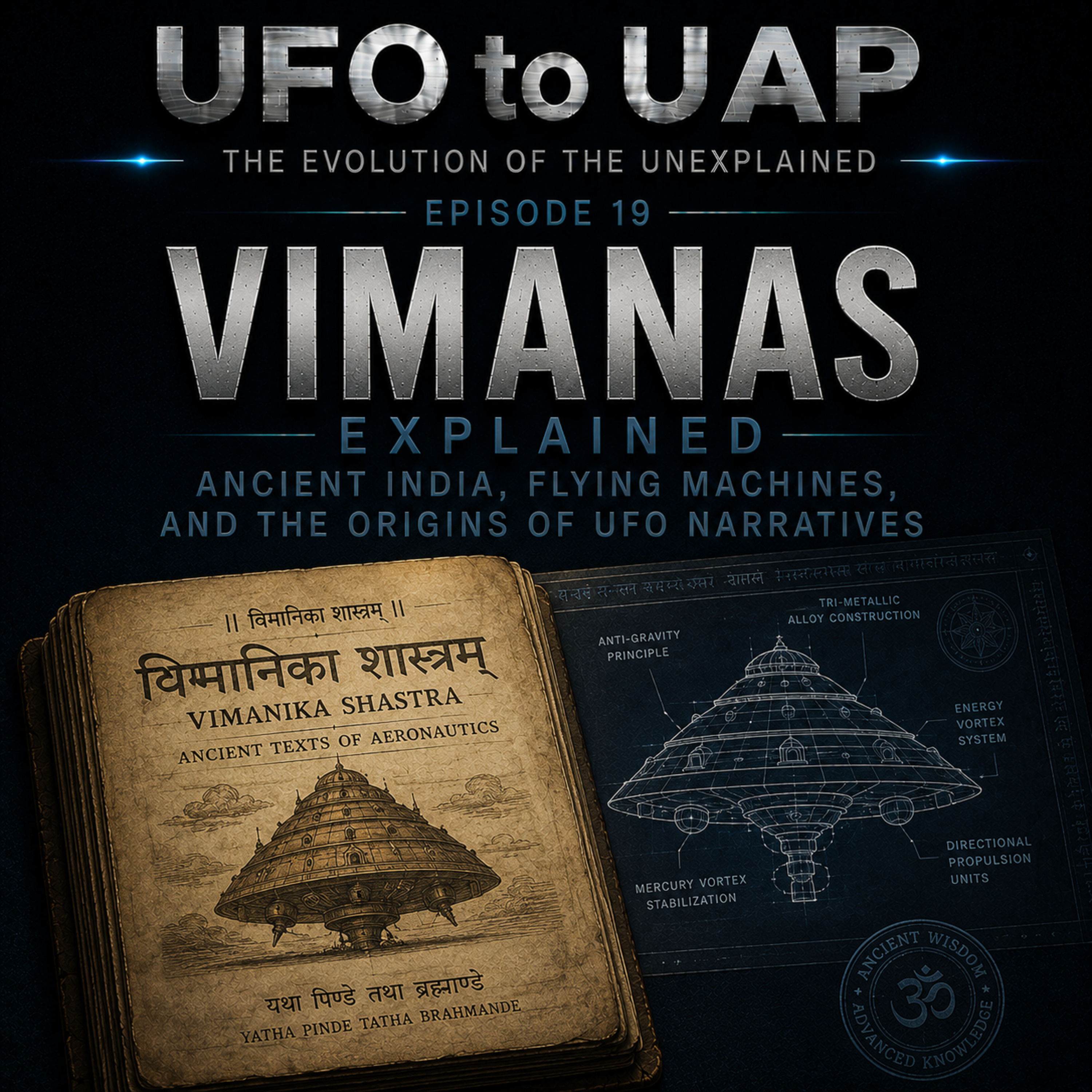
Vimanas: The Flying Machines of Ancient India
Tonight's Episode
What are Vimanas, and do ancient Indian texts describe advanced flying machines—or symbolic vehicles of gods, royalty and spiritual power?
In this episode of UFO to UAP Explained, host Matt Tones investigates the flying chariots described in the Ramayana and Mahabharata. From the Pushpaka Vimana and luminous vehicles to aerial battles, vertical movement and weapons deployed from the sky, these ancient stories can sound surprisingly technological to modern readers.
The episode separates what the texts actually say from later interpretation. It examines the changing meaning of “Vimana,” the role of poetry and mythology, and the controversial Vaimanika Shastra—often promoted as an ancient aircraft manual but widely regarded as a 20th-century work whose designs do not meet practical aerodynamic principles.
Were Vimanas evidence of lost technology, extraterrestrial contact or ancient aerospace engineering? Or are modern readers projecting aircraft and spacecraft onto symbolic accounts of divine power and the heavens? Discover why similar sky vehicles appear across cultures and what these stories reveal about humanity’s enduring attempt to understand the unknown.
Episode Timestamps
(0:01) Did flight begin before modern aviation?
(0:39) Introducing the Vimanas of ancient India
(1:20) The Ramayana and Mahabharata
(1:59) The Pushpaka Vimana
(2:25) Luminous vehicles and vertical flight
(2:59) Aerial battles and powerful weapons
(3:22) Symbolic story or eyewitness account?
(3:29) What the word Vimana actually means
(3:58) Divine vehicles, poetry and mythology
(4:18) The controversial Vaimanika Shastra
(4:39) Why the aircraft manual is disputed
(5:11) Sky vehicles across ancient cultures
(5:45) Shared experience and the intelligence lens
(6:12) Language limits in ancient accounts
(6:29) How modern technology shapes interpretation
(6:55) What Vimanas do—and do not—prove
(7:22) Why humanity keeps looking to the sky
Sources:
The Ramayana;
The Mahabharata;
Rigveda;
Samarangana Sutradhara;
Vaimanika Shastra / Vymaanika Shaastra;
Indian Institute of Science review of the Vaimanika Shastra;
academic research on ancient Indian texts, mythology, Sanskrit literature, archaeology, and modern interpretations of vimana traditions.
Keywords:
Vimanas, ancient Indian flying machines, Pushpaka Vimana, Ramayana flying chariot, Mahabharata aerial battles, Vaimanika Shastra, ancient aircraft theory, ancient astronaut theory, lost technology, extraterrestrial contact, Hindu mythology, divine flying vehicles, ancient India UFOs, aerial weapons in mythology, ancient aerospace engineering, sky gods, modern projection, unidentified anomalous phenomena, UFO to UAP Explained.
What if the idea of flight did not begin with the Wright
brothers? What if, long before engines,
before metal aircraft, before we ever left the ground, there were
stories of machines that could rise into the sky?
Not myths whispered in isolation, but written into some
of the oldest and most complex texts humanity has ever
produced. Texts that describe vehicles
that move through the air, battles fought in the sky, and
weapons that seem far beyond their time.
Across ancient India, these objects had a name, Vermanas.
But here's the question we're asking tonight.
Were these accounts of advanced flying craft, or are we looking
at something else entirely? Because once again, we are
standing at the edge of a familiar path, ancient text,
modern interpretation, and a story that feels just close
enough to be real. Welcome to UFOTUAP, the
disclosure report. I'm your host, Matt Tones.
Thank you for listening. Please subscribe and share the
episode which is titled Vermanas, the Flying Machines of
Ancient India. To understand Vermanas, we must
begin with the text themselves. Two of the most important works
in ancient Indian literature are the Mahabharata and the
Ramayana, and I know my pronunciation was terrible there
and I do apologise. These are not minor works.
They are vast epics composed over centuries, containing
mythology, philosophy, history and cosmology, and within them
are repeated references to flying Chariots.
In the Ramayana, there is a specific object often cited, the
Pushpaka Vamana, described as a vehicle that can move at great
speed, travel across vast distances, and carry multiple
passengers. It is said to rise into the sky,
move whatever the user desires, and return at will.
But let's slow down here, because this is where the
fascination begins. Descriptions of vermanas often
include movement through the air, radiant or luminous
appearance, the ability to change direction, and sometimes
vertical ascent and descent. In some passages they are
described as shining, like the sun moving with great speed
through the heavens. In the Mahaba Rata there are
also accounts of aerial battles, weapons deployed from the sky,
and destructive force described in vivid, almost overwhelming
terms. To a modern reader, these
depictions and descriptions can feel familiar, not identical to
modern aircraft, but suggestive, close enough to trigger a
question. Were these symbolic or were they
observational? Now we move into the critical
layer because, just like the Sumerian tablets, we must
separate what is written from what is inferred.
The word vermana does not translate directly to aircraft.
In its earliest usage, it often refers to a chariot, a palace,
or a divine vehicle, something associated with gods or royalty,
not necessarily a machine in the modern sense.
This matters because ancient texts are poetic, symbolic, and
deeply metaphorical. Descriptions of movement through
the sky may represent divine power, spiritual ascension, or
cosmological storytelling. Now we address one of the most
cited and most misunderstood elements, and I do apologise if
I get this pronunciation wrong. Vimanika Shastra This text is
often presented as an ancient manual describing detailed
aircraft design, propulsion systems and advanced technology.
But here's the reality. Most scholars agree that the
Vimanika shastra is not ancient. It is believed to have been
completed in the early 20th century, and when studied
scientifically, it's descriptions of flight have been
found to be aerodynamically unworkable, inconsistent with
real engineering principles. And this is critical because
much of the ancient aircraft narrative comes not from the
epics themselves, but from later reinterpretations like this one.
Now we step back because this is where the real inside emerges.
We've now seen Sumerian texts describing gods from the sky,
biblical accounts describing Chariots of fire, Indian epics
describing Vermanas, different cultures, different time
periods, similar themes, sky beings, divine vehicles,
movement through the heavens. So we ask, is this coincidence
or is it something deeper? Let's now apply the intelligence
lens, the first one being shared human experience.
All ancient civilizations look to the sky.
They observed celestial bodies and built cosmologies around
them. The sky was mysterious,
powerful, and beyond human reach, so naturally it became
the domain of the divine. Let's now look at language
limitation. Ancient people described
extraordinary concepts using familiar language and symbolic
imagery. A chariot may not mean a literal
car. It may be the closest available
analogy for something beyond ordinary experience.
And now modern projection. This is where things shift.
Today we live in a world of aircraft, spacecraft and
advanced propulsion. So when we read vehicle moving
through the sky, we don't see divine symbolism, we see
technology. This is not discovery, it is
interpretation. So what are the manas?
They are real elements of ancient Indian text, described
as flying vehicles or divine transports, but they are not
confirmed evidence of ancient aircraft, extraterrestrial
technology, or advanced lost civilizations.
What they are is something more subtle, a reflection of how
ancient cultures understood power.
Describe the unknown and imagine the heavens.
Because the deeper question is not did ancient civilizations
have flying machines? The deeper question is, why do
so many civilizations describe the describe the sky in the same
way? And why do we keep returning to
those descriptions and seeing something new?
Because sometimes we're not uncovering hidden technology,
we're uncovering something else entirely, the way humans have
always tried to understand the unknown.
Thank you for listening. I'm Matt Tones.
Please subscribe, share our episode, and don't forget to
tell your mom about this one. Music.
 Amazon Music
 Apple Podcasts
 Castbox
 Castro
 Goodpods
 iHeartRadio
 Overcast
 Pocket Casts
 Podbean
 Podcast Addict
 Spotify
 YouTube