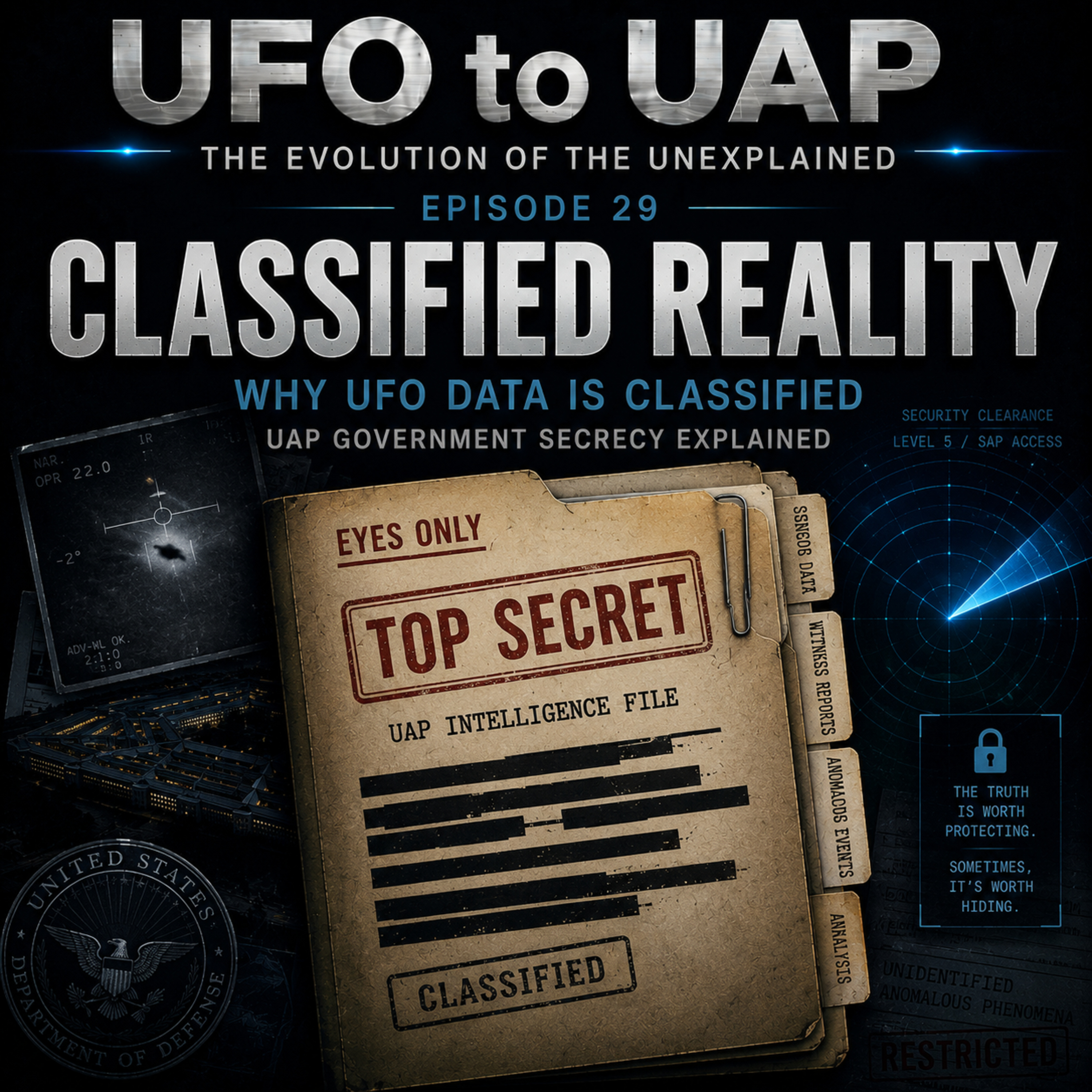
Classified Reality: Unveiling the Hidden UFO Data in Government Secrecy
Tonight's Episode
What does “classified” really mean—and why can the government possess UAP data without being able to reveal the full picture?
In this episode of UFO to UAP Explained, host Matt Tones investigates how national-security classification shapes what the public can know about UFO and UAP encounters. Rather than assuming officials hold one complete answer, the episode explores a more complex possibility: fragmented evidence spread across agencies, sensor systems, clearance levels and restricted programmes.
Discover why radar, satellite and infrared data may remain secret because releasing it could expose military capabilities, intelligence sources, detection limits and operational vulnerabilities. The discussion explains need-to-know access, compartmentalisation, legal restrictions and why senior authority does not always guarantee full visibility.
The episode also examines the difference between truth and intelligence. Government systems may not need to solve the UAP phenomenon; they may only need enough information to monitor behaviour, assess risk and protect strategic advantage. Is the public being denied a hidden truth, or does classified reality contain only partial data, competing interpretations and structured uncertainty?
Episode Timestamps
(0:00) If they know, why don’t they tell us?
(0:52) What does classified actually mean?
(1:13) The myth of one complete government answer
(2:17) Classification protects capability, not curiosity
(2:59) Why the system controls access
(3:36) Intelligence sources and methods
(4:06) Radar and satellite capabilities
(4:30) The structural limit of disclosure
(5:10) Compartmentalisation and fragmented UAP data
(5:50) Why even presidents may lack access
(6:21) Multiple interpretations and partial knowledge
(6:42) The meaning of classified reality
(7:38) Classification law and legal consequences
(8:22) Operational security and sensor vulnerabilities
(9:03) Global strategy and irreversible disclosure
(9:44) The hidden cost of transparency
(10:28) Truth versus actionable intelligence
(11:08) Managing UAP risk instead of solving it
(11:26) Public answers versus ongoing assessment
(13:06) Structured uncertainty inside government
(14:38) Limited knowledge, not necessarily hidden truth
(15:19) Preserving capability over explanation
(16:24) A constrained reality the system cannot fully share
(17:27) What are governments unable to reveal?
Sources:
AARO Historical Record Report;
ODNI / U.S. Department of Defense UAP reports;
U.S. House Oversight Committee UAP hearing and David Grusch testimony;
UAP Disclosure Act / NDAA records;
National Archives UAP Records Collection;
NASA UAP Independent Study Team Report;
U.S. Government Accountability Office reports on classified programs and defense oversight.
Keywords:
classified UAP data, government UFO secrecy, national security classification, hidden UFO data, UAP intelligence, compartmentalised information, need-to-know access, military sensor data, radar UAP evidence, satellite surveillance, intelligence sources and methods, classified aerospace capabilities, government UAP investigation, structured uncertainty, operational security, Pentagon UFO data, UAP disclosure limits, unidentified anomalous phenomena, UFO government cover-up, UFO to UAP Explained.
There is a question that sits underneath everything.
Not the one people ask publicly, not the one that gets debated,
but the one that quietly shapes how people think about this
entire subject. And it sounds like this.
If they know, why don't they just tell us?
It's a simple question, and it feels like it should have a
simple answer. Because in most areas of life,
information works in a predictable way.
If something is known, it can be explained.
If it can be explained, it can be shared.
And if it can be shared, it can be understood.
But what if that chain breaks? What if there are systems where
knowledge does exist, but cannot move freely from one layer to
another? Because tonight we are not
asking what is being hidden, we're asking something far more
precise. What does classified actually
mean and why does it limit reality itself?
Welcome back to UFO to UAP, the disclosure report.
I'm your host, Matt Tones. Thank you for listening in.
Please subscribe on Spotify and share the episode.
Today's episode is titled Classified Reality.
Why UFO data is classified and UAP Government secrecy
explained. Most people approach this topic
with an assumption already in place that somewhere inside the
system there is a complete picture, a unified
understanding, a final answer. And that answer is being
deliberately withheld. It's a powerful idea because it
turns uncertainty into intention.
It replaces we don't know with a no, but won't say.
But there's a problem. That assumption depends on
something being true that the system has a complete answer to
begin with. And once you start examining how
the system actually works, that assumption begins to break down.
When people hear the word classified, they think of
secrecy, hidden files, locked information, something
deliberately kept out of reach. But classification is not just
about hiding information, it's about protecting something far
more important, capability. Because in national security
systems, information is not classified because it is
interesting. It is classified because
releasing it creates risk, risk of exposure, risk of
exploitation, risk of losing advantage.
So the real question is not why is this secret?
It is why does this, what does this reveal if it becomes
public? The system doesn't protect
truth, it protects access. And this is where that shift
happens because the system is not designed to protect truth.
Truth is not it's priority. It's priority is control over
access. Who sees information, when they
see it and under what conditions?
Because once information becomes fully visible, it cannot be
controlled anymore, and in systems that rely on control,
that matters more than explanation.
At the centre of classification is a principle that governs
everything, sources and methods. A source is where information
comes from. A method is how that information
is obtained. And both are protected above
almost everything else, because if those are exposed, the system
loses its ability to operate. An example, a radar system
doesn't just detect objects, it reveals range, resolution,
tracking capability. A satellite doesn't just
observe, it reveals coverage, timing, precision.
So when UAP data is released, it doesn't just reveal the object,
it reveals the system that saw it.
And this is where everything changes, because now we
understand something fundamental.
There is a limit, a hard limit of disclosure, not just on what
can be released, but on what can be known publicly at all.
Even if the data exists, even if it is accurate, it cannot be
shared fully without exposing something else.
And that creates A boundary. Not a political boundary, not a
narrative boundary, a structural 1.
Inside the system, information is not stored in one place, it
is divided. And this is where we've touched
on previously on compartmentalization and why no
one has the full picture. Data is separated across
programmes, agencies, clearance levels, each holding their part
of the picture, but never the whole, which means something
critical. No single person sees
everything. Not analysts, not intelligence
officials, not leadership. So the idea that someone knows
everything starts to collapse. And this is where people usually
push back. They assume, surely the
president would know. But access in these systems is
not based on authority. It's based on need to know.
And that applies at every level, even the highest, which means
position does not equal visibility.
Now we're going to challenge something deeper.
The belief that there is one answer, 1 explanation, one truth
that resolves everything. But what if that's not what
exists? What if the system holds
multiple partial understandings, different data, different
interpretations, different confidence levels?
This is not a solved problem being hidden, it is an
unresolved problem being managed.
So now we arrive at the core idea, classified reality.
A version of reality that exists inside the system but cannot be
fully shared. Not because it is being hidden
deliberately, but because sharing it would break the
system that observes it. There is a point in every system
where disclosure ends, not gradually, not quietly, but
absolutely, a boundary that cannot be crossed.
From the outside, that boundary looks like secrecy, but from the
inside it looks like necessity, because beyond that point, the
cost of visibility is greater than the value of explanation.
This is where the idea of disclosure meets reality.
Now we're going to step into something concrete, because
classification is not just a policy, it is enforced through
law. There are legal frameworks that
determine what can be said, what can be shown, and what must
remain protected. And those frameworks are not
flexible. They are binding.
Breaking classification is not a matter of interpretation, it is
a matter of consequence. So even if someone has access to
information, even if they believe it should be known, they
they may not be able to share it because the system is designed
to prevent exactly that. Beyond law, there is another
layer operations, the systems that detect, track and analyse
UAP or active systems. They operate in real time, they
adapt, they evolve, and revealing too much about them
creates vulnerability. If an adversary understands what
can be detected, how it is detected and where the gaps
exist, they can exploit it. So disclosure is not just about
sharing information, it is about protecting the system's ability
to function. Now we expand that further.
Because no system exists in isolation.
Every capability, every sensor, every piece of intelligence
exists within a global environment.
Releasing information does not just affect the public, it
affects other nations, competing technologies and strategic
balance. And once something is revealed,
it cannot be taken back. So every decision to release
information is also a decision about what changes after that
release, and if that change creates risk, the information
stays classified. There is a common belief that
transparency always leads to clarity, that if everything were
visible, everything would make sense.
But in systems like this, transparency has a cost.
It removes uncertainty. It removes ambiguity.
And those are not always weaknesses.
In some systems they are protective because ambiguity can
prevent exposure. It can limit understanding in
ways that protect capability. Now we arrive at one of the most
important distinctions, the difference between truth and
intelligence. Truth is absolute.
It is what something is. Intelligence is different.
Intelligence is usable understanding.
It is not required to be complete.
It is required to be actionable. So the system does not need full
truth, it needs enough understanding to respond, and
that changes the objective completely.
From the outside, it feels like the system should be working
toward a definitive explanation, but internally that is not
always the goal. The goal is not to solve the
phenomenon. The goal is to monitor it,
understand its behaviour and assess potential risk because
solving it may not be possible, but managing it is necessary.
At this point, we can see the gap clearly.
The public expects answers. The system produces analysis.
The public expects resolution. The system operates in ongoing
assessment. And that mismatch creates
tension, a tension that leads to frustration, speculation,
misunderstanding. So now we understand the wall.
It's not a barrier designed to hide truth.
It is a structural limit created by law, operations and strategy.
And that limit does not move easily, because moving it comes
at a cost, a cost the system is designed to accept.
There is one idea that continues to sit at the centre of this
conversation. No matter how much information
is released, no matter how many reports are published, it
remains the belief that somewhere inside the system
there is a complete answer, a final explanation, a hidden
truth that explains everything we have seen, and that this
truth is being deliberately withheld.
It is a simple narrative, and it is a powerful one because it
gives certainty to uncertainty. But now we need to step back
from that idea and examine it properly, because when you look
at how the system operates, you begin to see something
different. Not a complete picture, not a
unified understanding, but fragments.
Pieces of data collected across different systems at different
times, under different conditions.
Radar returns, sensor readings, pilot observations, each
providing a part of the story, but none providing the whole.
What exists inside the system is not clarity, it is structured
uncertainty. Now let's connect that back to
the public. If the system itself does not
hold a complete answer, then it cannot release 1.
And even if parts of that answer exist, they are restricted by
classification, context, and fragmentation, which means
something important. The public is not being denied a
complete truth because that complete truth may not exist in
the formal, in the form that people expect from the outside.
This creates A perception, a perception of secrecy,
concealment, intentional control.
But that perception is shaped by expectation, the expectation
that answers should exist. That system should know that
information should resolve uncertainty.
But when those expectations meet reality, the result is
confusion. So now we redefine what we're
actually looking at. This is not a case of hidden
knowledge. It is a case of limited
knowledge inside a restricted system, a system that observes,
records, analyses, but does not fully understand.
And because it does not fully understand, it cannot fully
explain. Even in uncertainty, control is
maintained because the system still protects how it observes,
what it detects, and how it responds.
And that protection creates the appearance of secrecy.
But the function is different. It is not hiding answers.
It is preserving capability. And that distinction is
critical. At its core, the system has one
priority. Not truth, not explanation, but
stability, maintain operational integrity, maintaining strategic
advantage, maintaining control, and everything else, including
disclosure is secondary to that. So now we arrive at the final
shift in understanding. We move from asking what are
they hiding to asking what are they unable to release?
And the answer is not everything.
It is enough to prevent full visibility, because full
visibility would expose the system itself, and that is a
cost the system is not designed to accept.
So we step back one final time. We're not looking at a hidden
truth. We're looking at a constrained
reality. A reality that exists inside a
system that cannot fully share what it sees, not because it
refuses to, but because it cannot do so without
consequence. Classified reality is not about
secrecy for its own sake. It is about limitation.
A limitation on what can be revealed, what can be
understood, and what could be proven.
And that limitation defines everything we see.
Because in the end, this is not just about UFOs, it's about how
knowledge exists inside systems that cannot fully share it, and
what happens when those systems encounter something they cannot
completely explained. The answers do not disappear,
they do not resolve. They maintained and remained
inside a structure that limits how they can be seen.
This is UFO to UAP the disclosure report.
I'm your host, Matt Tones, and I'm going to leave you with one
final thought. Sometimes the most important
question is not what are they hiding, but what are they unable
to reveal. Music.
 Amazon Music
 Apple Podcasts
 Castbox
 Castro
 Goodpods
 iHeartRadio
 Overcast
 Pocket Casts
 Podbean
 Podcast Addict
 Spotify
 YouTube