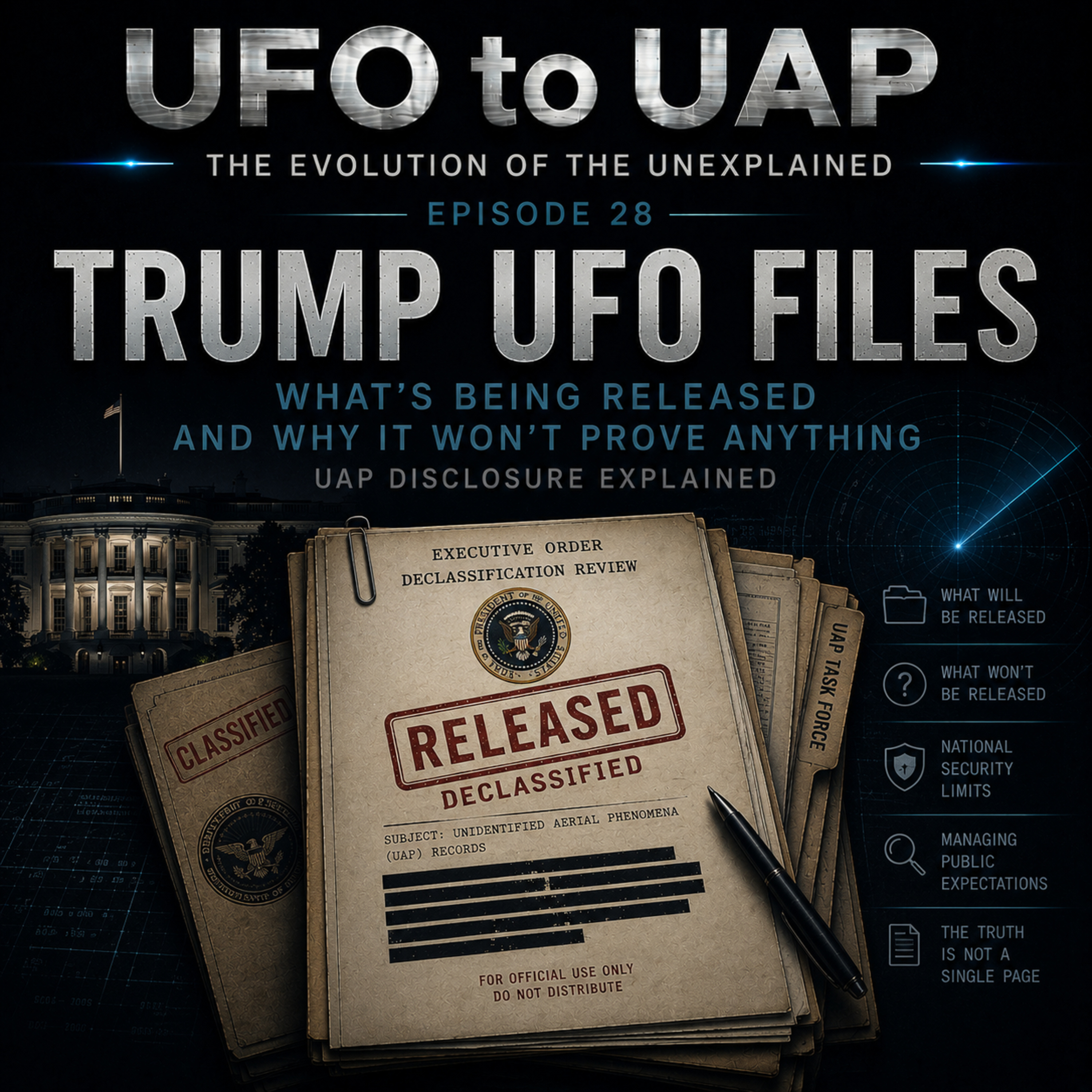
Trump's UAP Files: Unveiling Alien Truths and Hidden Mysteries
Tonight's Episode
What will Donald Trump’s reported UAP file release actually reveal—and can declassified documents ever provide definitive proof of UFOs or non-human intelligence?
In this episode of UFO to UAP Explained, host Matt Tones examines reports that Trump has ordered the release of UAP-related government files. The episode separates public expectations of “disclosure” from the controlled process of reviewing, redacting and approving classified material for release.
Discover why government documents often contain pilot reports, sensor summaries, internal briefings and unresolved observations rather than final conclusions. The discussion explores missing context, protected intelligence sources, radar and infrared interpretation, redactions and the fragmented structure of UAP data across government systems.
Could the files contain important new evidence, or will they expand the mystery without resolving it? This episode explains why releasing information is not the same as revealing the full truth—and how politics, national security and strategic framing shape what the public is allowed to see.
Episode Timestamps
(0:00) Trump’s reported UAP file release
(1:03) Releasing files versus revealing truth
(1:50) Political pressure and controlled disclosure
(3:03) Why released documents are filtered
(3:44) The Epstein effect and public expectations
(4:22) What government UAP files contain
(5:05) Missing context and partial visibility
(5:38) Scientists, speculation and verified facts
(6:35) How releases legitimise UAP uncertainty
(7:01) Why more information can create ambiguity
(7:44) Pilot reports, sensors and unresolved observations
(8:22) Why a UFO smoking gun is unlikely
(9:12) Redactions and protected intelligence methods
(10:04) How documents are cleared for release
(10:40) Radar and infrared data require interpretation
(11:30) Gradual disclosure and information control
(12:23) Why there may be no single revelation
(13:30) Disclosure provides access, not certainty
(14:19) Politics, timing and strategic framing
(15:11) The repeating cycle of release and uncertainty
(16:10) What Trump’s UAP files may actually prove
(17:04) Why the UFO question will remain open
Sources:
National Archives — UFO and Project Blue Book records;
U.S. Department of Defense / ODNI UAP reports;
AARO Historical Record Report;
NASA UAP Independent Study Team Report;
U.S. House Oversight Committee UAP hearings;
UAP Disclosure Act / NDAA records;
White House and federal declassification records relating to UFO, UAP, national security, and intelligence transparency.
Keywords:
Trump UAP files, Donald Trump UFO disclosure, Trump UFO files, government UAP release, declassified UFO documents, UAP disclosure, controlled disclosure, Pentagon UFO files, classified UAP data, UFO document release, government redactions, UAP sensor evidence, radar UFO data, infrared UAP evidence, non-human intelligence, UFO smoking gun, government UFO secrecy, unidentified anomalous phenomena, UFO disclosure analysis, UFO to UAP Explained.
There are moments when something shifts, not quietly, not in the
background, but publicly, when a subject that is lived in the
shadows suddenly moves into the light.
And for decades, people have been waiting for one moment in
particular, the moment when the government finally says here it
is, the files, the documents, the evidence, proof that answers
the question once and for all. And now that moment appears to
be here with reports that Donald Trump has ordered the release of
UAP related files and claims that very interesting material
has already been identified. The expectation is immediate.
This is it. This is disclosure.
This is where everything changes.
But before we go any further, we need to pause because we've seen
this moment before. Not exactly like this, but close
enough to recognise the patent. And the patent tells us
something important. Releasing files is not the same
as revealing truth. So tonight we're not asking what
will be in the files, we're asking something far more
important. What will these releases
actually prove and what will they never be able to approve?
Because the answer to that question defines everything that
follows. Welcome back to UFO to UAP, the
disclosure report. I am your host, Matt Tones,
thank you for tuning in. Remember to subscribe on Apple
Podcasts or Spotify and do me a favour and share the episode.
This one is titled The UAP Files.
What Trump is releasing and what it won't prove.
When a political figure, especially one at the level of a
former president and current president, talks about releasing
information, it carries weight. It signals intent, it signals
pressure, and it signals that something inside the system is
moving. In this case, the message is
clear. There are documents, they are
described as interesting, and they're expected to be released
publicly, which immediately triggers a reaction because the
public interprets this as revelation, but the system
interprets it differently. Controlled release, and those
two interpretations are not the same.
When people hear files are being released, they imagine something
very specific. Clear documentation, definitive
evidence, a structured explanation, something that
answers What are UA PS? Where do they come from?
Who knows about them? Something that removes doubt,
Something that forces agreement. Something that changes
everything. Because that's what we associate
with document releases. We assume if it's written down
it must be known, and if it's known it must be provable.
But that assumption is where the misunderstanding begins.
Because when the system releases files, it does not release
complete truth. It releases approved material.
Material that has been reviewed, filtered, contextualised and
cleared. And that process matters because
it determines what you see and more importantly, what you don't
see. A release document is not real
reality. It is a version of reality that
can be shown. And that distinction is
everything. We've seen this pattern before.
I call it the Epstein effect effect.
Large scale document releases high public expectation and
massive attention. And then something interesting
happens. The files don't resolve the
question, they expand it. They provide more detail, more
context, more fragmentation, but not definitive answers, because
documentation do not always contain conclusions, they
contain observations, assessments and interpretations.
And interpretation is not proof. To understand what will be
released, you need to understand what these documents are.
They are not final conclusions. They are working material,
reports, briefings, internal assessments, documents that were
never designed to explain everything but to inform
decisions. That means they are incomplete,
context dependent and often ambiguous.
So when they are released publicly, they do not become
clearer, they become open to interpretation.
Now we arrive at something critical, because even when
documents are real and even when they are accurate, they are
really complete. They exist inside a larger
system of information, classified data, sensor records,
internal discussions. And when those layers are
removed, what remains is partial visibility.
So the public receives fragments while the system retains
context, and without context, interpretation becomes
inevitable. Now we address something that is
already emerging. Alongside the discussion of UAP
files, there are reports and speculation about scientists,
individuals connected to Advanced Research, some of whom
have died, disappeared or been associated with unusual
circumstances. Now this is where we need to be
precise, because this is where narratives can move faster than
facts. There is a difference between
verified information and interpreted patents.
The system may investigate, it may respond, but that does not
automatically confirm a connected explanation.
This is where your positioning matters, because your role is
not to amplify speculation, it's to analyse how the system
responds to emerging narratives. When files are released, they
don't close the question, they do something else.
They legitimise the discussion. They move the topic from
speculation to acknowledged uncertainty.
And that shift is powerful, but it is not resolution because the
release of information does not guarantee understanding.
And so we arrive at the core issue.
People believe more information equals more clarity.
But in complex systems, the opposite can be true.
More information can create more ambiguity because it introduces
conflicting data, incomplete narratives and multiple
interpretations. When these files are released,
the first thing people will do is search for answers.
Clear answers. Something definitive, something
that stands out from everything that came before.
But to who? But to understand what will be
there, you have to understand what already exists inside the
system. Most UAP related materials falls
into a few category. Observational reports, pilot
accounts, sensor data summaries, internal assessments.
Not conclusions, not confirmations, descriptions,
accounts of something seen, something tracked, something
recorded, but not something fully understood.
So when the files are released, what you're likely to see is not
answers, but records of unresolved observations.
This is the moment where expectations will collide with
reality, because many people are waiting for a single document, a
single piece of evidence that confirms everything.
A smoking gun. But that kind of evidence
requires conditions that do not exist here.
It requires complete data, full context, and the ability to
verify independently. And those conditions are not met
because even inside the system, the data is fragmented,
distributed, and often incomplete.
So instead of 1 definitive answer, you get multiple
incomplete pieces, and those pieces do not combine neatly.
There's a common assumption that more information equals more
clarity, But in complex systems, that assumption breaks down
because more information induced introduces more variables, more
observations, more interpretations, more
inconsistencies. And when those things increase,
so does uncertainty. So instead of resolving the
question, the files may actually expand it.
Another factor that will shape what people see is reduction.
Sections removed, details obscured, information withheld.
Not randomly, but deliberately because certain elements cannot
be released. Capabilities, sources, methods.
These are protected regardless of the topic, so even when the
documents are released, they are incomplete by design.
Before anything is made public, it passes through a process
review, assessment, and clearance, and that process
determines what is acceptable to release, not what is true in
total, but what is safe to show. That means every document you
see has already been filtered, not to deceive, but to protect,
and protection limits visibility even when the data is real.
There is another problem. Interpretation.
A radar track does not explain itself.
An infrared signature does not define its origin.
It shows behaviour, not meaning. So when these documents are
released, what people are really seeing is interpreted data, not
objective truth. Which means different people can
look at the same document and reach completely different
conclusions. Inside the system, that may be
attempts to connect the dots. Patents may be identified,
possibilities may be considered. But publicly those connections
are rarely presented as facts because to do so would require
certainty. And certainty is it is very
difficult to achieve under these conditions.
So instead, the system presents observations and leaves
interpretation open. This is where everything comes
together, because what we're seeing is not just a release of
information, it is a controlled process.
Information is introduced gradually, selectively and
strategically, not to overwhelm the system, but to manage it,
because sudden clarity can create instability, but gradual
ambiguity can be absorbed. So when the files arrive, the
experience will likely be the same as before.
There will be moments of intrigue, fragments of insight,
and pieces that don't fully align.
Some people will see confirmation, others will see
uncertainty, and many will still ask the same question, Where's
the proof? Because even with more
information, the core issue remains unchanged.
There is an idea that sits behind all of this.
The belief that one day there will be a moment.
A moment where everything is revealed, where the documents
are complete, where the answers are clear, where the question
finally ends. And moments like this, where
files are announced, where releases are promised, they feel
like that moment. But history tells us something
different. There is no single moment of
revelation. There are only stages of
visibility, and each stage reveals more without ever
revealing everything. What we're seeing here is not
separate from the evidence problem, it is an extension of
it, because the same constraints apply the same limitations, the
same structure. Daughter exists, but it is
fragmented. Context exists, but it is
restricted, and so when information is released, it
carries those same limitations with it, which means the files
will not solve the problem, they will demonstrate it.
Now we move into something deeper because disclosure is
often misunderstood. People think disclosure means
answers, but in reality, disclosure means access to
information. And access to information does
not guarantee understanding because information without full
context, without full data, without full alignment, becomes
something else, interpretation. So disclosure does not end the
conversation, it expands it. Now let's look at the political
layer. Because announcements like this
do not exist in isolation. They are shaped by public
interest, institutional pressure, and timing.
Releasing files signals movement.
It signals responsiveness. It signals that the system is
engaging. But engagement is not
resolution. It is positioning.
Even as information is released, control is maintained through
selection, redaction, and framing.
The system decides what is shown, what is withheld and how
it is presented, and that ensures something critical that
no single release creates uncontrollable consequences.
At this point, we need to accept something.
The question we are asking may not have a definitive endpoint
because the conditions required for resolution do not exist.
The data is incomplete, the system is fragmented, the
environment is unpredictable, and all that leads to 1 outcome.
The question remains open. Now we step back and look at the
pattern again. The system observes, records,
analysis and releases comparatively.
The public expects, interprets, reacts and asks for more, and
the cycle continues. Release, reaction, uncertainty.
Repeat not once, but again and again and again.
So what does this movement represent?
Not disclosure, not confirmation.
It represents another stage in the process, another point where
the system adjusts visibility. Not to end the question, but to
manage it. So we return one final time to
the question at the centre of this episode.
What will these files prove? And the answer is, they will not
prove what people expect them to approve.
They will show observations, uncertainty and the limits of
understanding, but they will not provide definitive answers.
The release of UAP files is not the end of the story.
It is part of the system continuing to engage with a
question it cannot fully resolve.
And that is why even now, after decades of investigation and now
public release, the outcome remains the same.
No final proof, but also no final dismissal.
Because in the end, this is not just about documents.
It is not just about politics, it is not even just about Uaps.
It is about how systems deal with the unknown and what
happens when the unknown refuses to become known.
The files will be released, they will be read, they will be
analysed and the question will remain.
This is UFO to UAP the disclosure report.
I'm Matt Tones and leaving you with one last thought.
Sometimes the most important thing to understand is not what
is being revealed, but why. It will never fully answer the
question. Music.
 Amazon Music
 Apple Podcasts
 Castbox
 Castro
 Goodpods
 iHeartRadio
 Overcast
 Pocket Casts
 Podbean
 Podcast Addict
 Spotify
 YouTube