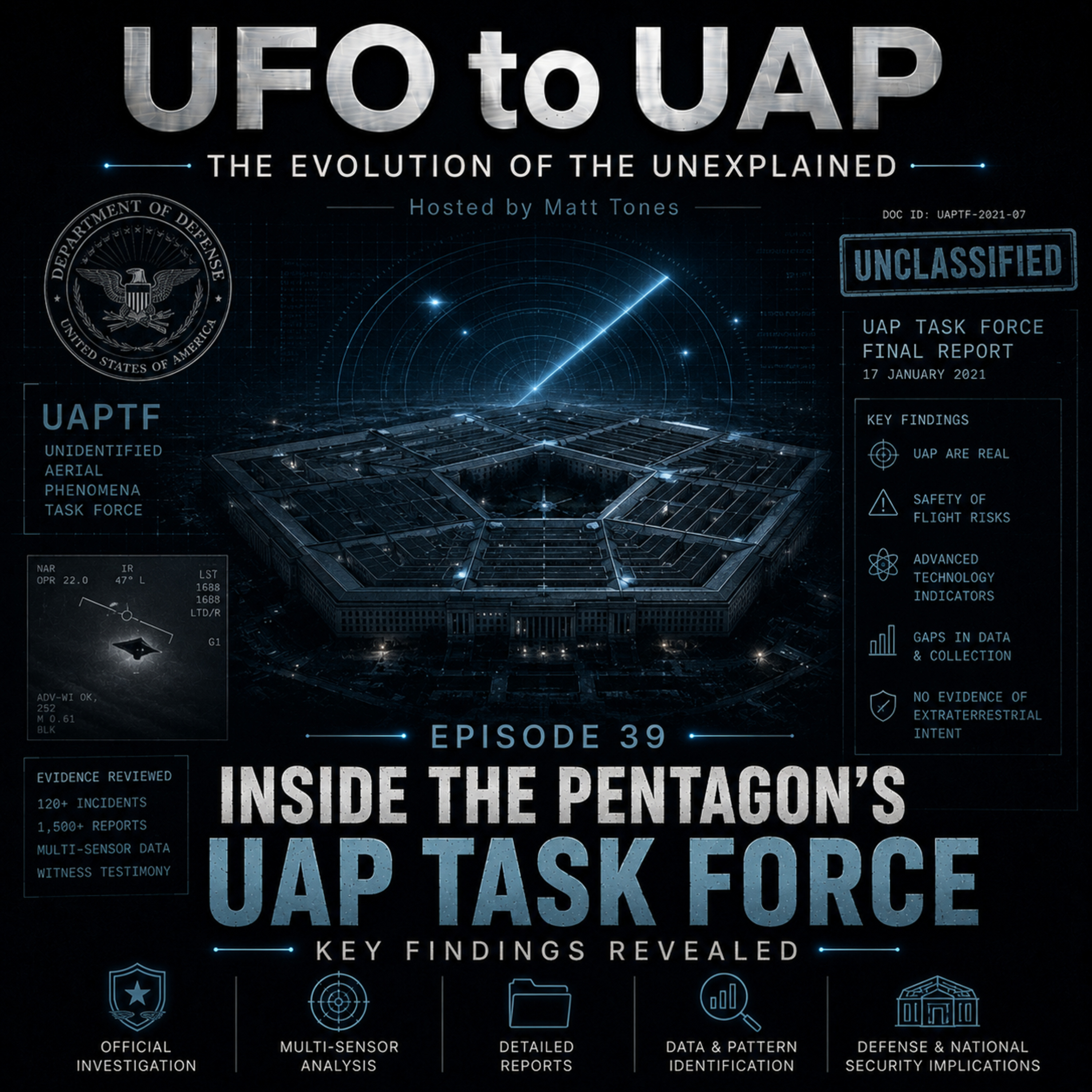
Unveiling the UAP Task Force: The Pentagon's UFO Rebranding Strategy
Tonight's Episode
Why did the Pentagon replace “UFO” with “UAP,” and how did that rebranding change the way unexplained military encounters were investigated?
In this episode of UFO to UAP Explained, host Matt Tones examines the rise of the Pentagon’s Unidentified Aerial Phenomena Task Force and the events that pushed UFO reports from cultural taboo into formal intelligence analysis.
The investigation traces the path from AATIP and the Navy’s FLIR1, Gimbal and GoFast videos to the 2004 USS Nimitz Tic Tac encounter and the Department of Defense’s creation of the UAP Task Force in August 2020. Rather than confirming extraterrestrial craft, the program focused on unidentified objects near military assets, fragmented reporting systems, advanced sensors and possible national-security threats.
The episode also breaks down the June 2021 preliminary UAP assessment, which reviewed 144 military incidents and left most unresolved because of insufficient data. Explore pilot stigma, radar and infrared evidence, sensor errors, congressional pressure, foreign surveillance concerns and the government’s cautious category of “other.”
Was the UAP Task Force genuine transparency, controlled disclosure or an intelligence-modernisation effort? Discover how the Pentagon’s new language, reporting procedures and permanent investigative structure changed the UFO debate without solving the mystery.
Episode Timestamps
(0:02) How UFO became UAP(0:59) The Pentagon creates the UAP Task Force(1:31) Why the Pentagon began taking UFOs seriously(2:20) AATIP and the origins of the modern UAP era(3:19) FLIR1, Gimbal and GoFast(4:09) The USS Nimitz Tic Tac encounter(5:07) National security and unidentified objects(5:49) Creation of the UAP Task Force in 2020(6:11) Centralising military UAP reports(7:08) Pilot stigma and the reporting problem(8:06) The 2021 preliminary UAP assessment(9:07) The five possible explanation categories(10:05) Radar, infrared and sensor limitations(11:14) Congress drives UAP oversight(12:12) Public disclosure versus cautious language(13:08) The Task Force’s actual mission(14:11) From AOIMSG to AARO(15:12) Sceptical explanations and scientific caution(16:19) Transparency or controlled disclosure?(17:31) The lasting legacy of the UAP Task Force
Sources:
U.S. Department of Defense — Establishment of the Unidentified Aerial Phenomena Task Force;
ODNI — 2021 Preliminary Assessment on Unidentified Aerial Phenomena;
U.S. Department of Defense — AOIMSG successor office announcement;
AARO Historical Record Report;
NASA UAP Independent Study Team Report;
U.S. Department of Defense / ODNI Annual UAP Reports.
Keywords:
UAP Task Force, Pentagon UFO investigation, Pentagon UAP program, UFO to UAP rebranding, Unidentified Aerial Phenomena Task Force, 2021 UAP report, USS Nimitz Tic Tac, Navy UFO videos, FLIR1, Gimbal, GoFast, AATIP, AOIMSG, AARO, military UAP encounters, Pentagon UFO disclosure, controlled disclosure, UAP national security, pilot UFO reports, radar UAP evidence, infrared UFO footage, congressional UAP oversight, unidentified anomalous phenomena, government UFO investigation, UFO reporting stigma, UAP sensor data, UFO disclosure podcast.
For decades, the word UFO carried baggage, ridicule,
tabloid headlines, late night radio conspiracy culture.
Pilots avoided reporting sightings, military personnel
stayed silent, and governments treated the subject as something
dangerous to discuss publicly. Then suddenly, something
changed. The Pentagon stopped using the
term UFO and replaced it with UAP, Unidentified Aerial
Phenomenon. That change was not cosmetic.
It was institutional strategic, because when the US government
changed the language, it changed the framework.
The mystery was no longer being discussed as fringe mythology.
It was now being treated as an intelligence issue, an aerospace
issue, a sensor issue and potentially a national security
issue. Then came the creation of the
UAP Task Force, a real Pentagon initiative created to
investigate unexplained aerial encounters involving military
personnel. Not Internet rumours, not
civilian ghost stories, but encounters involving Navy
pilots, advanced military sensors, radar systems,
classified operational zones and objects.
Investigators could not immediately explain.
And suddenly the biggest question changed.
The question was no longer do people report UFOs?
Of course they do. The new question became, why is
the Pentagon taking this seriously now?
Tonight we investigate how the UAP task force emerged, the
events that forced its creation, the famous Navy encounters, the
2021 report, the unexplained cases, the political pressure
behind disclosure, the data limitations, the national
security concerns, and how Pentagon transformed UFOs from
taboo into an institutional intelligence problem.
This is UFO to UAP, the disclosure report hosted by Matt
Tones. And tonight we go inside the
Pentagon's UAP task Force. To understand the UAP task
force, we first need to understand what came before it.
Because the task force did not appear suddenly, it emerged from
years of growing pressure inside the military and intelligence
community. One of the earliest modern
programmes connected to this shift was AATIP, the Advanced
Aerospace Threat Identification Programme.
AATIP reportedly operated within the Department of Defence
beginning in the late 2000s. Its mission remains debated.
Some argue it focused broadly on aerospace threats.
Others argue it specifically investigated anomalous aerial
encounters. The programme later became
publicly associated with Luis Elizondo.
So Luis Elizondo, a former intelligence official who
claimed the government was not adequately addressing
unexplained military encounters. Then came the Navy videos and
everything changed. 3 videos transformed public discussion.
Floor 1 Gimbal and Go fast. The footage showed unusual
aerial objects recorded by U.S. military systems, objects that
appeared difficult to track, unusually manoeuvrable, and
unlike ordinary aircraft behaviour pilots expected to
encounter. Now this is important.
The Pentagon did not officially declare the Israelian spacecraft
because that never happened. But the government did confirm
the footage was authentic military imagery.
And that confirmation mattered enormously because suddenly the
conversation shifted from Internet speculation to verified
military encounters. The most famous case involved
the USS Nimitz encounter in 2004.
Navy pilots described an object now commonly referred to as the
Tic Tac, a wide object allegedly manoeuvring in unusual ways over
the Pacific Ocean. Pilots reported rapid
acceleration, unusual movement and behaviour they struggled to
explain. Again, important distinction
witnesses described unusual performance.
The government did not officially conclude the object
violated physics. That difference matters because
careful language is essential in this field.
Now here is where the story becomes strategically important.
The Pentagon's concern was not initially extraterrestrials.
It was uncertainty. Unknown objects operating near
military assets create serious problems because from a defence
perspective, an unusual or unexplained object represents
multiple possibilities. Foreign surveillance technology,
advanced drones, sensor errors, electronic warfare systems,
classified aerospace breakthroughs, or something
genuinely unidentified. And in national security
environments, uncertainty itself is dangerous.
Military systems are built around identification.
Friend, foe, known, unknown. Once objects appear that cannot
be rapidly categorised, institutions become
uncomfortable very quickly. That discomfort helped drive the
creation of the UAP Task Force. In August 2020, the Department
of Defence formally established the UAP Task Force.
The timing was not accidental. Public attention was growing
rapidly. Congressional interest was
increasing, military encounters continued accumulating, and
internal reporting systems remained fragmented.
The UAP Task Force was created to centralised analysis.
Its mission included collecting reports, standardising
investigation, assessing potential threats and improving
coordination across military branches.
This represented A historic shift.
For decades, UFO reports inside military culture often carried
stigma. Pilots feared ridicule.
Careers could suffer. Incidents went under, reported
or unreported. Now, suddenly, the Pentagon was
formally encouraging reporting that cultural change may be one
of the most important aspects of the entire modern disclosure
era. One of the most important or
most significant findings surrounding the task force was
not necessarily about the objects themselves.
It was about reporting culture. Military personnel often avoided
discussing anomalous encounters. Why?
Because stigma damages careers. Pilots are trained observers.
Their credibility matters enormously.
Reporting strange objects risked embarrassment, professional
consequences or concerns about mental stability.
This created a serious intelligence problem.
If personnel refused to report anomalies, the military loses
data, and from a national security standpoint that is
unacceptable. The UAP task force represented
an institutional attempt to normalise reporting, not because
the government embraced extraterrestrial theories, but
because unidentified objects in military airspace cannot simply
be ignored. Then came the report that
changed everything publicly. In June 2021, the Office of the
Director of National Intelligence released the
preliminary assessment on Uaps. The report was short, only 9
pages publicly, but its impact was enormous.
Why? Because it acknowledged
something extraordinary. Not extraterrestrials, not alien
visitation, but unresolved uncertainty.
The report reviewed 144 military incidents.
Only one could be confidently explained.
The rest remained unresolved. Due to insufficient data.
That phase matters. Insufficient data because can't
even say it. Because, contrary to sensational
headlines, the report did not conclude alien craft existed,
physics had been broken, or extraterrestrials had been
confirmed. Instead, it revealed a much more
complicated reality. The government had encounters it
could not fully explain, and its data systems were inadequate.
One of the most important parts of the report involved
categorization. Investigators grouped incidents
into possible explanatory buckets, airborne clutter,
natural atmospheric phenomena, U.S. government or industry
programmes, foreign adversary systems, and other.
The final category became famous other.
Why? Because it represented
unresolved cases, incidents lacking sufficient explanation.
Now, importantly, other does not automatically mean
extraterrestrial. It simply means investigators
lacked enough information for definitive classification, and
that distinction is very critical.
But psychologically, the existence of unresolved military
cases electrified public attention because for the first
time in decades, the government openly admitted some encounters
remain unexplained. One of the most misunderstood
aspects of modern UAP investigations is the sensor
issue. Modern military systems collect
enormous amounts of information radar, infrared, Electro optical
imagery, telemetry, tracking systems, data fusion networks.
But complex sensor environments also create problems.
Misinterpretation can occur, artefacts can emerge, data can
conflict. Optical distortions happen,
radar anomalies happen, perspective illusions happen.
And this became central to the Pentagon's analysis.
Many UAP incidents involved incomplete data sets, fragmented
sensor records, inconsistent reporting standards, and missing
contextual information. The task force repeatedly
emphasised better day collection was essential.
And that is very important because the UAP task force was
fundamentally an intelligence modernization effort, not simply
a hunk for aliens. So that should say hunt for
aliens, not hunk for aliens. Well, look guys, at least you
know it's, it's all being recorded without a highlight of
editing. It's genuine, authentically for
myself. Another critical piece often
overlooked. Congress drove much of the
process, particularly the Senate intelligence community.
Lawmakers demanded briefings, analysis, standardised reporting
and threat assessment. Why?
Because unidentified objects near military operations create
oversight concerns, Congress wanted answers.
Were adversaries operating advanced systems?
What data being ignored? Sorry, Was data being ignored?
Were agencies coordinating properly?
Was national security being compromised?
This transformed UFOs politically.
The subject moved from fringe culture into oversight and
intelligence infrastructure. That shift cannot be overstated.
Now we arrive at one of the biggest tensions in the
disclosure era, public expectation versus institutional
language. Many people expected Full
disclosure, Alien confirmation, revolutionary revelations.
But government reports remain cautious.
Technical bureaucratic uncertainty focused.
This created frustration. Some believed the government was
hiding the truth. Others argued the public was
over interpreting complete information or sorry, incomplete
information. And perhaps both sides
misunderstood the situation because intelligence systems
rarely operate in obsolete, especially with limited data.
The task force was never designed to prove
extraterrestrial visitation. Its purpose was understanding
anomalies affecting military operations, and that is a very
different mission. And this is the most important
thing to understand. The Pentagon's primary concern
was always national security, not cosmic philosophy, not alien
diplomacy. Unknown objects near military
systems represented potential threats until identified, and
that is standard defence logic. But completely ordinary
explanations become serious if identification fails.
And This is why the task force mattered institutionally,
because the military acknowledged its understanding
was incomplete and that admission alone represented a
major cultural shift. The UAP task force did not
remain static. Over time, the institutional
framework evolved. First came AOIMSG, the Airborne
Object Identification and Management Synchronisation
Group, then eventually ARROW, the Old Domain Anomaly
Resolution Office. Each transition reflected
government institutionalisation or, sorry, growing
institutionalisation. The government was no longer
treating UAP reports as isolated curiosities.
It was building permanent infrastructure.
That matters enormously historically.
But regardless of what UAP ultimately are, the
investigative architecture is becoming permanent.
Now let's fairly examine scepticism, because sceptics
raise important points. Some incidents may involve
sensor artefacts, classified US systems, drones, optical
illusions, radar interpretation errors or misunderstood
atmospheric effects. And sceptics correctly note
extraordinary claims require extraordinary income.
I'm so sorry. Extraordinary evidence That
standard matters. The task force itself repeatedly
avoided sensational conclusions. It acknowledged uncertainty, not
alien confirmation. And that caution is important
for maintaining credibility because the strongest
investigations avoid premature conclusions.
So why did the UAP task force become historically important?
Because it normalised institutional engagement with
the unknown. The stigma barrier weakened,
pilots began reporting more openly, Congress demanded
accountability, military systems adapted and public discussion
fundamentally changed. The Pentagon effectively
transformed UFOs from taboo mythology into a legitimate
investigative category that may ultimately become the task
force's greatest legacy, not proving extraterrestrials but
legitimising inquiry itself. Now we reach the deeper
question. Was this genuine transparency or
controlled disclosure? Some believe the government is
slowly normalising public discussion.
Others argue the task force simply reflects improved
intelligence coordination. Perhaps both are partially true
because regardless of motive, the result is undeniable.
The US government publicly acknowledged unexplained
incidents exist, military encounters occur, and
investigation is necessary. That alone would have been
unimaginable decades earlier. The Pentagon's UAP task force
did not solve the UFO mystery, but it changed the conversation
forever. It moved the subject from
ridicule into intelligence analysis, from speculation into
institutional process, and from culture cultural taboo into
national security infrastructure.
The findings remain incomplete. The data remains limited.
The conclusions remain cautious. But one thing became undeniable.
The unknown had officially entered the system.
And once institutions begin formally investigating
anomalies, the story changes permanently.
Whether these incidents ultimately involve advanced
technology, sensor complexity, adversarial systems, or
something much stranger, the implications are enormous.
Because for the first time in modern history, governments
publicly admitted there are things in our skies that do not
fully understand. And perhaps that is where the
real disclosure story truly begins.
This has been UFO to UAP the disclosure report.
Thank you for your time. Please subscribe and share the
episode.
 Amazon Music
 Apple Podcasts
 Castbox
 Castro
 Goodpods
 iHeartRadio
 Overcast
 Pocket Casts
 Podbean
 Podcast Addict
 Spotify
 YouTube