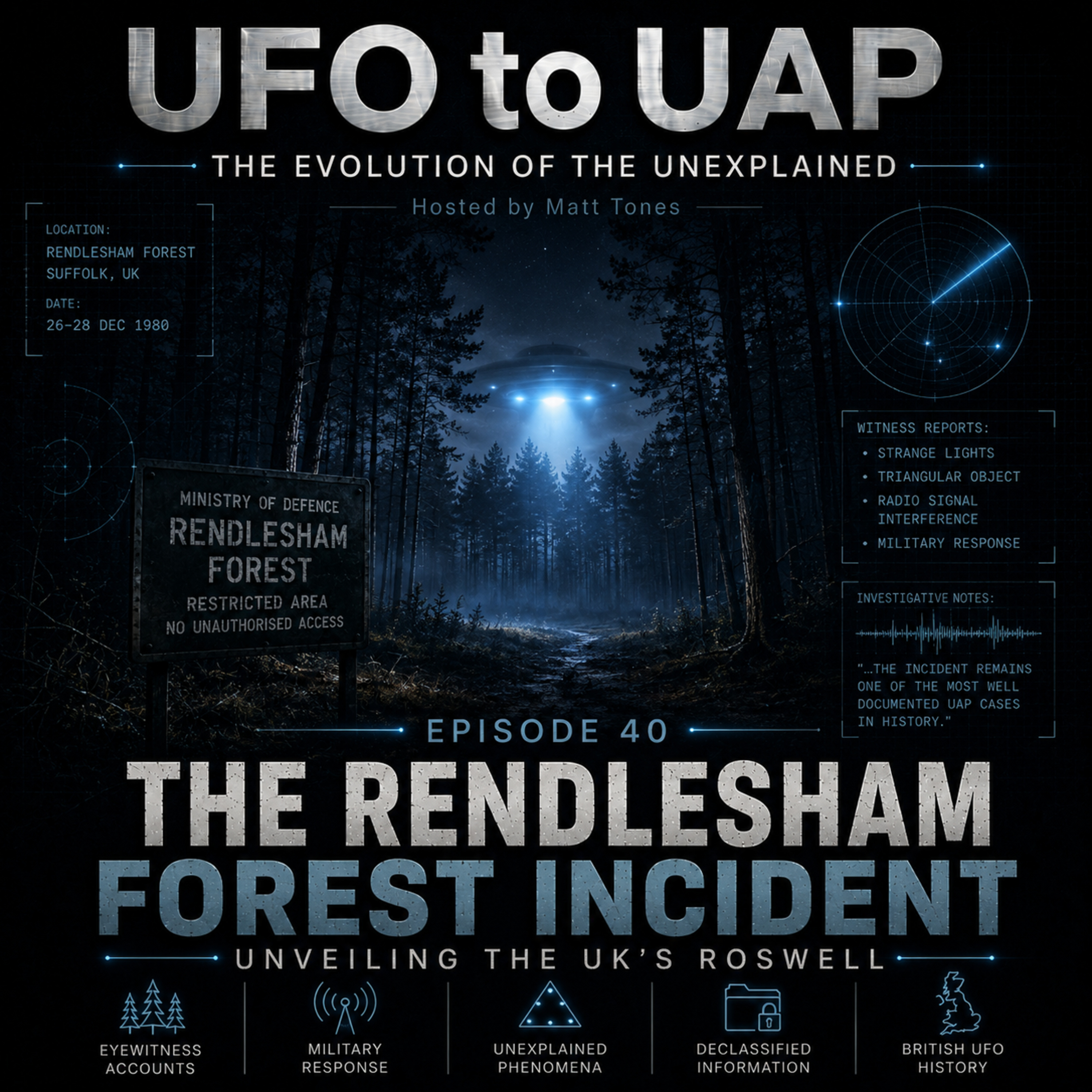
Unraveling the Rendlesham UFO: Decoding Britain's Roswell Mystery
Tonight's Episode
What happened in Rendlesham Forest in December 1980, and why is Britain’s most famous military UFO case still unresolved?
In this episode of UFO to UAP Explained, host Matt Tones investigates the Rendlesham Forest incident, often called Britain’s Roswell. The case unfolded near RAF Bentwaters and RAF Woodbridge, strategically important US Air Force bases linked to NATO operations during the Cold War.
Security personnel entered the forest after seeing unusual lights and fearing an aircraft had crashed. John Burroughs and Jim Penniston later described strange illumination, unusual movement and a possible triangular craft near the ground. Penniston also claimed he touched the object, although his later accounts involving binary codes and a cognitive download remain highly controversial.
The episode examines Lieutenant Colonel Charles Halt’s role, the real-time Halt tape and the official memorandum sent to the UK Ministry of Defence. It also evaluates disputed radiation readings, the reported nuclear-weapons connection and sceptical explanations involving the Orford Ness Lighthouse, stars, meteors, fatigue and nighttime misperception.
Did trained military witnesses encounter an unknown craft, classified technology or a combination of stress and environmental effects? Rendlesham offers no definitive proof of extraterrestrial visitation, but its military witnesses, official records, audio evidence and strategic location continue to make it one of the most important unresolved UAP cases in history.
Episode Timestamps
(0:00) The Rendlesham Forest incident begins
(1:19) Britain’s Roswell as a national-security mystery
(2:14) RAF Bentwaters, RAF Woodbridge and the Cold War
(3:31) Unusual lights enter Rendlesham Forest
(4:01) John Burroughs and Jim Penniston investigate
(4:29) Claims of a triangular craft
(5:24) Penniston’s alleged contact with the object
(5:45) Binary codes and evolving testimony
(6:39) The Orford Ness Lighthouse explanation
(8:24) Lieutenant Colonel Charles Halt investigates
(8:58) The famous Halt tape
(9:41) The official Halt memorandum
(10:43) Radiation readings and disputed evidence
(11:45) The nuclear-weapons connection
(13:12) The Ministry of Defence response
(14:54) Sceptical arguments and contradictions
(15:56) Rendlesham in the modern UAP era
(16:54) Memory, stigma and witness psychology
(18:45) What happened in Rendlesham Forest?
(19:22) Why the mystery still matters
Sources:
UK National Archives — Ministry of Defence UFO files;
UK Ministry of Defence Rendlesham Forest records;
Lt Col Charles Halt memorandum on the RAF Woodbridge incident;
Halt audio recording / Rendlesham Forest testimony;
Project Condign — Unidentified Aerial Phenomena in the UK Air Defence Region;
NASA UAP Independent Study Team Report;
AARO Historical Record Report.
Keywords:
Rendlesham Forest incident, Rendlesham UFO, Britain’s Roswell, RAF Bentwaters UFO, RAF Woodbridge UFO, John Burroughs, Jim Penniston, Charles Halt, Halt tape, Halt memorandum, Orford Ness Lighthouse, military UFO encounter, Cold War UFO case, nuclear weapons UFO connection, British UFO investigation, Ministry of Defence UFO files, triangular UFO, UAP disclosure, unidentified anomalous phenomena, unresolved UFO cases, military witness testimony, UFO evidence, UFO podcast, UAP podcast.
December 1980 Cold War Europe. NATO tensions rising.
American nuclear weapons stationed on British soil,
strategic air bases operating at high alert.
And deep within a quiet forest in Suffolk, England, something
happened. Not a blurry civilian sighting,
not a late night conspiracy theory, but an incident
involving trained US Air Force personnel, multiple military
witnesses, official memoranda, recorded audio evidence in one
of the most controversial military UFO cases in history,
the Rendlesham Forest incident, often called Britain's Roswell.
But unlike Roswell, this case did not revolve around a crash
recovery story. Instead, it's centred around
something potentially more unsettling.
An active encounter, witness entering the forest, military
personnel allegedly approaching an unknown object, lights
manoeuvring through restricted military airspace.
And perhaps most importantly, the incident occurred beside
bases connected to NATO nuclear operations during the Cold War.
That detail changes everything because Rendlesham is not just a
UFO story. It is a national security story,
a military credibility story, a Cold War story.
And decades later, it remains one of the most debated UAP
incidents ever recorded. Tonight we investigate what
happened in Rendlesham Forest, the testimony of military
witnesses, the Holt memo, the famous audio recording, the
nuclear weapons connection, sceptical explanations, the
evidence, the contradictions, and why this incident still
matters in the modern disclosure era.
This is UFO to UAP the disclosure report and I'm your
host, Matt Tones. And tonight we enter Rendlesham
Forest. To understand Rendlesham, you
first need to understand where it happened.
RAF Bentwaters and RAF Woodbridge were not ordinary
military facilities. There were strategically
important Cold War air bases used by the United U.S.
Air Force in the UK and according to multiple historical
accounts, they were associated with NATO nuclear weapons
storage during one of the most tense periods of the Cold War.
That matters enormously, because by 1980 the United States and
Soviet Union existed inside a permanent atmosphere of nuclear
anxiety. Military readiness was constant,
surveillance was consistent, intelligence operations were
consist, were constant, I should say, and any unknown object
nearest to nearest strategic military facility represented a
serious concern. Not because military officials
believed in aliens, but because they feared Soviet technology,
surveillance incursions, classified aerospace
breakthroughs, or threats to nuclear infrastructure.
That is the lens through which Rendlesham must first be viewed.
Not fantasy, not science fiction, but military
uncertainty. The incident began in the early
hours of December 26th, 1980. Security personnel stationed
near RAF Woodbridge reported unusual lights descending into
Rendlesham Forest. Initially some personnel
believed an aircraft may have crashed.
That alone justified immediate investigation. 2 servicemen
became central to what followed. AM and 1st Class John Burroughs
and Staff Sergeant Jim Peniston both entered the forest to
investigate the disturbance, and according to their testimony,
what they encountered was unlike anything they had seen before.
The men described strange lights moving through the trees,
unusual illumination, a glow that appeared controlled rather
than random. Then came the most controversial
claim of the entire incident. Penniston later stated they
encountered A triangular craft resting within the forest
clearing, Not hovering, not distant, but allegedly on or
near the ground itself. He describes smooth metallic
surfaces, unusual markings, strange symbols, coloured lights
and an object behaving unlike conventional aircraft.
Now pause here because this is where discipline analysis
becomes essential. There is no universally accepted
physical proof confirming a landed extraterrestrial craft,
no recovered material publicly verified, no authenticated
military photographs released confirming the object.
What we have is testimony, military testimony.
And that distinction matters because witness testimony can be
sincere while still remaining disputed.
According to Penistend, he moved closer enough to physically
touch the object. This detail became one of the
defining elements of the Rendlesham story.
Pettiston later described unusual surface textures,
unusual strange symbols, and intense psychological
impressions during the encounter.
Years later, his claims expanded further, including allegations
involving binary code sequences, cognitive downloads, and time
related symbolic information. Now this is important.
Those later claims are highly controversial and they did not
emerge immediately after the incident.
And that timing matters because investigators distinguish
between immediate contemporaneous testimony and
later evolving recollections. Critics argue later additions
weaken credibility. Supporters argue trauma and
delayed processing makes blamed evolving memories.
But from an investigator's standpoint, we must separate
what was reported immediately from what emerged decades later.
That distinction is critical for serious analysis.
Very quickly, sceptical explanations emerged.
The most famous involved the Orford Nest Lighthouse.
The lighthouse beam rotated at regular intervals and was
visible through portions of the forest.
Sceptics argue the moving light, atmospheric conditions, stress,
darkness and expectation may have created misinterpretation.
Other sceptical explanations include bright stars, meteors,
military confusion, optical distortion, fatigue and
environmental disorientation. These explanations cannot simply
be ignored. This is where Rendlesham becomes
genuinely difficult, because unlike weak UFO cases,
Rendlesham contains credible witnesses, conflicting
interpretations, official military involvement, but no
definitive resolution. That combination keeps the case
alive. Supporters of the incident
reject the lighthouse theory because witnesses claimed
movement inconsistent with the lighthouse.
The object allegedly appeared inside the forest.
Some descriptions involved structured craft like forms, and
military personnel insisted the event was far more complex than
a distant, rotating light. But sceptics counter human
perception at night is highly unreliable, especially under
stress, and history contains many examples of sincere
witnesses misinterpreting unusual conditions.
Both sides make important points, which is why Rendlesham
remains unresolved. Then things escalated.
Lieutenant Colonel Charles Holt entered the story.
Holt was not a random civilian witness.
He was the deputy base commander, a senior military
official, and his involvement transformed Rendlesham from a
strange military rumour into one of the most important military
UFO cases ever documented. On December 28th, Hout LED a
team in the Rendlesham forest to investigate reports of unusual
activity. Crucially, he carried a tape
recorder, and what happened next became legendary.
The Hulk tape remains one of the most famous audio recordings in
UFO history. On the tape, you can hear
military personnel reacting in real time, describing strange
lights, excitement, confusion and apparent aerial movement.
At one point, Holt describes the lights manoeuvring rapidly
through the trees and sky. The emotional authenticity of
the recording is one of the reasons the case became so
influential, because regardless of interpretation, the reactions
sound genuine. Not staged, not theoretical, not
bewildered, sorry, but bewildered, I should say.
There then came the document that elevated Rendlesham
permanently into UFO history, the Holt Memo.
Charles Holt formally documented the events in an official
memorandum sent to the UK Ministry of Defence.
This matters enormously because very few UFO cases produce
military witnesses, audio recordings and official military
paperwork. The memo described unexplained
lights, unusual movement, animal disturbances, radiation
measurements and aerial phenomena.
This became one of the most cited official military UFO
documents ever released publicly.
Now, importantly, the Holt memo did not claim aliens landed.
It documented unexplained observations.
That distinction is important, and this is one reason the
document retains credibility decades later.
It avoided sensational conclusions.
Instead, it documented uncertainty, which is exactly
what serious military reporting should do.
One of the most controversial aspects of the case involves
radiation measurements. According to reports, small
elevated readings were allegedly detected in areas associated
with the sightings. Supporters argue this suggests
something unusual physically interacted with the environment,
where sceptics disagree strongly.
Critics argue the readings were low, may have fallen within
normal environmental variation and were not scientifically
extraordinary. Additionally, questions emerged
regarding calibration methodology, environmental
contamination and, of course, interpretation.
Again, This is why Rendlesham remains difficult.
The evidence is suggestive but not definitive.
Interesting, but disputed, which is often where the strongest UFO
cases exist. Not proven, not disproven, stuck
permanently in ambiguity. Now we arrive at perhaps the
most important part of the entire case, the nuclear
connection. Because Rendlesham did not occur
near an ordinary location, multiple researchers and former
personnel have claimed RAF Bent Waters was associated with
nuclear weapons storage during the Cold War.
If true, this dramatically changes the significance of the
incident because across UFO history, one pattern appears
repeatedly. Nuclear sites, missile silos,
weapons facilities, strategic military infrastructure.
Again and again, UFO reports cluster around them.
This pattern appears in American missile bases, Soviet nuclear
regions, NATO facilities, and strategic military zones.
Why? There are several possibilities
1 Coincidence. 2 High military surveillance naturally produces
more reporting. 3 Classified military testing overlaps with
strategic facilities 4 Something genuinely anonymous appears
drawn toward nuclear infrastructure.
We do not know, but Rendersham fits directly into this larger
historical pattern, and that is one reason Mod UAP researchers
continue studying it seriously. The British Ministry of Defence
eventually acknowledged holding files related to the incident,
but publicly the Mod maintained the event did not represent a
threat to national security. This is important because the
government did not fully endorse extraordinary claims.
But neither did the incident disappear completely.
Instead, Rendlesham entered a strange middle ground,
acknowledged, documented but unresolved.
And that pattern feels very familiar in the modern UAP era,
because today's disclosure environment often works exactly
the same way. Governments acknowledge reports
exist, anomalies exist, investigations exist while
avoiding definitive conclusions. Rendlesham may have been decades
ahead of its time in that regard.
Many UFO stories fade quickly. Rendlesham did not Why?
Because it contains several extremely rare elements
simultaneously. Multiple military witnesses.
Senior officer involvement, official memoranda, recorded
audio, Cold War context, strategic military location,
nuclear weapons association, and decades of ongoing testimony.
Very few cases combine all of these.
That combination gives Rendlesham extraordinary staying
power. And, importantly, the witness
largely maintained their accounts for decades.
That consistency strengthened public interest significantly,
even though disagreements and contradictions still exist.
Now let's fairly assess the sceptical perspective, because
sceptics raise important concerns.
They argue no physical craft was recovered.
Witness memories evolved over time.
Environmental conditions were confusion, confusing, lighthouse
effects are underestimated and extraordinary conclusions are
unsupported by hard evidence. Some sceptics also argue the
case grew larger over time through media amplification,
that later retellings became more dramatic than the original
events. This criticism is not
unreasonable, and any serious analysis must acknowledge it
because Rendersham's reputation was shipped not only by the
incident itself, but by decades of documentaries, books,
interviews, and cultural mythology.
Over time, stories naturally evolve, especially when mystery
is involved. So why does Rendlesham matter
today? Because the modern UAP era
changed how historical cases are viewed.
After AARO Pentagon acknowledgments, military
footage releases, congressional hearings, whistleblower
allegations. People began re examining older
military UFO cases more seriously, not necessarily as
proof of extraterrestrials, but as examples of institutional
response to anomalies, military uncertainty, intelligence
compartmentalization, and unexplained encounters within
strategic environments. Rendlesham suddenly felt modern
again because the same theme continue appearing military
witnesses, sensor uncertainty, institutional caution, ambiguous
explanations, and unresolved anomalies that continuity
matters. Another reason Rendlesham
remains fascinating is because it exists at the intersection of
perception, memory, institutional authority and
mystery. Even if some aspects were
misinterpreted, the emotional impact on witnesses appears
genuine. And that raises difficult
questions. What happens when trained
military personnel encounter something they cannot explain?
How does stress shape memory? How does institutional
scepticism affect witnesses? Afterwards, several Rendlesham
participants later described ridicule, isolation and
dismissal, and psychological strain.
That pattern also appears repeatedly across UFO history.
Whether the phenomenon is extraordinary or not, the human
impact can be very real. Ultimately, Rendlesham forces us
to confront a difficult possibility.
Not necessarily aliens visited Britain, but something perhaps
more complicated. What if military institutions
occasionally encounter events they genuinely cannot explain in
real time? Not because the phenomena is
extraterrestrial, necessarily, but because enter sorry, but
because uncertainty is built into reality itself.
That possibility matters because governments are designed to
project certainty. Military systems are designed
around central control, and incidents like Rendlesham expose
moments where certainty breaks down, where trained observers
confront ambiguity, where official explanations fail to
fully satisfy everyone involved, and where mystery survives.
That may be the real legacy of Rendlesham Forest.
More than 4 decades later, the Rendlesham Forest incident
remains unresolved. No definitive proof, no
definitive debunking, just layer layers of testimony,
documentation, scepticism, military records, and unanswered
questions. Was it a a lighthouse,
misinterpretation or Cold War confusion, classified military
technology, psychological distortion, or something
genuinely anomalous? We still don't know, and I'd
love your thoughts in the comments.
But what makes Rendlesham extraordinary is not certainty.
It is credibility under uncertainty, military personnel,
strategic installations, official documentation and
recorded reactions, and a mystery that refused to
disappear. That is why Rendlesham remains
one of the most important new AP cases ever discussed.
Not because it proves extraterrestrial visitation, but
because it reveals how governments, institutions and
human beings respond when confronted with something they
cannot fully explain. And perhaps that is the true
heart of the UFO mystery itself. Not uncertainty, but the
persistence of the unknown. This has been UFO to UAP the
disclosure report. I'm host Matt Tones.
Thank you for tuning in.
 Amazon Music
 Apple Podcasts
 Castbox
 Castro
 Goodpods
 iHeartRadio
 Overcast
 Pocket Casts
 Podbean
 Podcast Addict
 Spotify
 YouTube