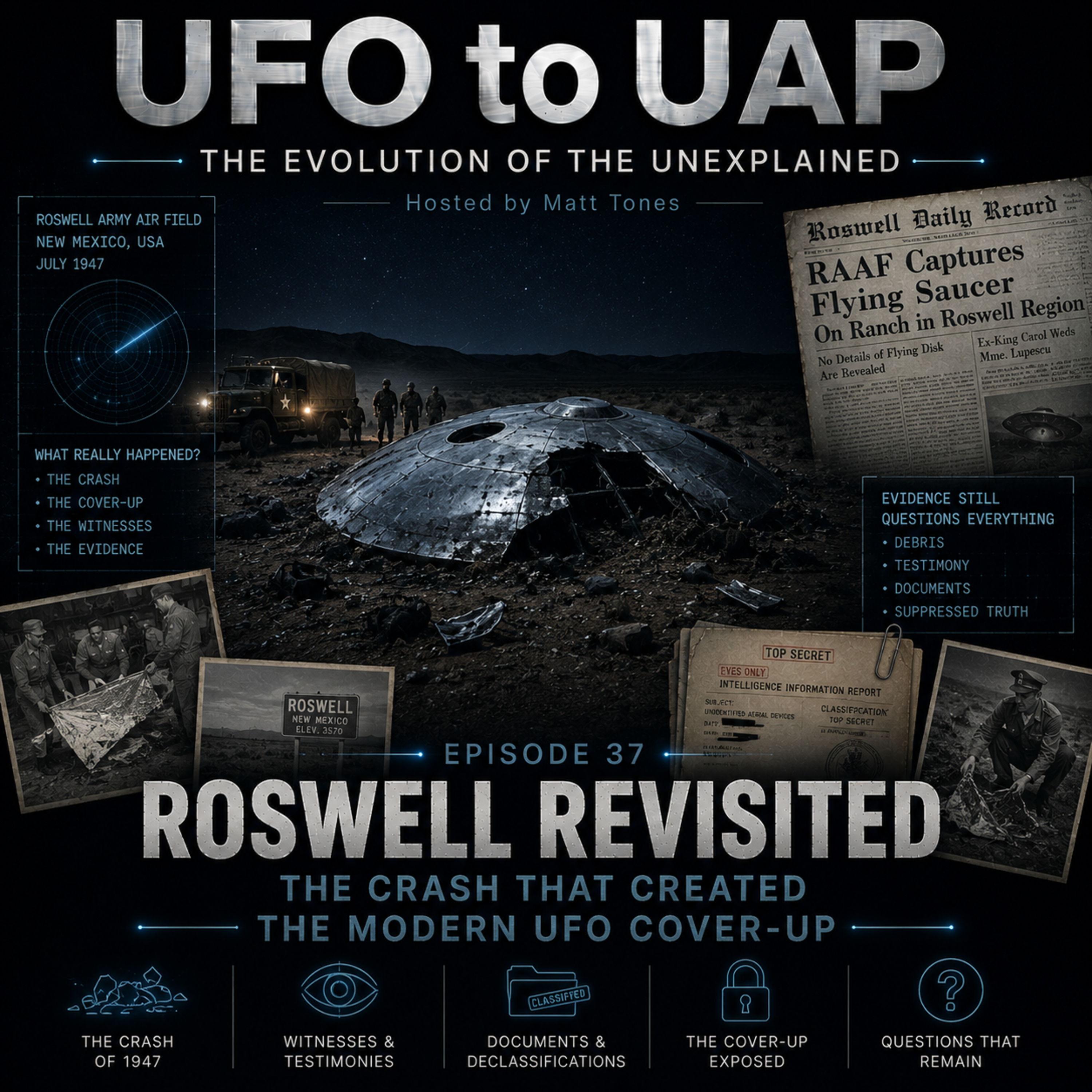
Roswell Revisited: The Birth of the Modern UFO Cover-Up
Tonight's Episode
What really happened near Roswell, New Mexico, in July 1947—and did the military’s sudden reversal create the modern UFO cover-up?
In this episode of UFO to UAP Explained, host Matt Tones revisits the Roswell incident, from rancher William “Mac” Brazel’s discovery of unusual debris to the Roswell Army Air Field announcement that it had recovered a “flying disc.” Within hours, officials replaced that claim with a weather-balloon explanation, beginning decades of suspicion about government secrecy and extraterrestrial evidence.
The episode examines the official Project Mogul explanation, Cold War surveillance, witness claims of bodies and retrieval teams, memory contamination, military intimidation and the growth of Roswell mythology. It also explores how Roswell shaped later ideas about Area 51, reverse engineering, crash retrieval programs, special access programs and hidden aerospace technology.
Did Roswell involve a classified balloon, experimental military technology or something genuinely anomalous? No theory has ended the debate. But the incident permanently changed public trust and became the template for modern UFO disclosure, whistleblower allegations and government cover-up claims.
Episode Timestamps
(0:00) The Roswell incident begins
(1:09) Did Roswell create the modern UFO cover-up
(2:24) America, the Cold War and military secrecy
(3:25) Mac Brazel discovers unusual debris
(4:21) The military announces a recovered flying disc
(5:03) The story changes to a weather balloon
(5:45) Project Mogul and the official explanation
(6:38) Witnesses, bodies and retrieval claims
(7:35) How Roswell became cultural mythology
(9:09) Modern whistleblowers revive crash retrieval claims
(10:08) Special access programs and secrecy architecture
(11:24) Roswell, Area 51 and reverse engineering
(12:01) Ridicule as a UFO reporting barrier
(13:03) Classified technology as an alternative explanation
(14:01) Roswell as an information war
(15:24) Pentagon UAP disclosure changes public perception
(16:29) Secrecy, trust and hidden knowledge
(17:16) Roswell’s lasting legacy
(18:00) What really happened in 1947?
Sources:
National Archives — Project Blue Book records;
U.S. Air Force — The Roswell Report: Fact versus Fiction in the New Mexico Desert;
U.S. Air Force — The Roswell Report: Case Closed;
FBI Vault — Roswell UFO files;
CIA historical material on early flying saucer reports;
AARO Historical Record Report;
U.S. Department of Defense historical UAP reporting.
Keywords:
Roswell incident, Roswell UFO, Roswell New Mexico, 1947 UFO crash, Roswell flying disc, Project Mogul, Roswell weather balloon, UFO cover-up, government UFO secrecy, Roswell Army Air Field, Mac Brazel, alien crash claims, crash retrieval programs, recovered alien technology, Area 51, reverse engineering UFOs, special access programs, military UFO investigation, Cold War UFO secrecy, UFO whistleblowers, UAP disclosure, Pentagon UAP investigation, extraterrestrial evidence, modern UFO mythology, unidentified anomalous phenomena, UFO podcast.
July 1947 A remote desert outside Roswell, NM.
A rancher discovers strange debris scattered across the
landscape. Metallic fragments, unusual
materials, objects unlike anything he had seen before.
Days later, the United States military announces something
extraordinary. The Army airfield at Roswell has
recovered a flying disc. The headline spreads around the
world. And then, almost immediately,
the story changes. The military retracts the
statement. Officials now claim the wreckage
was only a weather balloon, nothing unusual, nothing
extraterrestrial. Case closed.
But for nearly 80 years, the Roswell incident has refused to
disappear because Roswell became more than a crash story, it
became the foundation of modern UFO secrecy itself.
The moment many people believe the government realised the
phenomenon was real, information had to be controlled, retrieval
programmes began, and the architecture of secrecy was
born. Tonight we revisit Roswell
through the lens of everything we now know about special access
programmes, contract to secrecy, crash retrieval allegations,
military compartmentalization and the disclosure era unfolding
today. Because Roswell is no longer
simply did aliens crash? Now the question is far more
important, did Roswell create the modern UFO cover up system
itself? This is Roswell revisited.
Welcome back to UFO to UAP, the disclosure report.
I am your host Matt Tones. Thank you so much for tuning in.
Today's episode is titled Roswell Revisited, the Crash
that created the modern UFO cover up, 1947 retrieval claims,
military secrecy, and the birth of the disclosure era.
Remember to subscribe and please share the episode.
To understand Roswell, you first need to understand America in
1947. The world had just emerged from
World War 2. But peace did not bring
stability. It brought a new fear, the Cold
War. the United States suddenly faced Soviet expansion, nuclear
competition, espionage, paranoia and technological uncertainty
and military secrecy exploded. Radar systems advanced rapidly.
Rocket technology accelerated. Experimental aircraft programmes
intensified, intelligence agencies expanded, and above all
else, America feared technological surprise.
That fear matters enormously. Because Roswell occurred at the
exact moment the United States entered the modern national
security era. The CIA would soon form Nuclear
secrecy intensified. Black projects expanded.
Compartmentalization deepened. So when unusual debris appeared
outside Roswell, the military was already operating in a
mindset of extreme secrecy. The story begins with rancher
William Mack Brazell. After storms passed through the
Roswell area, Brazell discovered strange wreckage scattered
across his property. Accounts vary depending on the
source and time period, but descriptions often included
metallic foil like materials, lightweight beams, unusual
fragments and debris that supposedly behaved strangely
now. Importantly, many of the more
extraordinary claims emerged decades later.
That distinction matters because Roswell evolved over time.
The original 1940 Seven Storey was much smaller.
The mythology expanded gradually, but one thing remains
historically undeniable. The military initially announced
recovery of a flying disc. That headline is real.
And that's why Roswell became historic.
Because official acknowledgement happened first.
Before the retraction, before the weather balloon explanation,
before the narrative reversal. This is the moment everything
changed. On July 8th, 1947, the Roswell
Army Airfield issued a press release stating they had
recovered a flying disc. Not a weather balloon, Not
debris, a flying disc. Newspapers exploded with the
story and then within hours, senior military officials
intervened. Photographs were staged showing
weather balloon materials. The narrative changed
completely. Officials declared there was no
flying saucer, only a misidentified balloon.
Now here's the key issue. Why would trained military
personnel at one of the world's most sensitive military bases
incorrectly identify a weather balloon as a flying disc?
That question became central to decades of suspicion.
Critics argue confusion during the flying source of craze
explains the mistake. Supporters of the cover up
theory argue the retraction itself proves concealment and
from that moment Ford public trust fractured.
Now we need to discuss the official explanation because
decades later the United States government released detailed
reports stating Roswell involved Project Mogul, A classified
surveillance balloon programme. Project Mogul used high altitude
balloon arrays designed to detect Soviet nuclear tests.
At the time, the project itself was highly classified, meaning
military secrecy surrounding the debris was legitimate and
according to government investigations, unusual
materials, secrecy and confusion all stemmed from this classified
balloon project. To sceptics of the alien claims,
the explanation results Roswell, But to believers, serious
questions remain because witnesses continued emerging for
decades, describing unusual objects, military intimidation,
retrieval operations and sometimes even bodies.
Again, evidence quality varies dramatically, but the mythology
grew stronger over time. This is where Roswell
transitions from historical mystery into full cultural
mythology. Because beginning in the late
1970s and 80s, new witnesses began describing small humanoid
bodies, military recovery teams, secret transport operations, and
crash retrieval procedures. These accounts transformed
Roswell forever. Now it was no longer merely
strange debris. Now Roswell allegedly involved
non human beings. Critics point out many claims
emerged decades after the fact. Memory contamination becomes a
major issue. Cultural influence matters.
Books, television, movies, conspiracy culture all shaped
public perception. And yet, despite these problems,
Roswell continued growing. Why?
Because the deeper issue wasn't simply bodies, it was secrecy.
People increasingly believed if government deception occurred
once, what else might be hidden? Roswell became the foundation of
modern UFO culture. Before Roswell, flying sources
were mostly strange sightings. After Roswell, people began
imagining retrieval programmes, hidden technology, underground
facilities, reverse engineering and government concealment.
Roswell created the idea that the government knows more than
it admits. The concept transformed UFO
history permanently and culturally.
It's spread everywhere. Books, documentaries, late night
radio, Hollywood films, conspiracy theories.
Eventually, Roswell became symbolic of hidden truth itself.
Even people who knew little about UFOs knew the word
Roswell. That's extraordinarily powerful.
Few events in modern history achieved that kind of
mythological status now. Here's why Roswell became newly
relevant in the modern disclosure era.
For decades, Roswell existed mostly in fringe culture.
But then modern whistleblower narratives began emerging and
suddenly themes from Roswell reappeared.
Retrieval programmes, Compartmentalise, Secrecy.
Contractor involvement. Reverse engineering claims.
Hidden materials. The language change, but the
structure looks strangely familiar.
That's why Roswell matters again.
Not because the original claims were conclusively proven, but
because modern allegations unexpectedly revived similar
concepts. When David Grusch discussed
crash retrievals, hidden programmes and compartmentalised
access, many people immediately thought Roswell.
Because, whether true or false, Roswell became the template for
everything that followed. Now let's explore the deeper
theory. What if Roswell forced the
government to build a permanent secrecy architecture?
Think about the timing 1947. Nuclear fears arising,
intelligence systems expanding, Cold War beginning, advanced
aerospace competition accelerating.
Now imagine, hypothetically, that genuinely unknown
technology was recovered. How would the government
respond? Most likely extreme
classification. Compartmentalization, scientific
isolation, restricted access, contractor involvement, in other
words, exactly the kinds of systems later associated with
Black projects and special access programme culture.
This is why Roswell remains so central.
Because believers argue Roswell was not merely a cover up, it
was beginning of the cover up system itself.
Interestingly, Roswell predates Area 51 mythology.
Most people associate UFO secrecy with Nevada, but Roswell
actually came first. And over time the mythology
evolved geographically. Roswell became the crash site.
Area 51 became the alleged research location.
Then came S4 stories. Reverse engineering narratives,
hidden hangers, exotic propulsion theories.
But but structurally, all these narratives trace back to
Roswell. That's the origin point, the
moment people began believing the government possesses
recovered technology. Now we arrive at another crucial
issue. Ridicule.
Because after Roswell, UFO discussions increasingly became
associated with embarrassment, mockery, dismissal, and over
time that social pressure became powerful.
People feared discussing sightings publicly.
Military witnesses often stayed silent.
Pilots avoided reporting incidents.
Why? Because credibility mattered.
This is important because many modern disclosure advocates
argue ridicule itself became a control mechanism not
necessarily through giant coordinated conspiracies, but
through cultural reinforcement, and Roswell played a major role
in that process. The story became so
controversial that discussing UFOs publicly often carried
reputational risk. Now let's examine the most
fascinating possibility. What if Roswell involved not
extraterrestrials, but advanced technology misidentified by
civilians? This is a critical perspective
often overlooked because 1947 was also the dawn of
experimental surveillance systems.
Radar balloons, classified aerospace projects, meaning
highly unusual debris, could genuinely appear extraordinary,
especially to civilians unfamiliar with military
technology. That possibility makes Roswell
extremely complicated, because even if extraterrestrials were
not involved, real secrecy still may have existed.
And once secrecy enters the story, public suspicion
naturally expands. Roswell also revealed something
deeper. Information itself had become a
battlefield. The military rapidly realised
controlling narratives matters, especially during the Cold War,
because perception effects national security, public
stability, geopolitical competition.
And once governments begin managing narratives, trust
becomes complicated. This dynamic still exists today.
Every modern disclosure debate involves official statements,
counterclaims, leaks, ambiguity, scepticism, media framing.
Roswell was arguably the first major UFO information war and
perhaps the most important. Most historical events fade.
Roswell didn't. Why?
Because unresolved mystery creates psychological gravity,
especially when official storage change, witnesses disagree,
secrecy exists, documents remain incomplete.
Roswell contains all of those ingredients simultaneously.
And over generations, the mystery became self sustaining.
Each new disclosure wave revised it.
Each new whistleblower reopened the questions.
Each classified programme revealed later in history made
people wonder what else remained hidden.
That's why Roswell survived. When 10s of thousands of other
UFO stories disappeared, it became symbolic not just of
aliens, but of hidden truth. Today, Roswell exists in a
completely different environment than it did decades ago.
Because now the Pentagon acknowledges UAP encounters,
military footage exists, congressional hearings occur,
whistleblower protections expanded, pilot publicly
testify. This changes public psychology
enormously. Roswell no longer sounds as
impossible to modern audiences. That doesn't prove the claims,
but it changes perception and that's why Roswell has re
entered mainstream discussion. The cultural barrier collapsed.
So after nearly 80 years, what is Roswell really about?
Is it about extraterrestrials? Maybe.
But perhaps something even deeper is happening.
Perhaps Roswell is fundamentally about secrecy, trust, power, and
hidden knowledge because Roswell forces society to confront an
uncomfortable possibility. What if governments sometimes
conceal information they believe the public should not know?
That question extends far beyond UFOs, and maybe that's why
Roswell still resonates. Roswell was never just a crash
story. It became the birth of modern
UFO mythology, the beginning of retrieval narratives, the
foundation of disclosure culture in the symbolic origin of hidden
aerospace secrecy. Whether the incident involved
Project Mogul, military confusion, classified
technology, or something far stranger, Roswell changed
history. Because after Roswell, the
public began believing the government may know more than it
says. And once that belief enters
culture, it never fully disappears.
Now, nearly 80 years later, we're still asking the same
question. What really happened in the
desert outside Roswell in 1947? And perhaps even more
importantly, what began there? This is UFO to UAP the
disclosure report. Thank you again for tuning in.
Please share the episode and don't forget to tell your mum.
Music.
 Amazon Music
 Apple Podcasts
 Castbox
 Castro
 Goodpods
 iHeartRadio
 Overcast
 Pocket Casts
 Podbean
 Podcast Addict
 Spotify
 YouTube