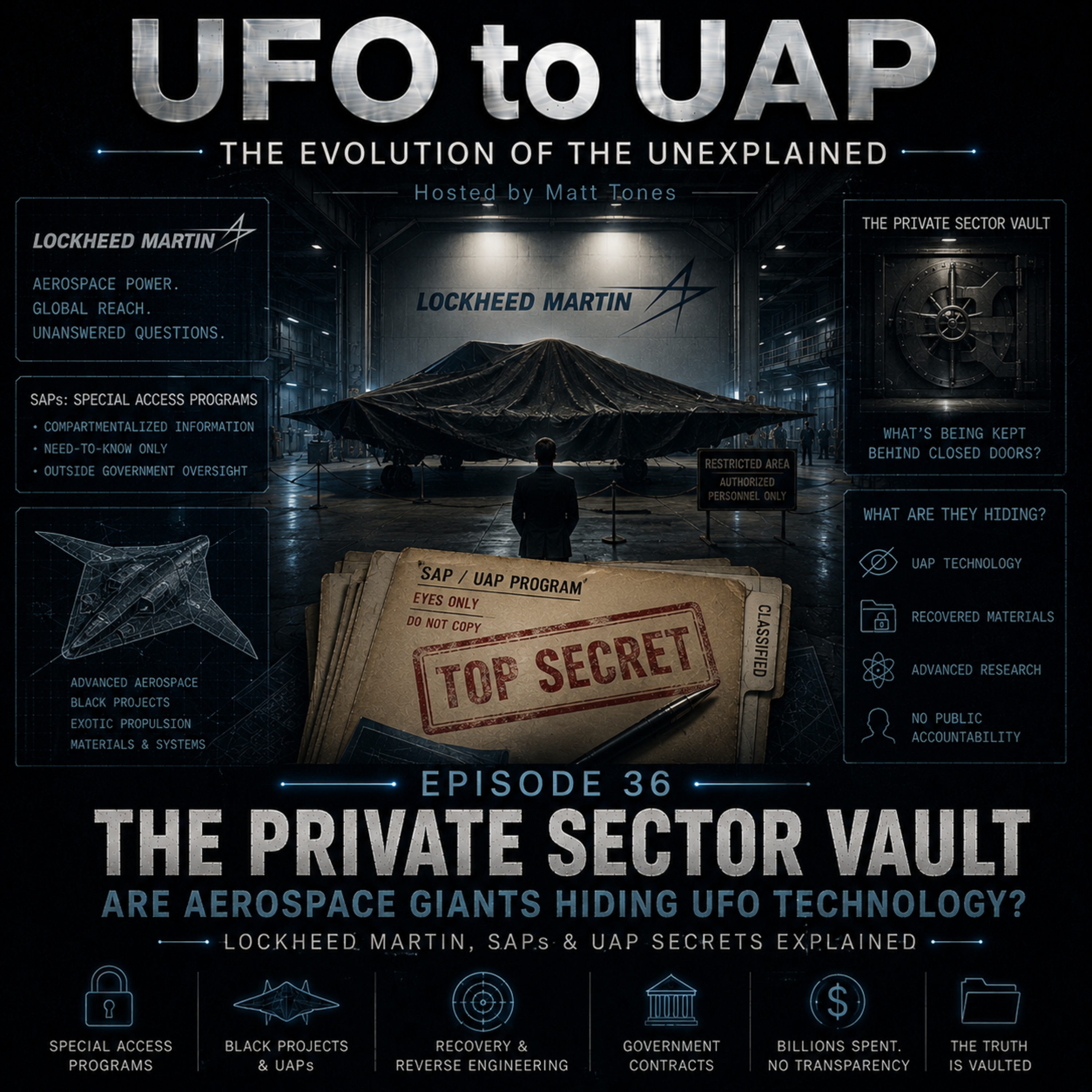
The Private Sector Vault: Are Aerospace Giants Hiding UFO Tech?
Tonight's Episode
Could the deepest UFO and UAP secrets be hidden not inside the Pentagon, but within private aerospace companies protected by classified contracts and special access programs?
In this episode of UFO to UAP Explained, host Matt Tones investigates claims that crash-retrieval materials, reverse-engineering efforts and advanced aerospace technology may have been transferred to private contractors. The episode explores how government secrecy became fragmented after the Cold War, with companies such as Lockheed Martin, Northrop Grumman, Boeing and General Dynamics playing major roles in classified defence development.
The investigation examines special access programs, David Grusch’s whistleblower allegations, the disputed Wilson memo and the limits of Freedom of Information laws when records sit inside corporate systems. It also explores Lockheed Martin’s Skunk Works, the history of secret aircraft, the difficulty of reverse-engineering unknown technology and the eminent-domain language proposed in the UAP Disclosure Act.
Are aerospace giants hiding recovered UFO technology, or has real classified aviation history fuelled a powerful modern myth? The episode separates documented secrecy structures from unverified claims while asking who controls advanced technology—and whether congressional oversight can reach the private-sector vault.
Episode Timestamps
(0:02) Could UFO secrets be hidden in private industry
(1:05) The private-sector vault theory
(2:00) How national-security secrecy became privatised
(3:03) Special access programs and classified contractors
(4:04) Could extraordinary projects evade oversight?
(5:06) David Grusch and crash-retrieval allegations
(6:23) The disputed Wilson memo
(7:58) FOIA and the private-company blind spot
(9:10) Lockheed Martin and Skunk Works mythology
(10:41) Could unknown technology be reverse-engineered?
(12:13) The UAP Disclosure Act and eminent domain
(13:27) Who controls advanced technology?
(14:34) Strategic ambiguity and aerospace deterrence
(15:31) Government, corporations and modern secrecy
(16:08) Where hidden UAP programs might exist
(17:14) Who actually controls the vault?
Sources:
U.S. House Oversight Committee — 2023 UAP hearing testimony;
David Grusch congressional testimony;
AARO Historical Record Report;
UAP Disclosure Act / NDAA records on recovered technologies and contractor oversight;
U.S. Department of Defense SAP and classified program oversight materials;
National Archives UAP records collection;
NASA UAP Independent Study Team Report.
Keywords:
private aerospace UFO technology, aerospace contractors UAP, Lockheed Martin UFO claims, Skunk Works UFO technology, David Grusch allegations, Wilson memo, special access programs, crash retrieval programs, reverse engineering UFOs, UAP Disclosure Act, eminent domain UAP, private contractor secrecy, Pentagon UFO investigation, congressional UAP oversight, classified aerospace programs, military-industrial complex, recovered alien technology, government UFO secrecy, UAP disclosure, unidentified anomalous phenomena, UFO podcast.
For years, people assumed that if UFO secrets existed, they
would be hidden inside the Pentagon, buried somewhere
beneath military bureaucracy, locked inside classified
government vaults, protected by intelligence agencies.
But what if that assumption is wrong?
What if the most important secrets were never stored inside
government facilities at all? What if they were outsourced,
Moved into private industry, hidden behind corporate walls
instead of military bases, protected not by soldiers but by
contracts? Because in the modern disclosure
era, one idea keeps appearing again and again.
From whistleblowers, from congressional discussions, from
special Access programme investigators, from the Wilson
memo, from David Grusch, the claim that the deepest UAP
programmes may not belong to the government anymore, but to
private aerospace contractors. Tonight we investigate one of
the most controversial theories in the entire disclosure
movement, the possibility that advanced technology, crash
retrieval materials and deeply hidden aerospace programmes may
exist inside the private sector itself.
And if that's true, it changes everything, because governments
can be investigated. But corporations?
That's a very different problem. This is the Private Sector
Vault. Welcome back to UFODUAP, the
disclosure report. I am your host Matt Tones, and
today's very interesting topic is titled The Private Sector
Vault. Our Aerospace Giants hiding UFO
technology, Lockheed Martin special access programmes, crash
retrieval claims and the hidden Disclosure Wall.
To understand this theory, you first need to understand how
secrecy evolved after World War 2.
Most people imagine government secrecy as centralised one giant
vault 1 hidden archive. But that's not how modern
national security systems actually work.
Modern secrecy is fragmented, distributed, layered and
increasingly privatised, especially after the Cold War.
Over time, the United States government outsourced enormous
portions of advanced military development to private
contractors companies like Lockheed Martin, Northrop
Grumman, Ravian, Boeing, General Dynamics.
These corporations became deeply integrated into National Defence
infrastructure, not just building equipment but
developing advanced aerospace systems, stealth technology,
surveillance systems, classified weapons and experimental
platforms. And importantly, many of these
projects operated inside special access programmes or SA PS
programmes so compartmentalised that access was restricted even
within government itself. That distinction matters
enormously because once secrecy moves into contractor
environments, visibility changes, oversight changes,
access changes, and public accountability becomes
dramatically weaker. Special access programmes are
real. That's important to establish
immediately. This is not a conspiracy theory.
Special access programmes exist because governments legitimately
require extreme secrecy around military technology,
intelligence capabilities, surveillance systems and
strategic weapons. But over time, special access
programme culture becomes extraordinarily complex.
Programmes were divided into compartments.
Sub compartments waved access systems, deeply restricted
channels. And critically, not all SA PS
operate under the same oversight mechanisms.
Some programmes are so sensitive that only tiny groups know they
exist. Now think about that carefully.
If a highly restricted aerospace programme existed, how visible
would it actually be? Would Congress necessarily know?
Would presidents automatically know?
Would the public ever know the answer?
Not necessarily, and that realisation forms the foundation
of modern disclosure fears, because secrecy systems already
exist that could theoretically conceal extraordinary projects.
That does not prove hidden UFO programmes exist, but it proves
the architecture exists, and that distinction is critical.
Then came David Grusch and suddenly the private contract
issue exploded into public consciousness.
Because Gruch did not simply claim the government has UFO
secrets, his allegations were much more specific.
He suggested crash retrieval programmes exist, reverse
engineering efforts exist, compartmentalised systems exist
and private space, sorry, private aerospace entities, may
possess recovered materials. That last part changed
everything, because now the disclosure debate moved beyond
government secrecy. Now the question became who
actually controls the technology?
And according to modern whistleblower narratives, the
answer may be private industry. That possibility is deeply
unsettling because Democratic oversight becomes much harder
once information moves into corporate environments.
Freedom of Information laws weaken, Congressional access
becomes restricted, classification structures become
more fragmented, and suddenly the line between public
authority and private control starts blurring.
Now this is where the Wilson memo becomes incredibly
important. Because according to the alleged
conversation described in that document, Admiral Thomas Wilson
supposedly traced the hidden programme to a private
contractor, not directly to the Pentagon, not to a public
military office, to a corporate structure.
And according to the memo, he allegedly encountered resistance
from programme managers who refused access even to him.
Again, the memo remains unverified, but the structure
described inside it feels disturbingly plausible to many
researchers. Why?
Because compartmentalization inside contractor systems
already exists. Programmes can be hidden through
restricted access controls, corporate proprietary
protections, classified contractual layers, independent
research and development structures.
And once programmes enter that environment, visibility narrows
dramatically. That's why the Wilson memo still
matters, Not because it proves extraterrestrials, but because
it describes A secrecy model that many believe could
theoretically conceal extraordinary aerospace
programmes. Now here's where things become
extremely important. Most people assume if something
existed, journalists could expose it through Freedom of
Information Acts, the Freedom of Information Act.
But there's a major problem. FOIA is, which is what we refer
to as the Freedom of Information Act, primarily applies to
government agencies and not private corporations.
And that creates a massive legal blind spot.
Imagine for a moment that highly sensitive materials we're
transferred into contractor custody under classified
agreements. Now suddenly records become
harder to access, oversight dramatically weakens,
transparency mechanisms collapse, public accountability
fragments, and even if government funding remains
involved, the information environment changes completely.
That's why many disclosure advocates became obsessed with
the private contractor issue, because they realised the deeper
the secrecy, the more likely the information would exist outside
ordinary public channels. And again, this does not prove
hidden UFO materials exist, but structurally it explains why
proving or disproving the allegations become incredibly
difficult. Now company appeared.
Sorry, no company appears more frequently in UFO mythology than
Lockheed Martin, specifically it's legendary Skunkworks
division. Skunkworks became famous for
developing stealth aircraft, experimental aerospace systems,
highly classified aviation technology, the SR-71 Blackbird,
the F117 Nighthawk. Programmes so advanced that they
appeared almost impossible when first revealed.
And because genuine secrecy surrounded these projects,
speculation naturally expanded. People began asking if stealth
aircraft remained hidden for years, what else could remain
hidden? This is where the mythology
deepened. Over decades.
Stories emerged claiming retrieved materials, reverse
engineering programmes, exotic propulsion research, hidden
aerospace breakthroughs. Again, evidence varies
dramatically. Some claims a week, others
remain unresolved. But culturally, skunk works
became symbolic of the hidden aerospace world itself, the idea
that somewhere inside massive secure hangers, technologies
existed decades ahead of public knowledge.
And once that imagination takes hold, the UFO narrative becomes
extremely difficult to separate from real, classified aerospace
history. Now let's confront one of the
biggest questions directly. If recovered technology existed,
could humans actually reverse engineer it?
That assumption is often taken for granted, but it may be
completely wrong. Imagine giving modern engineers
a smartphone, a microchip or a stealth drone to scientists from
the year 1800. Could they reproduce it?
Probably not. Not because they lacked
intelligence, but because entire scientific frameworks would be
missing. Now scale that concept
dramatically. Further, if truly new, non human
technology existed, the technology gap could be
enormous. That's why some allege
whistleblower narratives claim progress has been limited,
fragmented, slow. Again, these remain allegations,
but the logic itself is interesting because people often
imagine hidden programmes possessing complete
understanding. Reality may be far more messier.
Confused scientists, Partial breakthroughs, Competing
contractors. Decades of failed analysis.
That scenario actually feels more realistic than science
fiction fantasies. Fantasises about fully
operational aircraft. Now this is where things become
politically explosive. Because recent legislative
efforts hinted at the private contractor issued directly,
especially the proposed UAP Disclosure Act.
Buried inside portions of the legislation were references to
recovered technologies, biological evidence, eminent
domain authority, non human intelligence materials.
That language shocked many observers.
Why? Because eminent domain typically
refers to governments reclaiming property.
So, people immediately asked, why would legislation need
eminent domain provisions unless lawmakers believe materials may
already exist inside private custody?
That became one of the biggest disclosure debates in years.
Supporters argued the language suggested lawmakers had heard
credible testimony involving contractor held materials.
Critics argued the wording reflected speculation, not
confirmed evidence, but either way, the conversation had
shifted dramatically. Now Congress itself was
indirectly acknowledging the possibility that private
entities could theoretically possess extraordinary materials.
That alone was historically significant.
And now we arrive at the deepest issue of all.
Control because of advanced technologies existed inside
private contractor system. Who controls them?
Governments, corporations, intelligence structures,
shareholders, special access managers, and perhaps even more
importantly, who decides what the public is allowed to know?
That question extends far beyond UFOs.
It touches democracy, accountability, military
industrial power, technological inequality and the future of
secrecy itself. Because modern civilization
increasingly depends on systems ordinary people cannot see.
Algorithms, surveillance, infrastructure, artificial
intelligence, classified aerospace systems, corporate
state partnerships. The UFO issue becomes
psychologically powerful because it sits at the centre of all
these anxieties simultaneously. But we must also consider
another possibility. What if the contractor mythology
itself serves another purpose? Because historically, ambiguity
can be strategically useful. Imagine adversaries believing
America possesses hidden revolutionary aerospace
technologies. That uncertainty alone creates
geopolitical advantage. So, some analysts argue parts of
the UFO narrative may indirectly function as strategic
deterrence, necessarily through deliberate deception, but
through tolerated ambiguity. And historically, states
absolutely weaponize ambiguity. The reality complicates
everything because now genuine mystery, classified aerospace
history, psychological operations, misinformation, and
public speculation all begin overlapping.
Separating them becomes incredibly difficult.
Maybe the most important realisation is this.
The disclosure era is no longer primarily about are UF OS real?
That question has evolved. Now the deeper question is how
does secrecy function in the modern world?
Because the private contract issue reveals something
profound. Power today is distributed
differently than most people imagined.
Governments do not operate alone.
Corporations do not operate independently.
The two systems increasingly merged together, especially
around advanced technology. And if extraordinary programmes
existed, that hybrid structure is exactly where they would
likely live. Not inside ordinary military
offices, but inside fragmented networks of contracts,
compartments, secure facilities and restricted industrial
environments. That realisation changes how
people think about disclosure entirely.
Tonight, we'll explore one of the most controversial ideas in
modern UFO movement. Not alien bodies, not flying
sources, but the possibility that the deepest secrets of the
phenomenon, if they exist at all, may sit inside private
aerospace vaults beyond ordinary oversight.
And perhaps that's why disclosure feels so difficult.
Because maybe the issue is no longer simply government
secrecy. Maybe the issue is that the
modern secrecy itself has evolved, fragmented,
distributed, corporate, compartmentalised, difficult to
penetrate, difficult to prove, and nearly impossible for the
public to fully see. Whether the claims are
ultimately true or not, one thing is certain.
The disclosure conversation has permanently shifted.
The question is no longer what does the Pentagon know?
The question now is who actually controls the vault?
This is UFO to UAP. There's the disclosure report.
I'm your host, Matt Tones. Thank you for tuning in.
Please subscribe and tell your mom about this episode.
Music. Music.
 Amazon Music
 Apple Podcasts
 Castbox
 Castro
 Goodpods
 iHeartRadio
 Overcast
 Pocket Casts
 Podbean
 Podcast Addict
 Spotify
 YouTube