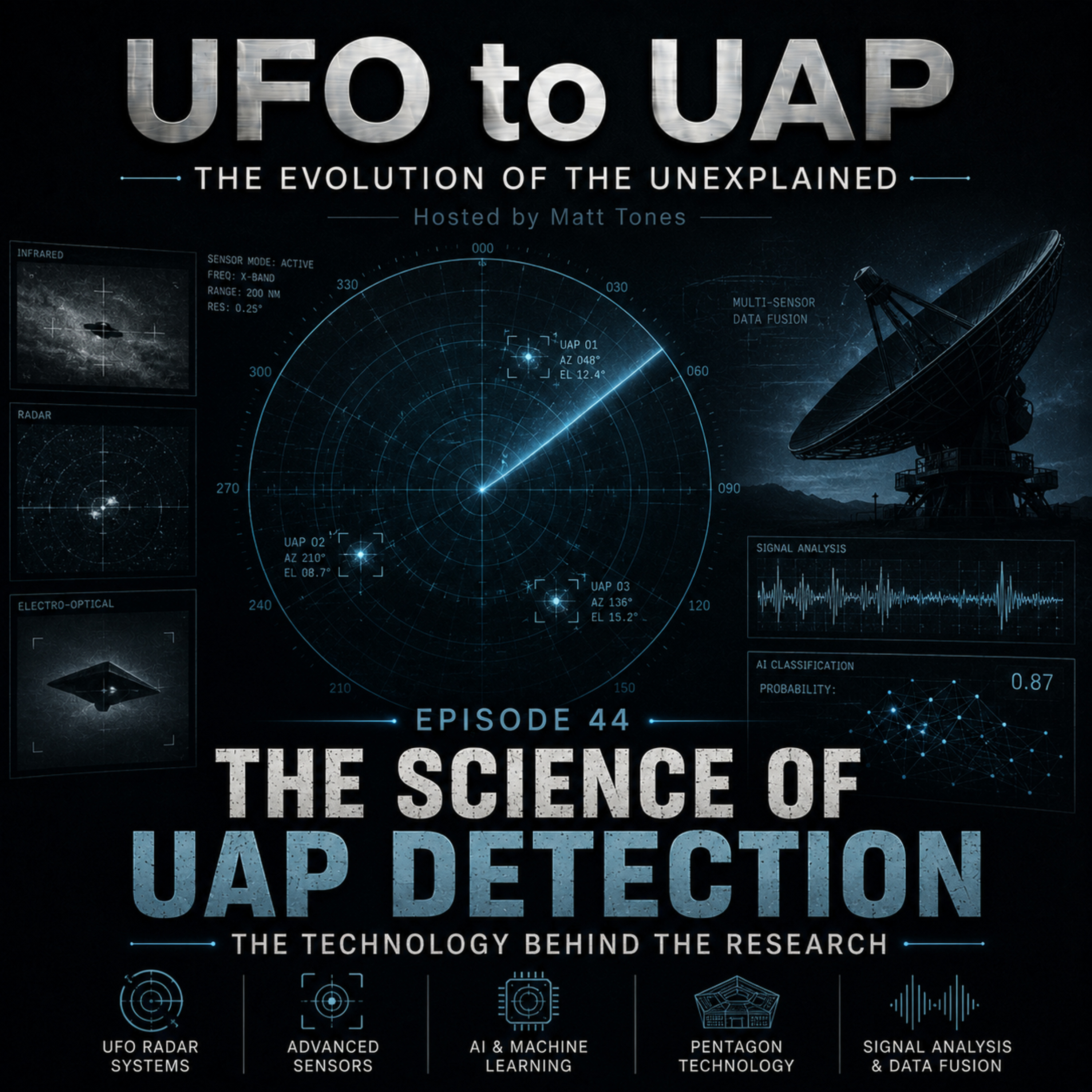
The Science of UAP Detection: Technology Behind the Research | UFO Radar, AI & Pentagon Sensor Systems Explained
Tonight's Episode
How do military radar, infrared cameras, satellites and artificial intelligence detect unidentified anomalous phenomena—and why do some UAP cases remain unexplained?
In this episode of UFO to UAP Explained, host Matt Tones explores the science and technology behind modern UAP detection. Beginning with the 2004 USS Nimitz Tic Tac encounter, the episode examines how radar operators, Navy pilots and advanced targeting systems recorded the same unexplained event through multiple independent sensors.
Discover how military radar tracks altitude, speed and movement; how FLIR infrared systems captured the famous Tic Tac, Gimbal and GoFast footage; and why even sophisticated Pentagon sensor platforms can produce incomplete or misleading data. The episode also explains multi-sensor fusion, satellite surveillance, thermal-signature analysis and the crucial difference between detecting an object and identifying it.
The investigation then turns to artificial intelligence, machine learning and automated anomaly detection. Could AI identify unusual flight patterns hidden within millions of radar returns? Could autonomous sensor networks and projects such as the Galileo Project finally provide the high-quality scientific evidence needed to investigate UAP objectively?
From the All-domain Anomaly Resolution Office, known as AARO, to the limitations of classified military data, this episode reveals how governments and scientists are using advanced technology to confront one of aerospace research’s greatest challenges: identifying what does not fit known patterns.
Episode Timestamps
(0:00) The USS Nimitz Tic Tac encounter begins
(2:43) The technology behind modern UAP investigations
(4:01) The difference between detection and identification
(5:01) How military radar detects and tracks unknown objects
(7:14) Radar evidence from the USS Nimitz incident
(8:56) The shift from eyewitness reports to scientific data
(9:36) Multi-sensor fusion and data-rich UAP cases
(11:31) How infrared technology detects hidden objects
(12:36) FLIR targeting systems and Navy UAP footage
(13:37) Analysing the Gimbal UAP encounter
(15:27) Thermal signatures and unknown propulsion systems
(16:22) Satellite surveillance and classified UAP data
(18:07) Why multiple independent sensors matter
(20:18) Artificial intelligence and anomaly detection
(22:40) The future of automated UAP monitoring
(25:15) The UAP data gap and limits of modern technology
(26:00) Strategic uncertainty and national security risks
(27:08) Why detection is easier than identification
(27:45) Autonomous sensors and the future of UAP research
(28:03) The Galileo Project and scientific evidence collection
(28:33) Science, scepticism and extraordinary explanations
(29:18) What UAP detection teaches us about uncertainty
(30:04) The future of UFO and UAP investigation
Sources:
NASA UAP Independent Study Team Report;
NASA Science UAP overview;
All-domain Anomaly Resolution Office (AARO);
ODNI / U.S. Department of Defense UAP reports;
U.S. Department of Defense reporting on AARO scientific review;
arXiv research on multimodal UAP observatories, radar systems, sensor metadata, AI-assisted detection, and anomaly analysis.
Keywords:
UAP detection, UFO detection technology, UAP radar, UFO radar evidence, Pentagon UAP sensors, military UAP technology, artificial intelligence UAP research, AI anomaly detection, machine learning UAP, USS Nimitz Tic Tac, Tic Tac UFO, Nimitz UAP encounter, Navy UFO videos, FLIR UAP footage, Gimbal UFO video, GoFast UAP video, infrared UFO detection, military radar systems, multi-sensor fusion, satellite UAP surveillance, thermal signature analysis, unidentified anomalous phenomena, unidentified aerial phenomena, AARO, All-domain Anomaly Resolution Office, Pentagon UFO investigation, Galileo Project UAP, scientific UFO research, UAP sensor data, UFO evidence, advanced aerospace technology, UAP national security, Matt Tones, UFO to UAP podcast
 Amazon Music
 Apple Podcasts
 Castbox
 Castro
 Goodpods
 iHeartRadio
 Overcast
 Pocket Casts
 Podbean
 Podcast Addict
 Spotify
 YouTube