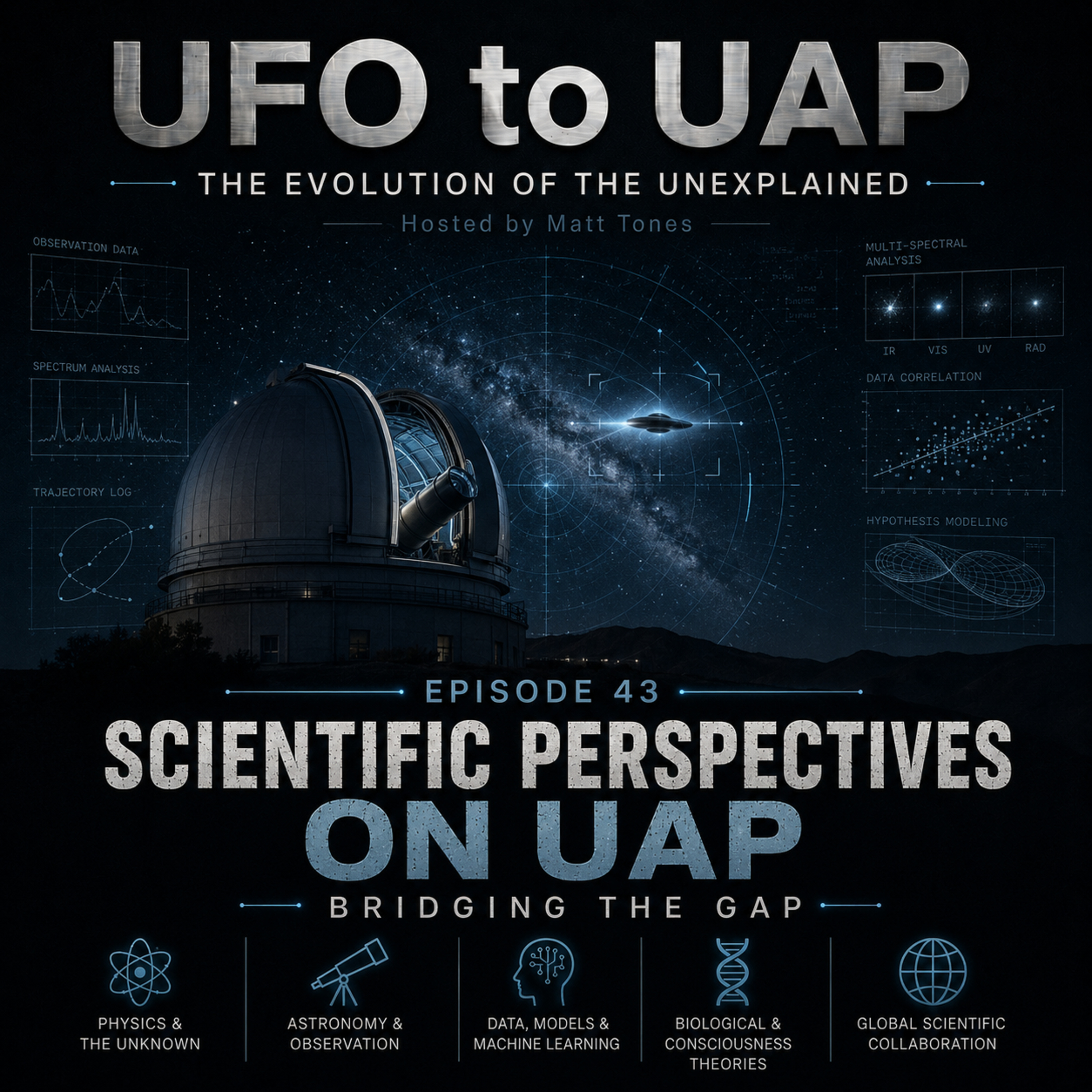
How Science is Revolutionising UAP Research: Data Triumphs Over Stigma
Tonight's Episode
Why did mainstream science avoid UFO and UAP research for decades—and what has finally changed?
In this episode of UFO to UAP Explained, host Matt Tones explores how scientific research, advanced sensor technology and better data collection are transforming the investigation of unidentified anomalous phenomena.
For years, professional stigma, limited funding and reputational risk prevented many scientists and academic institutions from seriously studying UFO reports. At the same time, eyewitness testimony often lacked the repeatable, measurable and independently verifiable evidence required by the scientific method. The result was an information vacuum frequently filled by speculation and conspiracy theories.
That landscape is now changing. Modern military systems can record unexplained aerial encounters using radar, infrared tracking, electro-optical cameras, satellite systems and multi-sensor platforms. Public discussion surrounding the Tic Tac encounter, Pentagon-authenticated UAP videos, NASA’s independent UAP study and investigations by the All-domain Anomaly Resolution Office, known as AARO, has helped move the subject closer to legitimate scientific inquiry.
The episode also examines civilian research initiatives such as the Galileo Project, founded by Harvard astrophysicist Avi Loeb, which uses calibrated sensors, multispectral imaging, radar integration, machine learning and artificial intelligence to collect higher-quality UAP data.
From human perception and sensor errors to classified military evidence and national security concerns, discover why many UAP cases remain unresolved—and how AI-powered monitoring, global sensor networks and rigorous scientific research could finally replace stigma and speculation with evidence.
Website: https://ufotouap.com
Episode Timestamps
(0:00) NASA, AARO and the rise of scientific UAP research
(0:32) How stigma kept UFOs outside mainstream science
(1:23) Why the modern UAP shift is scientific, not political
(2:17) The professional risks of researching UFO phenomena
(3:22) Why eyewitness testimony rarely meets scientific standards
(4:21) Military radar and infrared sensors change the debate
(5:19) The 2017 disclosure era and the Tic Tac encounter
(6:03) NASA enters the scientific UAP investigation
(6:54) The UAP data problem and fragmented evidence
(7:43) The Galileo Project and civilian sensor research
(8:41) Human perception, optical effects and misidentification
(9:44) Classified military data and the scientific access problem
(10:33) Strategic uncertainty in controlled airspace
(11:28) AI, machine learning and future UAP detection systems
(12:16) How science is finally overcoming the UFO stigma
(12:40) Why the UAP mystery remains unresolved
Sources:
NASA UAP Independent Study Team Report;
NASA Science UAP overview;
All-domain Anomaly Resolution Office (AARO);
U.S. Department of Defense / ODNI UAP reports;
Associated Press reporting on NASA’s call for more science and less stigma;
arXiv research on scientific UAP investigation, multimodal observatories, sensor metadata, anomaly detection, and data curation.
Keywords:
UAP research, scientific UAP research, UFO science, science of UFOs, unidentified anomalous phenomena, UFO stigma, UAP stigma, NASA UAP study, AARO UAP investigation, All-domain Anomaly Resolution Office, Galileo Project, Avi Loeb, scientific UFO evidence, UAP sensor data, military UAP encounters, Tic Tac UAP, Pentagon UFO videos, UAP radar evidence, infrared UAP tracking, multispectral imaging, artificial intelligence UAP research, machine learning UAP detection, civilian UAP research, UFO eyewitness testimony, UAP data collection, classified UAP evidence, aerospace anomalies, scientific method UFO investigation, UAP national security, UFO disclosure, UAP disclosure, Matt Tones, UFO to UAP podcast
December 2023 Washington NASA scientists released findings
from an independent UAP study at the Pentagon.
Arrow continues investigating military encounters involving
unidentified aerial phenomenon. Meanwhile, civilian researchers
launched new sensor systems aimed at tracking anomalies in
the skies using machine learning, Multi spectral
imaging, radar integration, and artificial intelligence.
Something remarkable is happening.
For decades, the UFO subject existed largely outside
mainstream scientific legitimacy.
Researchers avoided it, academic institutions distance themselves
from it, funding was scarce, careers could be damaged, and
the stigma surrounding unidentified aerial phenomena
created a powerful institutional barrier.
But now that barrier is beginning to weaken.
But because science suddenly confirmed extraterrestrial
visitation, it is. Not.
But because modern governments, military systems and scientific
organisations increasingly acknowledge something important,
there are aerial incidents occurring that deserve
structured analysis. And perhaps the most important
shift in the modern disclosure era is not political, it is
scientific. Tonight we investigate why
mainstream science historically avoided UAP research, how
military sensor technology changed the conversation, why
stigma became a major institutional obstacle, NASA's
recent involvement, the role of Arrow, the emergence of civilian
scientific initiatives like the Galielo So, the Galileo Project,
the challenge of incomplete data sets, and why modern science may
finally be entering the UAP conversation.
Seriously. Because this episode is not
about proving extraterrestrials, it's about understanding how
science responds when confronted with unresolved aerospace
anomalies. This is UFO to UAP the
disclosure report. I'm your host, Matt Tones, and
tonight we examine the scientific frontier of the
unknown. For decades, serious scientific
investigation of UFOs remained extremely limited.
And contrary to popular belief, the biggest obstacle was not
necessarily government sequence. It was stigma.
Academic institutions operate through peer review, funding
structures, professional credibility, publication
standards, and reputational risk.
The UFO topic threatened all of those things.
Researchers feared career damage, ridicule, association
with conspiracy culture, and loss of institutional
legitimacy. As a result, many scientists
simply avoided the subject entirely, even when military
silent sightings continued occurring quietly in the
background. This created a paradox.
The public remained fascinated by UFOs, but mainstream science
largely refused to engage directly.
And when science avoids A controversial subject, the
informational vacuum often becomes filled with speculation
instead. Another major challenge involved
evidence itself. Science depends on
repeatability, measurable data, controlled observation and
independently verifiable evidence.
Most UFO reports historically failed to meet those standards.
Eyewitness testimony alone is difficult to analyse
scientifically, and perception is imperfect.
Memory reconstruction occurs. Environmental conditions distort
interpretation. Optical illusions happen.
Psychological expectations influence observation.
This does not mean witnesses are dishonest.
Far from it. Manage so many military pilots
and observers appear entirely sincere, but sincerely alone
does not automatically create scientific certainty, And that
distinction is critical because is one of the greatest tensions
in UAP research is the gap between credible witnesses and
incomplete data sets. Then the technological landscape
changed. Modern military systems began
integrating advanced radar, infrared tracking, Electro
optical targeting systems, multi sensor fusion platforms,
satellite analysis and AI assisted detection systems.
Now, for the first time, anomalous aerial and counters
was sometimes being observed across multiple systems
simultaneously. That changed everything, because
the modern UAP conversation increasingly shifted away from
stories alone towards sensor data.
And from a scientific perspective, that transition
mattered enormously. The question was no longer
simply did someone see something unusual?
The question became, why are advanced military systems
repeatedly tracking objects that remain difficult to identify in
real time? That is a fundamentally
different problem. The disclosure era accelerated
dramatically after 2017. The public learned about a tip
Navy encounters, the Tic Tac incident, and military videos
later authenticated by the Pentagon.
Again, this did not confirm extraterrestrials, but it did
something equally significant. It normalised institutional
discussion. The government openly
acknowledged military personnel were encountering aerial
phenomena that warranted investigation.
And once the Pentagon publicly entered the conversation,
scientific institutions could no longer dismiss the issue quite
as easily. The stigma barrier began
weakening, slowly but unmistakably.
Then came another historic shift NASA.
For decades, many critics argued mainstream science ignored UAP
entirely. But in 2022 and 2023, NASA
established an independent study team examining unidentified
anomalous phenomena. From a scientific perspective.
This was enormously important symbolically because as NASA
approached the subject cautiously, methodically,
without sensationalism, researchers repeatedly
emphasised there was currently no evidence confirming
extraterrestrial origins. But they also stressed better
data collection was urgently needed, and perhaps that became
the most important scientific conclusion of all.
The problem was not necessarily lack of curiosity, the problem
was a lack of high quality data. This remains a central
scientific challenge. Data fragmentation.
Most UAP incidents occur unexpectedly, sensor coverage
varies, military systems remain classified, civilian recording
quality is inconsistent, and many encounters lack complete
data sets. Scientists repeatedly face the
same problem, insufficient information.
This is where public misunderstanding often emerged.
People frequently ask, why didn't science just solve the
mystery? But science cannot function
effectively without reliable data environments, and UAP
incidents rarely provide perfect observational conditions.
That does not invalidate every report, but it explains why
definitive scientific conclusions remain difficult.
Now a new generation of civilian scientific initiatives is
emerging, perhaps most notably the Galileo Project, founded by
Harvard astrophysicist Heavy Loeb.
Loeb, sorry about the pronunciation.
The project aims to study the anomalous aerial phenomena using
dedicated sensor systems designed specifically for
scientific analysis. This is a major shift.
Historically, scientists largely depended on military leagues,
witness testimony, or accidental recordings.
Now some researchers are building systems specifically
designed to collect calibrated data.
Multi spectral imagery, radar integration, and machine
learning assisted anomalous analysis.
Whether these projects ultimately discover anything
extraordinary remains unknown, but institutionally their
existence represent a major transformation science is
beginning to engage directly. Another critical scientific
dimension involves human perception itself.
Because not every UAP report necessarily represents exotic
technology. Some incidents may involved
atmospheric effects, optical distortions, misidentified
craft, sensor artefacts, or cognitive interpretation errors.
The human brain constantly attempts to construct coherent
narratives from incomplete information, especially during
unambiguous situations. That is why psychological plays
such as such an important role in UAP analysis.
Not to dismiss witnesses, but to understand how perception
functions under uncertainty. And importantly, modern
scientific investigation increasingly recognises multiple
explanations may coexist simultaneously.
Some cases may receive conventional explanations,
others may remain unresolved due to insufficient data, and a
smaller number may continue resisting immediate
interpretation entirely. One of the biggest complications
in UAP science is classification.
Many of the best sensor systems belong to the the military,
which creates a paradox. The highest quality data may
remain inaccessible to civilian researchers.
Governments cannot always release radar capabilities,
sensor architecture, tracking systems or operational
procedures publicly because doing so could expose defence
vulnerabilities. As a result, scientific analysis
often collides directly with national security restrictions,
and this tension creates enormous frustration.
Researchers want better access. Military institutions prioritise
operational secrecy. Both positions are
understandable, but if the result is fragmented scientific
visibility, ultimately modern institutions may be confronting
something deeper than UFO mythology.
There may be confronting unresolved uncertainty itself.
Military systems are designed around identification.
Science is designed around measurable analysis.
Yet UAP incidents frequently emerge inside incomplete
informational environments. And that creates what analysts
increasingly describe as strategic uncertainty.
Not necessarily evidence of extraterrestrials, but
unresolved aerospace ambiguity, like operating, I should say,
inside critical defence environments.
That alone is operationally significant, and perhaps this
explains why governments increasingly treat Uaps as as an
intelligence issue, a sensor issue, a scientific issue, and a
national security issue simultaneously.
Now the landscape is evolving rapidly.
Artificial intelligence, Machine learning, anomalous sensor
grids, Global aerospace monitoring systems, Civilian
satellite networks. The future of UAP investigation
may look radically different from the past.
Instead of I, Instead of isolated eyewitness accounts,
future investigations may rely on continuous multi sensor
analysis, AI anomaly detection, real time atmospheric modelling,
and global data sharing infrastructure.
This could dramatically improve scientific visibility, or it
could reveal that many incidents have conventional explanations.
At this stage, both possibilities remain open and
serious science requires maintaining that balance.
Care. For decades, the UFO subject
existed in a strange territory between public fascination and
institutional avoidance. Now, that boundary is changing.
Governments investigate openly, scientists cautiously engage,
military systems collect expanding data sets, and the
stigma that once suppressed serious discussion is slowly
weakening. This does not mean the mystery
is solved. Far from it.
The evidence remains incomplete. The data remains fragmented and
many claims remain disputed. But perhaps the most important
transformation is this The scientific community is
beginning to acknowledge that unresolved aerial anomalies
deserve structured analysis rather than automatic dismissal.
That shift alone is historic because regardless of where the
evidence ultimately leads, the future UAP investigation will
likely depend not on speculation, but on rigorous
scientific inquiry operating operating inside increasingly
sophisticated technological systems.
And perhaps that is how humanity finally begins bridging the gap
between mystery and understanding.
This has been UFO to UAP, the disclosure report.
I'm your host, Matt Tones. Thank you for tuning in.
Please share the episode, make sure you've subscribed and go
tell your mum about today's episode.
 Amazon Music
 Apple Podcasts
 Castbox
 Castro
 Goodpods
 iHeartRadio
 Overcast
 Pocket Casts
 Podbean
 Podcast Addict
 Spotify
 YouTube