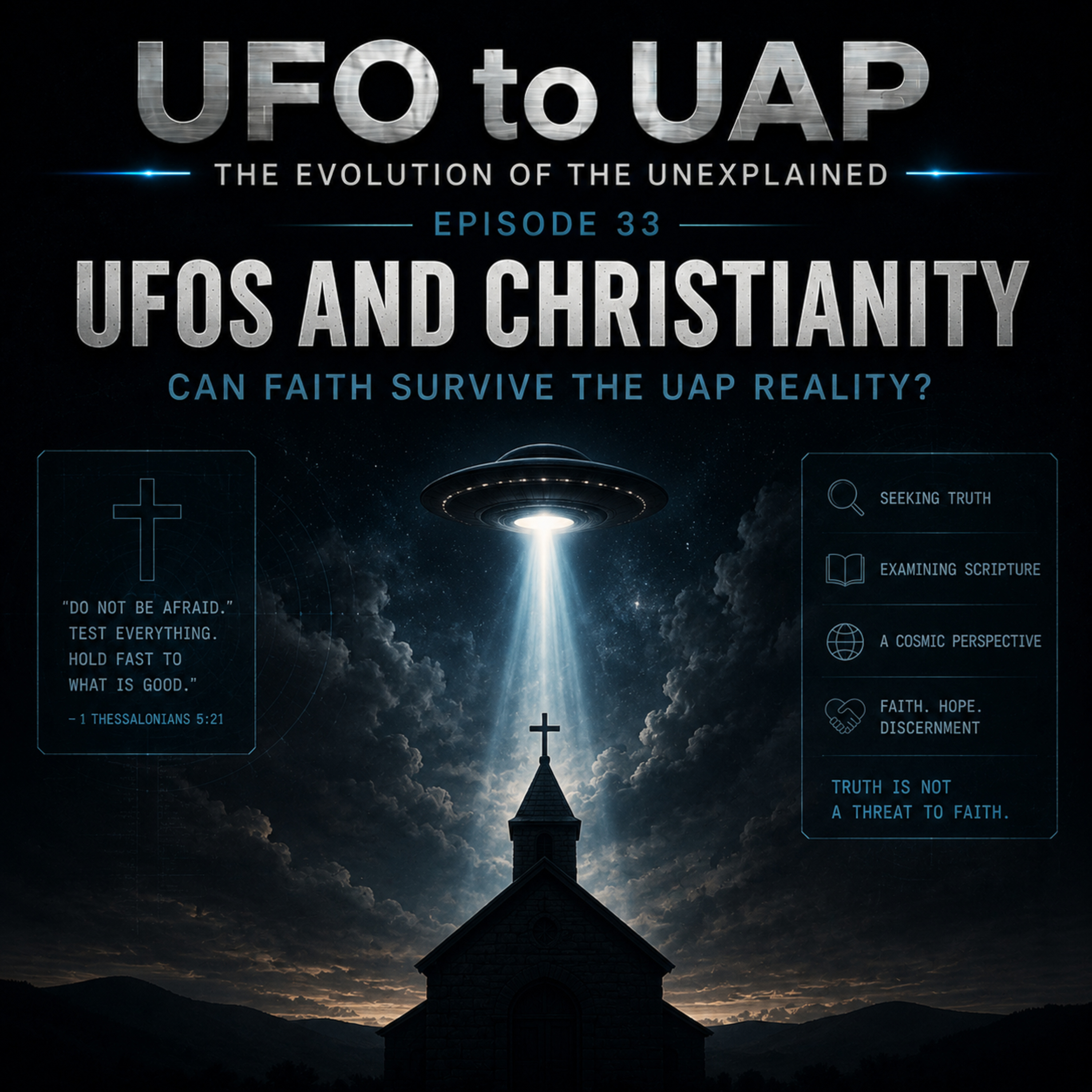
UFOs, UAPs, and Religion: Exploring Spiritual Impact
Tonight's Episode
What would UFO or UAP disclosure mean for Christianity, the Bible and humanity’s place in creation?
In this episode of UFO to UAP Explained, host Matt Tones explores the spiritual and theological impact of possible non-human intelligence. Could extraterrestrial life undermine Christian faith, challenge biblical interpretation or expand our understanding of God’s creation?
The episode examines how Christianity survived earlier scientific revolutions involving astronomy, evolution and the vast scale of the universe. It also considers biblical accounts of radiant beings, wheels within wheels, pillars of fire and visions in the sky—while separating thoughtful interpretation from claims that ancient scripture proves extraterrestrial visitation.
Are UFOs physical craft, spiritual entities, angels, demons, interdimensional beings or something else entirely? With no definitive answer, the discussion explores religious fear, spiritual deception, UFO cults, altered consciousness and the strange overlap between technology, psychology and spirituality.
Rather than forcing a choice between faith and investigation, this episode asks whether UAP disclosure could deepen humanity’s sense of humility, mystery and creation.
Episode Timestamps
(0:00) What happens if humanity is not alone?
(0:45) Could UAP disclosure challenge Christianity?
(1:30) Faith, Genesis, salvation and non-human intelligence
(2:15) Why disclosure can feel spiritually destabilising
(3:00) How Christianity survived scientific revolutions
(4:30) Strange beings and visions in the Bible
(5:15) Ezekiel’s wheels and ancient UFO interpretations
(6:00) Spiritual deception, UFO cults and blind belief
(6:45) Are UFOs demonic?
(7:30) Why the phenomenon remains unresolved
(8:15) Would extraterrestrial life disprove God?
(9:00) Missing time, telepathy and altered consciousness
(9:45) Technology, psychology and spirituality overlap
(10:30) Faith and UAP investigation are not opposites
(11:15) Mystery, humility and the future of belief
Sources:
Pew Research Center surveys on religion, science, UFOs, and belief in extraterrestrial life;
NASA UAP Independent Study Team Report;
NASA Science UAP overview;
AARO Historical Record Report;
U.S. Department of Defense UAP reporting; academic research on astrobiology, theology, religion, and the cultural impact of extraterrestrial life.
Keywords:
UFOs and Christianity, UAPs and religion, extraterrestrial life and the Bible, non-human intelligence, Christian UFO beliefs, UFO spiritual meaning, UAP disclosure and faith, Ezekiel’s wheels, ancient UFO theory, angels and aliens, demons and UFOs, interdimensional beings, spiritual deception, UFO cults, altered consciousness, theology and extraterrestrial life, biblical UFO interpretation, religion and disclosure, unidentified anomalous phenomena, UFO to UAP Explained.
For decades, the UFO subject lived in the shadows, dismissed,
mocked, buried beneath conspiracy theories and science
fiction. But now the world has changed.
Military pilots are speaking publicly.
Radar operators are describing impossible objects.
Government agencies are admitting something unexplained
is operating in our skies, and suddenly millions of people are
asking a question humanity has never seriously confronted
before. What happens if we are not
alone? For some people that question is
exciting, for others it's terrifying.
But for many Christians it creates A deeper fear.
Because if non human intelligence exists, what does
that mean for the Bible, For creation?
For God? Would disclosure destroy
Christianity? Or could faith survive a reality
far stranger than humanity expected?
Tonight we investigate one of the most controversial subjects
in the entire UAP conversation. Not whether UFOs are real, not
whether governments are hiding information, but whether
Christianity itself can survive the possibility that humanity
may not be alone. This is UFO to UAP the
disclosure report. I'm your host, Matt Tones, Thank
you for tuning in. Today's episode is called UFOs
and Christianity. Can Faith survive the UAP
reality? Please subscribe and share the
episode. For many Christians, the UFO
topic immediately triggers discomfort.
Not curiosity, not investigation.
Fear. Because the implications feel
enormous. If intelligent non human beings
exist, people immediately begin asking, was humanity special?
What about salvation? What about angels?
What about demons? What about Genesis?
And beneath all of those questions is 1 deeper fear.
What if the modern UFO reality destroys biblical belief
entirely? That fear is more common than
many people realise because religion has historically
provided humanity with the framework for understanding
existence itself. Who are we?
Why are we here? What created us?
What exists beyond death? For centuries, faith answered
those questions. But now modern disclosure is
introducing something new into the equation, the possibility
that reality itself may be far more complicated than humanity
assumed. And for many believers, that
feels destabilising. But here's what's important.
Christianity has survived world changing revelations before.
Again and again and again. There was a time when humanity
believed Earth sat at the centre of the universe.
Then astronomy shattered that belief.
The Earth wasn't the centre, the sun was, and suddenly people
feared religion would collapse. It didn't.
Then came evolution. Again.
People declared Christianity was finished.
It survived. Then science revealed something
even more staggering. The universe wasn't small.
It was unimaginably vast. Billions of galaxies, countless
stars, possibly endless worlds. And still faith endured.
Why? Because Christianity adapted not
by abandoning belief, but by recognising that expanding
knowledge does not automatically eliminate God.
And that matters enormously in the UFO conversation because
many people assume if extraterrestrial intelligence
exists, Christianity fails. But historically, faith has
repeatedly survived humanity discovering the creation is
larger than expected. In many ways, that pattern is
already happening again. Modern audiences often forget
how strange the Bible actually is because growing up in
religion, people normalise stories that are objectively
extraordinary. But step back for a moment and
look carefully. Throughout Scripture, we find
accounts of beings descending from the heavens, pillars of
fire, radiant clouds, visions in the sky, voices from above,
objects moving with impossible motion, and encounters beyond
ordinary human understanding. One of the most discussed
examples is Ezekiel, a prophet describing wheels within wheels,
flashing light, metallic brilliance, and movement unlike
anything familiar to human experience.
For decades, some researchers have attempted to reinterpret
these accounts as ancient UFO encounters.
Now, to be clear, that does not prove extraterrestrials visited
ancient civilizations, but it does reveal something important.
Human beings have always struggled to describe
experiences beyond their understanding.
Ancient people interpreted extraordinary events through
spiritual language. Modern civilization interprets
extraordinary events through technological language.
And maybe both groups are trying to explain something
fundamentally mysterious. That possibility changes the
conversation completely. One reason many churches reject
the UFO topic entirely is because they fear spiritual
deception. And honestly, some of those
concerns are understandable. Parts of UFO culture absolutely
drift into dangerous territory. Cult behaviour.
False prophecy, Messianic claims, apocalyptic obsession,
manipulation. Blind belief.
Those risks are real. But here's the problem.
Fear is not investigation. And historically, Christianity
was never meant to avoid difficult questions.
In fact, many of the great theological thinkers in history
confronted uncertainly, directly because truth does not fear
examination. Avoiding reality does not
protect faith, it protects comfort.
And that distinction matters because modern disclosure is
forcing humanity into uncomfortable territory, not
just scientifically, but spiritually.
This is one of the most emotionally charged questions in
the entire Christian UFO debate. Some believers are convinced
that the phenomenon is demonic, that UF OS a spiritual deception
designed to mislead humanity. Others reject that completely.
The problem is, nobody actually knows.
And intellectual honesty matters here because despite decades of
speculation, there is still no definitive evidence proving UFOs
are extraterrestrial, or that UFOs are angels, or UFOs are
demons, or even that UFOs are interdimensional beings.
The phenomenon remains unresolved, and uncertainty
creates discomfort. Humans crave certainty,
especially during periods of social instability.
But reality does not always provide immediate answers.
And maybe that's one of the most important lessons in this entire
discussion. Sometimes mystery remains
mystery. Now we arrive at the deeper
question. If intelligent non human life
exists, would that actually disprove God or would it simply
expand humanity's understanding of creation?
Now think carefully about that. The universe already contains
billions of galaxies, trillions of stars world's humanity will
never reach, and realities we barely comprehend.
Would additional intelligence truly diminish divinity, or
would it make existence even more extraordinary?
For many theologians, the existence of other intelligent
beings would not destroy Christianity at all.
It would simply mean humanity is not the entirety of creation.
And honestly, that possibility may fit Scripture more
comfortably than people realise. Because the Bible repeatedly
reminds humanity of one thing, human understanding is limited.
That has always been part of the spiritual worldview.
One reason the UFO subject creates so much confusion is
because the phenomenon refused to behave like normal
technology. Witnesses frequently describe
experiences involving missing time, altered consciousness,
telepathic impressions, overwhelming emotional
reactions, and profound psychological transformation
that creates a strange overlap between technology, psychology
and spirituality. And this is exactly why the
phenomenon remains so difficult to categorise, because it
doesn't behave like ordinary aerospace engineering, which
means both scientists and theologians are entering unknown
territory together. And maybe that's why this
conversation feels so destabilising, because modern
civilization prefers categories, science, religion, technology,
spirituality. But the UAP phenomenon
repeatedly blows those boundaries.
Maybe the biggest mistake in this entire discussion is
assuming Christians must choose between faith and investigation,
because those things are not opposites.
The existence of unexplained phenomenon does not
automatically eliminate God, and faith does not erase mystery.
If anything, the UAP conversation may be forcing
humanity to rediscover, to rediscover something.
Ancient civilizations already understood that reality is
stranger than we want it to be. And maybe humility, not
certainty, is the correct response.
For thousands of years, human beings have looked into the sky,
searching for meaning. Ancient prophets describe
luminous visions, civilizations recorded signs in the heavens.
Many governments now admit unidentified phenomena continue
to exist. But perhaps the most important
realisation is this acknowledging mystery is not the
same as abandoning faith. The existence of unexplained
phenomena may not destroy Christianity at all.
It may simply remind humanity that creation itself is far
larger, far deeper, and far more mysterious than we ever
imagined. This has been UFO to UAP the
disclosure report. I'm your host, Matt Tones.
Thank you for listening in. Please subscribe and share the
episode. Music.
 Amazon Music
 Apple Podcasts
 Castbox
 Castro
 Goodpods
 iHeartRadio
 Overcast
 Pocket Casts
 Podbean
 Podcast Addict
 Spotify
 YouTube