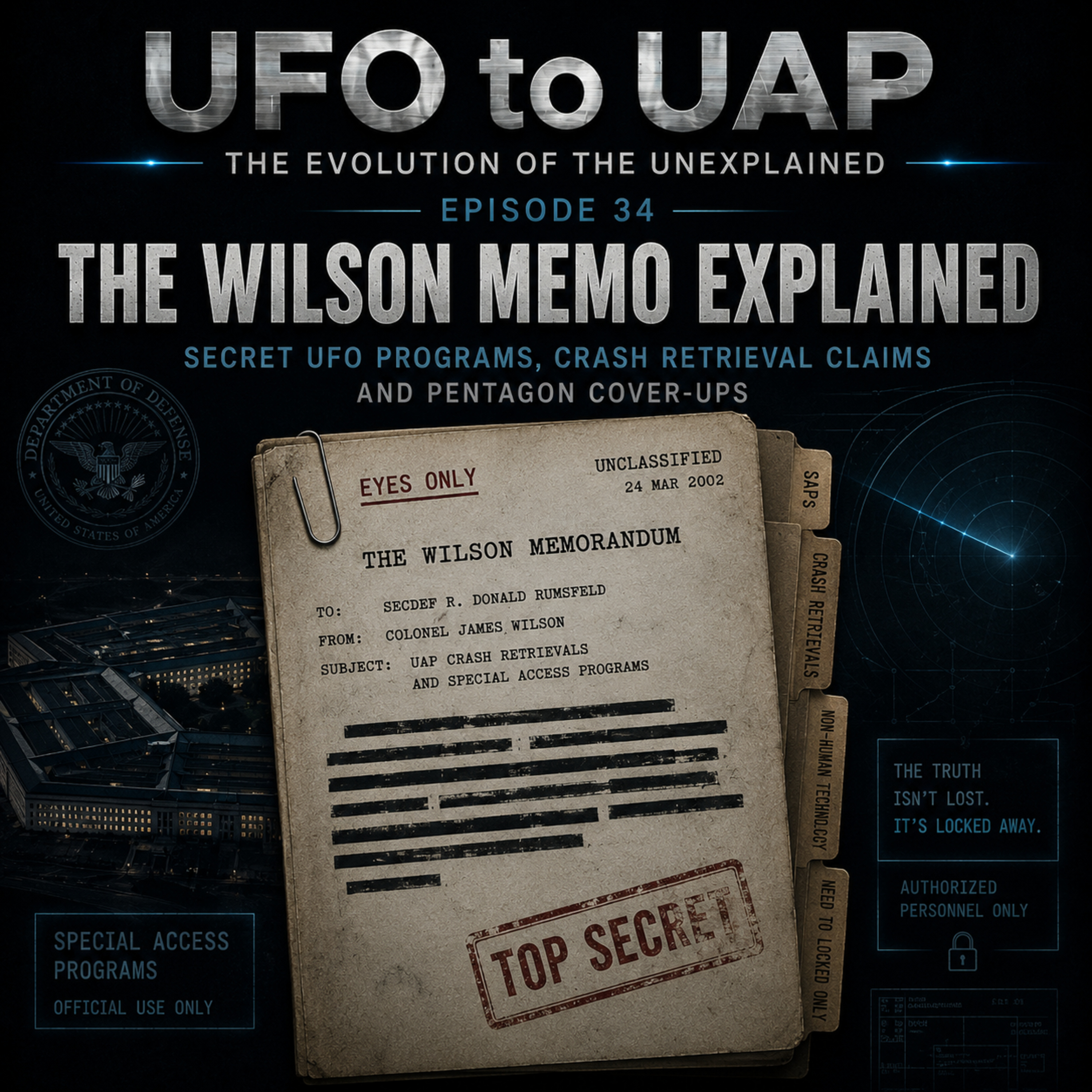
UAP Investigation: The Wilson Memo, Secret UFO Programs and Pentagon Intrigue
Tonight's Episode
What does the controversial Wilson Memo actually allege—and could a deeply compartmentalised UFO program exist beyond normal Pentagon oversight?
In this episode of UFO to UAP Explained, host Matt Tones investigates the document said to record a 2002 conversation between astrophysicist Eric Davis and former Defence Intelligence Agency director Admiral Thomas Wilson. According to the memo, Wilson discovered a hidden special access program connected to recovered technology, traced it to a private aerospace contractor and was denied access despite his senior position.
The episode examines how classified compartments, “need to know” rules, defence contractors and restricted oversight could conceal sensitive aerospace research. It also explores alleged crash-retrieval and reverse-engineering claims, links to David Grusch’s later testimony, and why the memo remains central to modern UAP disclosure.
Is the Wilson Memo authentic, partly true, disinformation or an elaborate myth built around real secrecy structures? With no definitive authentication, weak provenance and public denials, the document remains unproven. Yet its description of private contractors, legacy programs and officials blocked from access continues to shape debate about who controls hidden UAP information.
Episode Timestamps
(0:01) The Wilson Memo mystery begins
(1:43) Links to modern UAP whistleblowers
(3:03) What is verified and what remains alleged
(4:01) Admiral Thomas Wilson and the DIA
(4:58) Special access programs explained
(6:10) Need-to-know secrecy and compartmentalisation
(7:12) How the memo surfaced
(7:50) Eric Davis and the alleged 2002 meeting
(8:13) The private aerospace contractor claim
(9:17) Connections to David Grusch(
10:09) Crash retrieval and reverse engineering
(12:20) Wilson is allegedly denied access
(13:37) Defence contractors and hidden oversight
(15:18) Plausibility is not proof
(16:40) Why the memo matters even to sceptics
(18:30) Authentication problems and weak provenance
(20:23) Could hidden programs resist exposure?
(21:40) Why the memo remains unresolved
(22:57) Eric Davis, Wilson’s denial and ambiguity
(24:33) Why uncertainty keeps the story alive
(26:54) Could the memo be disinformation?
(28:44) Technology beyond human understanding
(30:19) Final verdict on the Wilson Memo
Sources:
Wilson-Davis memo / notes entered into the Congressional Record;
U.S. House Oversight Committee — 2023 UAP hearing and David Grusch testimony;
AARO Historical Record Report;
U.S. Department of Defense statements on alleged hidden UAP programs;
UAP Disclosure Act / NDAA records on recovered technologies, SAPs, and contractor oversight;
NASA UAP Independent Study Team Report.
Keywords:
Wilson Memo, Admiral Thomas Wilson, Eric Davis, secret UFO programs, Pentagon UFO investigation, special access programs, crash retrieval programs, reverse engineering UFO technology, private aerospace contractors, David Grusch, legacy UAP programs, UFO disinformation, government UFO secrecy, classified aerospace programs, UAP whistleblowers, Pentagon intrigue, defence contractor secrecy, unidentified anomalous phenomena, UAP disclosure, UFO to UAP Explained.
Tonight, we're talking about one of the most controversial
documents in modern UFO disclosure.
Not a blurry video. Not a leaked photograph.
Not an anonymous Internet rumour.
A memo. A document that allegedly
records a conversation between a senior Pentagon official, a
respected government scientist, and claims involving A deeply
hidden UFO programme buried inside the American defence
system. This is the story of the Wilson
Memo. A document that, if genuine,
suggests something extraordinary.
That sometime in the late 1990s, a high ranking Pentagon insider
may have discovered evidence of a deeply compartmentalised
programme involving recovered technology and then found
himself denied access. Denied not because the programme
didn't exist, but because he supposedly lacked the
authorization to know about it. Think about that for a moment.
An Admiral, a former director of the Defence Intelligence Agency,
a man connected to some of the highest levels of military
intelligence in the United States government allegedly told
You don't have the need to know. That idea sits at the centre of
the Wilson memo mystery, and for years the document was
dismissed, ignored, mocked, treated as fringe speculation.
Until something changed. Names connected to the memo kept
reappearing around modern disclosure.
David Grusch, Eric Davis. Special access programmes, Crash
retrieval allegations, Compartmentalised secrecy.
Suddenly people started asking whether the Wilson memo wasn't
just another UFO rumour, but perhaps an early glimpse into
the exact hidden system whistleblowers are talking about
today. Tonight, we break down who
Admiral Thomas Wilson was, how the memo surfaced, what it
allegedly says, why the claims matter, and why this document
continues to haunt the disclosure conversation decades
later. Because whether the memo is
true, partially true or completely false, it reveals
something very important. The structure of secrecy people
believe exists around the UFO phenomenon and maybe even more
importantly, how power really works inside the national
security world. This is UFO to UAP the
disclosure report. I am your host Matt Tones and
today's episode is titled The Wilson Memo.
Did a Pentagon Admiral discover a secret UFO programme?
Please subscribe and share the episode.
Before we go further, we need to understand something important.
The Wilson Memo is not an unofficial Pentagon release.
It has never been authenticated publicly by the United States
government. There is no official statement
confirming the events described inside.
It occurred exactly as written. That matters.
And throughout this episode, we're going to separate claims,
allegations, evidence, and speculation, because that
distinction matters now more than ever.
But here's why the Wilson Memo became impossible to ignore.
The people connected to it are real.
Not random Internet personalities, not anonymous
message board users. Real officials.
Real scientists, real intelligence figures.
And that changes the conversation entirely.
The central figure in this story is Admiral Thomas Wilson, Korean
military officer, former director of the Defence
Intelligence Agency. A man deeply embedded within the
American intelligence and defence structure, Wilson held
positions involving military intelligence, strategic
operations, classified programmes and national security
oversight. This was not a marginal figure.
This was someone operating near the core of the Pentagon system.
According to the story surrounding the memo, Wilson
became interested in UFO related programmes after briefings
connected to military and then intelligence discussions during
the 1990s. At that time, interest in
unidentified aerial phenomena was beginning to circulate
quietly among certain defence and intelligence circles.
Not publicly, not politically. Internally, especially after
repeated military encounters involving unusual radar tracks,
aerospace anomalies and classified reporting channels.
According to the allegations, Wilson eventually learned about
a deeply hidden special access programme tied to recovered
technology. And this is where the story
becomes explosive. To understand why, we need to
understand what a special access programme actually is.
Or an SAP. You've heard us discuss special
access programmes before on this show, but this story depends on
understanding how compartmentalization works.
Most people imagine classified information as one giant fault,
but the reality is far more fragmented.
Inside the national security world, information is divided
into layers and then subdivided again.
Access is not simply about rank. It's about authorization,
compartmentalization, operational necessity, and need
to know. That phrase matters need to
know, because according to the Wilson memo, that phrase became
the barrier that stopped the senior Pentagon insider from
going further. Some special access programmes
are so restricted that even highly cleared officials
allegedly cannot access them without being specifically read
into the compartment. That's how hidden programmes
remain hidden even inside the government itself.
And critics of the modern disclosure movement often
overlook this point. They assume if UFO programmes
existed, everybody important would know.
But that's not how compartmentalization works.
In theory, a deeply buried programme could exist inside
layers of private contracting structures, defence compartments
and restricted oversight systems without broad awareness across
government. That idea forms the backbone of
the Wilson memo narrative. Now let's talk about how the
memo itself appeared. The document surfaced publicly
years later after allegedly being stored among papers
connected to astrophysicist Eric Davis.
Davis is an important figure here because he is not just
another UFO commentator. He worked around advanced
aerospace concepts and had associations with defence
related research environments. His name repeatedly appears
around AAWSAP, Advanced propulsion discussions and
government connected UFO investigations.
The memo itself allegedly documents a conversation between
Davis and Admiral Wilson, a conversation said to have taken
place in 2002. Inside the memo, Wilson
allegedly describes attempting to investigate a deeply hidden
programme connected to recovered technology.
According to the document, Wilson learned about the
programme through defence channels and eventually traced
it to a private aerospace contractor.
He allegedly contacted the programme managers seeking
access and according to the memo, they refused him.
Imagine that scene, a Pentagon insider, an Admiral, demanding
answers and being told you are not authorised.
The implications of that claim are enormous because, if true,
it would suggest not only the existence of hidden programmes,
but programmes operating beyond conventional oversight.
That is exactly why the Wilson memo became legendary in
disclosure circles. Not because it proves aliens,
but because it describes a hidden architecture of secrecy.
And for many people, that feels disturbingly plausible.
But there's another reason this memo gained traction the
timeline. Years later, modern
whistleblowers will begin describing systems that sound
remarkably similar Compartmentalised programmes,
Restricted access. Private contractor control,
Legacy retrieval operations. The overlap between the Wilson
memo allegations and later disclosure narratives is
impossible to ignore. That does not prove the memo is
true, but it explains why interest exploded again after
the Gruche revelations. Suddenly, people asked, was this
document an early warning? Did someone already try to
expose the system years before the public was ready to listen?
Or is the entire thing an elaborate mythology built around
intelligence, culture, and secrecy itself?
That question remains unresolved, but one thing is
certain, the Wilson memo changed the disclosure conversation
forever. Next, we're going deeper into
what the memo actually alleges. The claim?
Crash retrieval connection, the aerospace contractor mystery,
and why some researchers believe the document may describe the
hidden centre of the UFO secrecy system itself.
According to the Wilson memo, the story becomes stranger the
deeper Admiral Wilson allegedly went, because this wasn't simply
a classified aerospace project, at least not according to the
claims. The memo alleges Wilson
discovered a deeply buried programme hidden within layers
of contractor secrecy, not publicly visible, not
acknowledged, and allegedly protected by extraordinary
compartmentalization. But here's the detail that
changed everything. According to the document, the
programme managers supposedly told Wilson they were attempting
to reverse engineer recovered technology.
Recovered. That word sits at the centre of
the entire controversy. Recovered from where?
Recovered from what the memo itself allegedly implies, the
technology was not simply advanced human engineering.
And that single implement implication is why the Wilson
memo became explosive inside disclosure circles.
Because now the conversation was no longer about sightings, Not
radar, not lights in the skies, not pilot encounters.
Now the allegation involved physical technology, hidden
programmes and possible crash retrieval operations.
And this is the point where the Wilson memo intersects directly
with modern disclosure claims, because decades later David
Grusch would publicly allege the existence of crash retrieval and
reverse engineering programmes tied to non human technology.
Again, that does not prove the memo is authentic, but the
overlap between the allegations is impossible to ignore.
And that overlap is exactly why interest in the Wilson memo,
explained, sorry, exploded again in recent years.
Now, according to the alleged conversation, Wilson supposedly
discovered the hidden programme through references buried inside
Special Access Programme oversight structures.
But when he attempted to investigate further, he
encountered resistance. Not subtle resistance.
Direct resistance. According to the memo, the
contractor representatives allegedly questioned why Wilson
was looking into the programme at all.
Think about how extraordinary that is, if true.
And Admiral a former DIA director allegedly being
interrogated by private programme managers over his
attempt to access information. And according to the story, the
situation escalated. Wilson allegedly threatened to
expose the issue through official channels, but the
response he supposedly received was chilling.
The managers allegedly warned him pursuing the matter further
could damage his career. Again, none of this has been
officially verified. But This is why the memo
captured attention, because it paints the picture of a hidden
world where private contractors, compartmentalised programmes and
buried oversight systems may operate with extraordinary
autonomy. That possibility deeply
unsettles people, especially when you consider how modern
defence contracting actually works.
Today, vast portions of advanced aerospace development occur
inside private industry. Lockheed Martin, Northrop
Grumman, Raytheon, Boeing, Massive corporations deeply
intertwined with defence infrastructure.
National Defence infrastructure. These companies handle advanced
weapons, stealth systems, classified aerospace research
and restricted military technologies.
And, importantly, private contractors operate differently
from government agencies. That distinction matters
enormously because once programmes move into contractor
environments, layers of public visibility begin disappearing,
oversight becomes more fragmented, access becomes more
restricted, and compartmentalization becomes
easier to maintain. This is one reason the Wilson
memo narrative feels plausible to many researchers, Not because
it proves hidden UFO programmes exist, but because the
structural framework itself already exists.
That's important. People often confuse
plausibility with proof. The Wilson memo is not proof of
recovered alien technology, but it describes A secrecy
architecture many believe could theoretically conceal
extraordinary programmes. And perhaps more importantly, it
reflects how deeply hidden modern special access programmes
can become. Now there's another aspect of
the Wilson memo that deserves attention.
The emotional tone. Because, according to people who
support the memos, authenticity. Wilson allegedly sounded
frustrated, angry, disturbed by what he encountered, not because
he confirmed extraterrestrials, but because he supposedly
discovered a system operating beyond expected oversight
boundaries. That idea sits at the centre of
many disclosure fears. Not simply are UF OS real, but
who controls the information? And, perhaps even more
unsettling, has secrecy evolved beyond democratic accountability
itself? Those are dangerous questions,
because once public trust begins eroding around transparency,
everything becomes unstable. And This is why the Wilson memo
matters, even to sceptics. Even if the document were
ultimately false, it still reveals the shape of modern
public anxiety surrounding hidden systems.
People increasingly believe parts of government operate
beyond visibility, corporations possess extraordinary classified
capabilities, and compartmentalization prevents
meaningful oversight. The Wilson memo became symbolic
of that fear. But there's another layer here,
one that makes this story even stranger.
The memo doesn't simply describe hidden technology.
It allegedly describes a failed attempt to understand it.
That distinction matters enormously.
According to the claims, the contractor representatives
supposedly admitted they struggled to reverse engineer
the recovered material, meaning even if the allegations were
true, humanity may not actually understand the technology
involved. And this is where the story
shifts from conspiracy into something more existential.
Because now we're no longer talking about hidden weapons,
we're talking about the possibility of technology
fundamentally beyond current human understanding.
Again, that remains unverified. But it explains why crash
retrieval narratives became so psychologically powerful.
Because they tap into something deeper than secrecy.
They tap into the idea that humanity may have encountered
something ahead of us, something we cannot fully comprehend.
And whether true or false, that idea reshapes how people think
about the phenomenon. Now, naturally, critics have
raised major objections to the Wilson memo.
And those objections matter. Some argue the memo lacks
authentication, the formatting is questionable, the chain of
custody is weak, and there is no definitive evidence proving the
conversation occurred exactly as written.
Others point out that intelligence communities are
filled with rumour, speculation and disinformation, and that is
absolutely true. The national security world is
not clean. It is layered with
compartmentalization, internal politics, misinformation,
counterintelligence and competing agendas.
That environment creates ambiguity constantly, which
means caution matters and intellectual honesty matters.
The Wilson memo should not be treated as confirmed fact, but
it also cannot be casually dismissed anymore, not after
modern disclosure developments revived many of the same themes
independently. That is why the memo continues
to survive decade after decade, because the broader disclosure
movement eventually caught up to its allegations.
And perhaps that's the strongest part of this entire story.
The memo appeared years before Grouche Arrow congressional
hearings and mainstream UAP disclosure.
At the time, many people laughed at it, but modern events changed
the context. Now, when people read the memo,
they see echoes of crash retrieval claims, hidden special
access programme structures, private contractor secrecy, and
denied access narratives. That doesn't validate the
document, but it changes how it is perceived.
Now imagine for a moment that some version of the Wilson Memo
story is true. Not necessarily every detail,
not necessarily extraterrestrials, but the core
structure, a hidden compartment, restricted oversight technology
buried inside contractor systems.
If something like that existed, how would the public ever
discover it? Think about that carefully.
Not through ordinary channels, not through press releases, not
through traditional transparency mechanisms.
But deeply compartmentalised systems are specifically
designed to resist exposure. That's their purpose.
And the realisation leads directly into the next phase of
the disclosure conversation. Because if the Wilson memo
describes the architecture correctly, the modern
whistleblowers may not simply be exposing secrets.
They may be colliding with an entire hidden structure designed
to prevent full visibility. And that possibility changes
everything. Because now the question is no
longer is there a secret. Now the question becomes, how
would anyone ever prove it exists?
And next, we will explore the biggest mystery surrounding the
memo itself. Why nobody has been able to
fully verify it, fully the monk it, or even make it disappear.
Most conspiracy stories eventually collapse.
The evidence falls apart, the witnesses disappear, the claims
unravel under scrutiny. But the Wilson memo is different
because decades later, it still exists in a strange state
between credibility, uncertainty, and mystery.
Never fully proven, never fully debunked, and somehow still
connected to the centre of the modern disclosure conversation.
That is extremely unusual, because normally documents this
controversial either become authenticated or disappearing to
irrelevance. The Wilson memo did neither.
Instead, it lingered quietly for years, for decades.
The modern disclosure brought it back from the dead, and suddenly
people started asking, why does this document keep resurfacing
around serious disclosure figures?
One reason is the people connected to it.
Eric Davis never publicly declared the memo fake.
That matters. But he also never fully
authenticated it publicly in a definitive, official sense.
That ambiguity became part of the mystery itself.
Then there's Admiral Wilson. Wilson has publicly denied
aspects of the story, but even those denials became
controversial because disclosure researchers argued his response
sounded careful, measured, restricted, Not explosive, not
aggressive. Again, that does not prove
anything. But intelligence culture
ambiguity itself often becomes fuel for speculation, and that
is exactly what happened here. Then came congressional
disclosure, whistleblowers, public hearings, David Gruge.
Suddenly themes once considered fringe were appearing in
mainstream political discussion. Crash retrievals, legacy
programmes, compartmentalised secrecy, restricted oversight,
private contractor involvement, and people who had ignored the
Wilson memo for years suddenly revisited it with fresh eyes
because the overlap was difficult to dismiss.
The memo now appeared less isolated, less random, less
disconnected from broader disclosure narratives.
Again, that still does not prove the claims, but it changed the
atmosphere around the document completely.
Now here's where things become psychologically fascinating.
The Wilson memo survives because it sits perfectly inside
uncertainty, too specific to ignore, too unverified to
confirm. And that combination creates
something powerful. Mystery, Not fantasy.
Mystery. The memo contains names,
structures, bureaucratic details, intelligence,
terminology, and realistic compartmentalization logic.
It sounds believable enough to feel possible, but remains
unverified enough to avoid closure.
That unresolved tension is exactly why the story refuses to
disappear, because humans are deeply uncomfortable with
incomplete narratives. We want certainty, especially
around subjects involving power and secrecy.
But the Wilson memo never gives certainty, only possibility.
And possibility is sometimes more psychologically powerful
than proof itself. There's another reason this
story persists. It reflects something people
increasingly suspect about the modern world that enormous
systems may exist beyond ordinary visibility.
Not necessarily UFO systems, just hidden systems in general.
Classified networks, restricted programmes, corporate state
partnerships, compartmentalised structures operating quietly
beneath public awareness. The Wilson memo became symbolic
of that fear because even outside the UFO issue, modern
governments already operate through hidden intelligence
structures, classified military projects, covert operations, and
black budget environments. That is not conspiracy theory.
That is historical reality. And once people understand that,
the idea of additional hidden compartments becomes easier to
imagine. And again, imagination is not
evidence, but understanding how secrecy works changes what
people consider plausible. Now let's consider another
difficult question. Could the Wilson memo itself be
disinformation? That possibility absolutely
exists in intelligence environments.
Disinformation is real, narratives are shaped
intentionally, information is leaked strategically, false
trials are sometimes introduced, and controversial subjects
become fertile ground for confusion.
Confusion. So yes, it is entirely possible
the memo could represent misinformation, actual truth
mixed with fiction, or even an intentional narrative operation.
And serious researchers acknowledge that possibility.
But even that creates another layer of mystery.
Because if the memo were disinformation, why create it?
What purpose would it serve? To distract?
To confuse? To hide?
Another programme? To seed mythology around
classified aerospace projects. Again, there are no definitive
answers. And that is the point.
Every direction leads back into uncertainty.
This is why the Wilson memo sits in a unique category with UFO
history. It is not just a UFO story.
It is a story about access, secrecy, power, and the
architecture of hidden knowledge.
That's why it continues to resonate, because at its core,
the memo asks A terrifying question.
What if there are compartments inside the national security
system so deeply buried that even senior officials cannot
penetrate them? That possibility fundamentally
changes how people think about government itself.
And whether true or false, that idea now exists permanently
inside public consciousness. Now there's one final aspect of
the Wilson memo. People often overlook the
emotional implication because if some version of the story were
true, then the people allegedly running these programmes may not
fully understand the technology either.
Think about that. Not even masterminds hiding
total answers, but human beings confronting something beyond
their comprehension, trying to contain it, trying to study it,
trying to reverse engineer something fundamentally
unfamiliar. That possibility is strangely
human and honestly far more believable than simplistic
conspiracy fantasies, because reality is usually messier than
fiction, Confuse people, fragmented systems, partial
understanding, conflicting agendas that feel much closer to
how real institutions operate. And maybe that's why the Wilson
memo continues to survive, Not because it proves aliens.
Not because it confirms crash retrievals, but because it feels
structurally possible in the side the world we already know
exists. A world of special access
programmes, hidden compartments, defence contractors and
restricted oversight. The memo simply pushes those
reality one step further, into territory the public cannot
verify and perhaps was never supposed to see.
So where does that leave us? The Wilson memo remains
unresolved. No definitive proof, no
definitive debunking. Only a document sitting at the
intersection of secrecy, disclosure, and the possibility
that parts of the UFO mystery may exist far deeper inside
hidden systems than the public realises.
And maybe that uncertainty is the most important part of all,
because the Wilson memo forces us to confront something
uncomfortable not just where the UFO secrets exist, but where the
modern secrecy itself has evolved beyond public
visibility. That question may ultimately
matter far more than the memo, because if hidden compartments
can operate beyond oversight, then the real mystery is no
longer just the phenomenon. The real mystery becomes who
actually controls the truth. This has been UFO to UAP the
disclosure report. Thank you for tuning in.
Please share the episode and don't forget to tell your mom.
Music.
 Amazon Music
 Apple Podcasts
 Castbox
 Castro
 Goodpods
 iHeartRadio
 Overcast
 Pocket Casts
 Podbean
 Podcast Addict
 Spotify
 YouTube