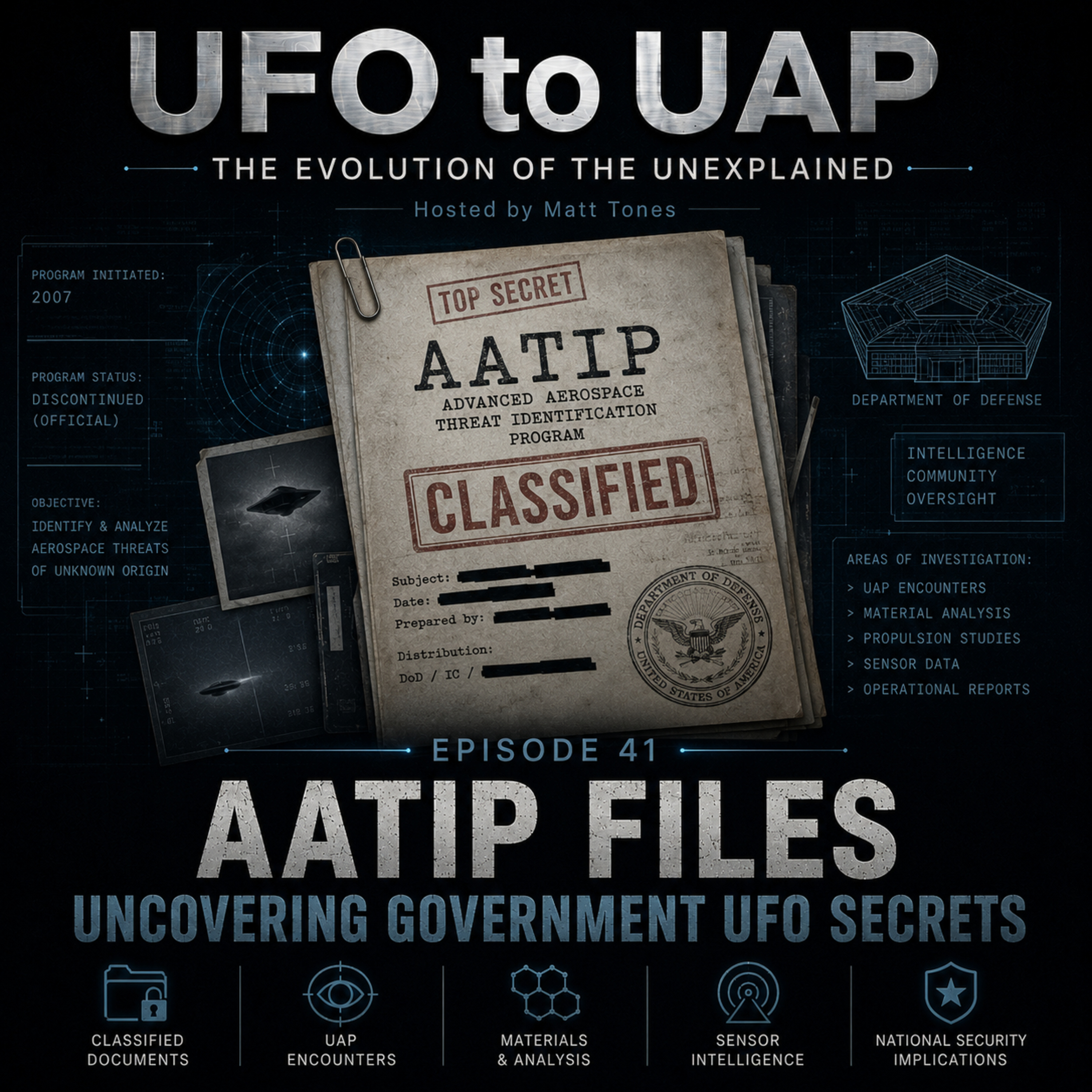
Inside AATIP: Unveiling the Pentagon's UFO Investigations and Military Impact
Tonight's Episode
What was AATIP, and why did the Pentagon secretly investigate UFO and UAP encounters involving military pilots, radar systems and restricted airspace?
In this episode of UFO to UAP Explained, host Matt Tones investigates the Advanced Aerospace Threat Identification Program, the little-known Pentagon initiative that helped transform UFOs from a subject of ridicule into a legitimate national-security and intelligence concern.
The episode traces the history of American UFO investigations from Project Blue Book to AATIP’s establishment in 2007, examining the role of Senator Harry Reid, advances in military radar and infrared detection, and growing concern about unidentified objects operating near defence systems.
At the centre of the investigation is the 2004 USS Nimitz Tic Tac encounter. Navy pilots, radar operators and targeting systems reportedly observed an unidentified object displaying unusual movement without visible wings or propulsion. The later release and official acknowledgement of the FLIR1, Gimbal and GoFast videos brought military UAP evidence into mainstream public discussion—but did not prove extraterrestrial visitation or alien technology.
The episode also explores the stigma that discouraged pilots from reporting unexplained encounters, the uncertainty surrounding AATIP’s findings and the controversial public role of former intelligence official Luis Elizondo. It examines how congressional pressure, intelligence briefings and demands for standardised reporting helped create the UAP Task Force, AOIMSG and the All-domain Anomaly Resolution Office, known as AARO.
Did AATIP begin a genuine era of UFO disclosure, or was it primarily an intelligence-modernisation program responding to surveillance risks and gaps in military reporting? Discover what the Pentagon investigation actually established, what remains disputed and why acknowledging uncertainty may be AATIP’s most important legacy.
Episode Timestamps
(0:00) The New York Times reveals the secret Pentagon UFO program
(1:20) Why unexplained aerial encounters became a national-security issue
(2:20) From Project Blue Book to the creation of AATIP
(3:29) How advanced military sensors changed UAP detection
(4:30) AATIP’s establishment and Senator Harry Reid’s role
(5:03) Foreign technology, surveillance and aerospace threat assessment
(5:40) Why the Pentagon program remained secret
(6:38) The 2004 USS Nimitz Tic Tac encounter
(8:39) Pilot stigma and the military UAP reporting problem
(9:38) What did AATIP actually discover?
(11:33) Luis Elizondo and the controversy surrounding AATIP
(12:18) Congressional oversight and demands for UAP transparency
(13:03) Genuine transparency or controlled disclosure?
(16:02) How AATIP opened the modern UFO disclosure era
Sources:
AARO Historical Record Report;
U.S. Department of Defense — Historical Navy UAP Video Release;
U.S. Department of Defense / ODNI UAP reports;
New York Times reporting on AATIP;
U.S. Senate statements and records linked to the Advanced Aerospace Threat Identification Program;
NASA UAP Independent Study Team Report.
Keywords:
AATIP, Advanced Aerospace Threat Identification Program, Pentagon UFO investigation, Pentagon UAP investigation, secret Pentagon UFO program, Department of Defense UFO program, government UFO investigation, military UAP investigation, UFO disclosure, UAP disclosure, modern UFO disclosure era, Pentagon UFO files, AATIP investigation, AATIP documentary, Senator Harry Reid AATIP, Luis Elizondo AATIP, Luis Elizondo UFO disclosure, USS Nimitz Tic Tac, Nimitz UAP encounter, 2004 Tic Tac incident, Tic Tac UFO, Navy UFO encounters, Navy UAP evidence, Navy UFO videos, FLIR1 UFO video, Gimbal UAP video, GoFast UAP video, military radar UFO evidence, infrared UAP footage, multi-sensor UAP evidence, unidentified anomalous phenomena, unidentified aerial phenomena, military pilot UFO reports, UFO reporting stigma, UAP national security.
December 2017 The New York Times publishes a story that changes
the UFO conversation forever. Hidden inside the Pentagon, a
little known programme had been quietly investigating
unidentified aerial phenomenon. Not science fiction, not
Internet conspiracy forums. A real government initiative,
funded, structured, embedded inside the national security
system. Its name AATIP or for future
reference, AATIP. AATIP stands for the Advanced
Aerospace Threat Identification Programme.
And suddenly, decades of UFO stigma collided with official
government acknowledgement. Military footage emerged, Navy
pilots came forward, Congressional interest
intensified, and the public began asking a question that had
once sounded impossible. Why was the Pentagon secretly
investigating UFOs? But the deeper question was even
more important. Not Did the government believe
in aliens, but why did national security institutions decide
unexplained aerial encounters deserved formal investigation?
That distinction changes everything, because a tip was
not born from curiosity alone. It emerged from military
uncertainty, intelligence concerns, advanced sensor
systems, unexplained encounters and growing fears that something
operating in restricted airspace was not being adequately
understood. Tonight we investigate how a tip
was created, what triggered Pentagon concern, the role of
Senator Harry Reid, the Navy encounters, the Tic Tac
incident, the secrecy surrounding the programme, the
controversy over its findings, the emergence of modern
disclosure culture, and how a tip transformed UFOs from
ridicule into an institutional intelligence problem.
This is UFO to UAP, the disclosure report.
I'm your host, Matt Tones, and tonight we open the 8 tip files.
To understand a tip, you first need to understand the
environment that created it. Because the United States
government had investigated UFOs before, most famously Project
Blue Book, running from 1952 to 1969.
Blue Book investigated thousands of UFO reports during the Cold
War. Officially, the project
concluded that there was no evidence represented
extraterrestrial technology or direct national security
threats, and publicly the subject gradually became
stigmatised. By the late 20th century, UFOs
were increasingly associated with conspiracy culture, tabloid
television, fringe speculation and public ridicule.
But behind the scenes, military encounters never fully
disappeared. Pilots continued reporting
strange objects, radar operators logged anomalies, and
intelligence systems occasionally encountered things
that struggled to categorise in real time.
The difference was most of those reports rarely reached public
attention. Then technology changed.
By the early 2000s, modern military detection systems had
evolved dramatically. Advanced radar, infrared
targeting systems, Electro optical sensors, integrated
tracking platforms. The skies would no longer be
monitored by human eyes alone. Machines were watching, too.
And according to multiple military accounts, those systems
began detecting objects behaving in unusual ways.
That distinction matters enormously because the modern
UAP era was shaped not only by witnesses but by sense of
fusion, multiple systems of observing the same event
simultaneously. That changed the credibility
landscape entirely. And it created a difficult
intelligence problem because once advanced military systems
repeatedly encountered unknown objects, the issue stopped being
cultural. It became operational in 2007.
The Advance Aerospace Threat Identification programme was
established within the Department of Defence.
One of the key political figures associated with the effort was
Senator Harry Reid. Reid supported funding for the
programme amid growing concern surrounding advanced aerospace
threats and unexplained military encounters.
Now this is important. AATIP was never officially
presented as an alien investigation unit.
Its framing was national security aerospace threat
assessment. Unknown objects in military
airspace create uncertainty, and uncertainty inside defence
systems is dangerous because unidentified aerial phenomenon
could potentially represent foreign adversary technology,
advanced drones, surveillance platforms, electronic warfare
systems, sensor anomalies or genuinely unexplained events.
From a Pentagon perspective, all those possibilities required
investigation. One reason a TIP became so
controversial was because of secrecy.
For years, the programme remained largely unknown
publicly, and that secrecy fueled speculation.
Why hide it? Why classify aspects of the
work? Why avoid public discussion?
But classified programmes inside the Pentagon are not unusual,
especially when they intersect with intelligence collection,
aerospace analysis, military sensor systems or National
Defence concerns. Still, the secrecy surrounding a
tip created an atmosphere. Atmosphere of intrigue because
once the public learned the government had quietly
investigated unidentified aerial encounters, the narrative
changed permanently. The UFO subject had officially
re entered the national security system.
Then came the case that changed everything publicly.
The USS Nimitz Encounter 2004 Off the coast of California,
Navy pilots operating from the USS Nimitz Carrier Strike Group
encountered an object unlike anything they expected to see.
Commander David Frivo later described an object shaped like
a Tic Tac, white, smooth, without visible wings or
propulsion. Pilots reported unusual
manoeuvring behaviour, rapid movement, abrupt directional
changes, and flight characteristics they struggled
to explain. Now who's here?
Because this is where careful language matters, the Pentagon
did not officially conclude the object violated physics, nor did
it officially declare the object extraterrestrial.
Instead, military personnel reported behaviour investigators
could not immediately explain with the available information.
And that distinction is critical because the strongest, most
disclosure analysis avoids exaggeration.
Eventually, 3 military videos became central to the modern
disclosure movement. Floor 1, Gimbal and Go Fast.
Originally leaked and later officially confirmed by the
Pentagon. These videos change public
perception dramatically because now the UFO conversation was no
longer based solely on eyewitness testimony.
Military sense of footage existed publicly and
importantly, the Pentagon acknowledged the footage was
authentic military material. Again, that does not equal alien
confirmation, but it did represent something historically
significant. The government openly admitted
its personnel had encountered aerial objects it could not
fully identify. That was a major institutional
shift. One of the biggest issues a tip
identified was not necessarily the objects themselves.
It was reporting culture. Pilots often avoided reporting
anomalous encounters. Why?
Because stigma destroys credibility.
Military aviation culture values reliability, composure,
accuracy, and professionalism. Reporting strange aerial
encounters risked ridicule, career damage, questions about
competence. As a result, many incidents
likely went undocumented. From an intelligence
perspective, that created a serious problem because if
personnel refused to report anomalies, value data
disappears. A TIP helped expose this
institutional weakness, and this may ultimately become one of its
most important legacies, not proving extraterrestrials, but
normalising serious reporting. Now we arrive at the question
everyone asks what did a tip discover?
The the the honest answer is far less definitive than public
pathology often suggests. A tip did not publicly confirm
extraterrestrial visitation, alien spot spacecraft or
revolutionary propulsion systems.
Instead, it documented unresolved uncertainty military
encounters existed. Some incidents lacked immediate
explanation, and investigators believed further analysis was
warranted. That is much more cautious than
many headlines suggested. But importantly, the uncertainty
itself mattered because unidentified objects operating
new military systems create strategic concern regardless of
origin. One of the most sensationalised
aspects of the a tip story involves claims about impossible
flight behaviour. Online discussion often
exaggerated this dramatically. The reality is more complicated.
Witnesses described unusual movement, rapid acceleration,
abrupt manoeuvres, lack of visible propulsion.
But interpreting sensor data is extraordinarily difficult.
Perspective effects Habit. Sorry, perspective effects
happen. Radar ambiguity exists.
Optical distortions occur. Incomplete data sets create
interpretation problems. That does not mean witnesses
fabricated experiences, nor does it automatically validate
extraordinary conclusions. It means the data environment
remains complex, and that complex is central to modern UAP
analysis. ATIP became even more
controversial because of Luis Alizondo, a former intelligence
official associated publicly with the programme.
Alizondo argued the government needed to take UAP encounters
more seriously. He also became one of the most
visible public figures in the modern disclosure movement.
Supporters viewed him as a credible insider pushing
transparency. Critics question the scope of
his role, aspects of his claims, and the ambiguity surrounding a
tips exact structure. Regardless of interpretation,
Elizondo helped move the UAP conversation into mainstream
public discourse, and that influence cannot be overstated.
Another critical factor? Congress The modern disclosure
era did not emerge solely from whistleblowers or media stories.
Political pressure mattered enormously.
Lawmakers increasingly demanded intelligence briefings,
standardised reporting and oversight regarding unidentified
aerial encounters. Why?
Because unidentified objects near military operations
represent airspace integrity concerns, surveillance risks,
intelligence uncertainty and possible technological threats,
this transformed UFO politically.
The subject moved from fringe culture into formal oversight
infrastructure. And that transition was
historic. Now we reached the deeper issue.
Was a tip genuinely transparent or controlled disclosure?
Some researchers argue a TIP represented the beginning of
gradual normalisation, a slow public introduction to a subject
previously hidden behind stigma and classification.
Others argue a tip was primarily an intelligence modernization
effort, a practical response to military reporting gaps.
Perhaps both interpretations contain truth.
Because disclosure rarely occurs as a single dramatic event.
It emerges through institutional adaptation, changing language,
evolving reporting systems, public pressure and gradual
normalisation. A tip may represent the exact
moment that process accelerated publicly.
A TIP did not exist in isolation.
It emerge its sorry. Its emergence helped pave the
way for the UAP Task Force, AOIMSG, and eventually ARROW.
And this is critical historically, because the
government did not abandon investigation after a tip became
public, it expanded institutional infrastructure.
That expansion suggests the issue remained operationally
relevant, Again, not necessarily extraterrestrial, but
significant enough for permanent investigative architecture to
emerge. And that alone is remarkable,
ultimately a tip for society to confront something
uncomfortable. Not necessarily are aliens real,
but something more profound. What happens when advanced
institutions encounter uncertainty they cannot
immediately resolve? Military systems are designed
around identification, control, categorization.
And yet a tip exposed moments where certainty broke down,
where trained observers, advanced sensors and
intelligence systems encountered anomalies that resisted
immediate explanation. That may be the real
significance of the programme. Not confirmation, but
acknowledgement of uncertainty. For decades, the UFO subject
existed largely outside official legitimacy.
Then a tip changed the landscape, not by proving
extraterrestrials but by institutionalising
investigation. The programme demonstrated
military encounters were occurring, pilots were reporting
anomalies, intelligence concerns existed and governments were
taking the issue seriously enough to investigate quietly.
That alone transformed the conversation forever.
The unknown had re entered the system and once national
security institutions formally acknowledged uncertainty, public
curiosity become impossible to contain.
The question remain unresolved, the evidence remains incomplete
and the interpretations remain contested.
But one thing is undeniable. AATIP reopened a door the the
government once considered determined to keep closed.
Let me say that again. ATIP reopened a door the
government once appeared determined to keep closed and
the modern disclosure era emerged through that opening.
This has been UFO to UAP the disclosure report.
I'm Matt Tones, thank you for tuning in.
Please subscribe via Spotify. Please share this episode, it's
a massive help.
 Amazon Music
 Apple Podcasts
 Castbox
 Castro
 Goodpods
 iHeartRadio
 Overcast
 Pocket Casts
 Podbean
 Podcast Addict
 Spotify
 YouTube