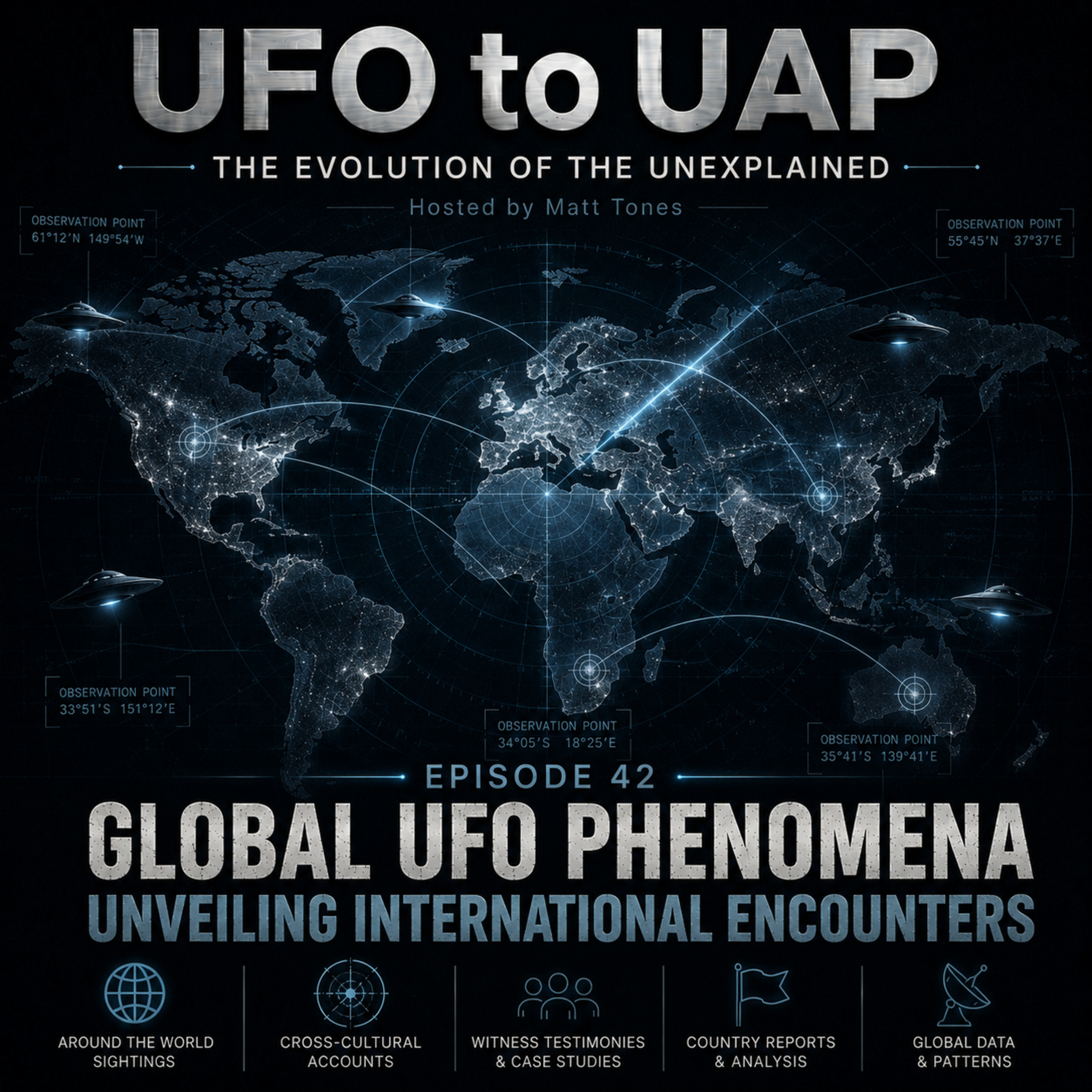
Governments and UFOs: Global UAP Responses and Transparency
Tonight's Episode
How have governments around the world responded to UFO and UAP encounters—and why do secrecy, uncertainty and controlled disclosure appear across radically different political systems?
In this episode of UFO to UAP Explained, host Matt Tones investigates the global history of unidentified anomalous phenomena and the institutional responses that followed. From the United States and United Kingdom to France, Russia, Brazil and Japan, military personnel, commercial pilots, radar operators and civilian witnesses have reported objects and events they could not readily explain.
Explore the conflicting military statements surrounding Roswell, the Rendlesham Forest incident and Halt memorandum, France’s transparent GEIPAN investigation program, Soviet-era UFO secrecy, Brazil’s controversial Varginha incident and the Japan Airlines Flight 1628 encounter over Alaska.
The episode also examines why governments investigate UFOs in the first place. Unknown objects near military bases, nuclear facilities, naval groups and civilian flight corridors represent potential intelligence and national-security risks, regardless of whether their origin is foreign technology, sensor error, misidentification or something genuinely unexplained.
Different countries use different radar systems, classification policies and reporting procedures, making international UAP evidence difficult to compare. Yet the same pattern repeatedly emerges: witnesses report anomalies, military agencies investigate quietly, governments release limited information and public uncertainty continues.
Discover how AARO, Project Blue Book, AATIP, the UAP Task Force, public hearings and international aerospace-monitoring programs are moving the subject from ridicule toward formal institutional analysis—and why government transparency still falls far short of full UFO disclosure.
Episode Timestamps
(0:00) Global UFO encounters and controlled disclosure
(1:14) International UAP investigations and government transparency
(1:58) Roswell, military secrecy and the United States response
(3:08) Project Blue Book, AATIP, the UAP Task Force and AARO
(3:36) The Rendlesham Forest incident and Halt memorandum
(5:08) France’s GEIPAN public UFO investigation program
(6:44) Soviet UFO reports and Cold War secrecy
(8:21) Brazil’s controversial Varginha incident
(9:35) Japan Airlines Flight 1628 over Alaska
(10:54) Why governments investigate unidentified objects
(11:48) Radar differences, classification and fragmented UAP data
(12:52) Public hearings and the normalisation of UAP reporting
(13:32) How institutions respond to unexplained phenomena
(14:26) The global pattern in government UFO investigations
Sources:
AARO;
ODNI / U.S. Department of Defense UAP reports;
National Archives UAP Records Collection;
NASA UAP Independent Study Team Report;
UK National Archives / Ministry of Defence UFO files;
France CNES / GEIPAN;
Australia National Archives UFO records;
Canada Library and Archives UFO records;
arXiv research on global UAP studies and scientific investigation.
Keywords:
government UFO investigations, global UAP response, international UFO cases, UFO government transparency, UAP disclosure, global UFO disclosure, unidentified anomalous phenomena, government UFO files, military UFO encounters, Roswell incident, Rendlesham Forest incident, Halt memorandum, GEIPAN France, French UFO investigation, Soviet UFO reports, Cold War UFO secrecy, Varginha incident, Brazil UFO case, Japan Airlines Flight 1628, pilot UFO encounters, radar UFO evidence, AARO, Project Blue Book, AATIP, UAP Task Force, military UAP investigation, UFO national security, controlled disclosure, government UFO secrecy, international UAP evidence, UFO transparency, aerospace anomalies, Matt Tones, UFO to UAP podcast
December 1980 Cold War Europe NATO tensions rising Deep inside
Rendlesham Forest, American military personnel reports
strange lights moving through the trees beside a strategic air
base linked to nuclear operations.
Thousands of kilometres away, other governments are
confronting their own unexplained encounters.
Brazil, France, Japan, Russia, the United States.
Different nations, different political systems, different
military cultures. Yet the same pattern appears
again and again. Pilots report anomalous objects.
Radar operators track unusual returns, witnesses describe
events they struggle to explain, and governments respond with a
familiar mix of caution, secrecy, uncertainty and
controlled disclosure. Because UFO phenomena are not
uniquely American, they are global.
And perhaps the most fascinating aspect of the mystery is not
simply what people are seeing, but how institutions around the
world react when confronted with the unknown.
Tonight, we investigate the most significant international UAP
encounters, how governments responded, the rise of global
disclosure systems, military secrecy, institutional
ambiguity, Cold War intelligence fears, public transparency
programmes, and the remarkable similarities appearing across
completely different nations. Because while governments may
disagree politically, their reactions to unexplained aerial
phenomenon often look strikingly alike.
This is UFO to UAP, the disclosure report.
I'm your host, Matt Tones, and tonight we go global to
understand global UFO phenomenon.
We begin with the United States, because America shaped much of
the modern UFO narrative. Roswell 1947, a ranch outside
Roswell, NM. Initial military statements
reference the recovery of a flying disc.
Then, suddenly, the narrative changed.
The object became a weather balloon.
That reversal ignited decades of suspicion.
But Roswell's true historical significance may not lie in
whether the extraterrestrials crashed in New Mexico.
It's important male instead lie in institutional response,
conflicting statements, military secrecy, narrative control and
public distrust. Those patterns would repeat
globally for decades, and as the Cold War intensified, the United
States increasingly viewed unidentified area phenomena
through a national security lens, not necessarily as alien
visitation but as potential Soviet technology, aerospace
threats, surveillance platforms, or intelligence uncertainties.
That framework still dominates modern UAP policy today.
Programmes evolved. Project Blue Book, a TIP, the
UAP task force, AOIMSG and eventually Arrow.
The language modernised, the systems evolved, but one thing
remained constant. The government repeatedly
acknowledged there were aerial incidents it could not
immediately explain. Now we move across the Atlantic.
December 1980 Renderschon Forest and we just done an episode on
this one, perhaps the most famous military UFO case in
British history. American servicemen stationed at
RAF Brent Bent Waters reported strange lights descending into
the forest near strategically sensitive military facilities.
Witnesses described unusual aerial movement, a triangular
craft and unexplained lights manoeuvring through the trees.
Then came one of the most important aspects of the case,
the Hulk Memo, an official military memorandum written by
Lieutenant Colonel Charles Holt documenting unexplained
observations during the incident.
This matters enormously because Renderschaum produced military
witnesses, recorded audio, the official documentation, and
decades of ongoing controversy. But perhaps even more
interesting than the signing itself was the institutional
response. British authorities never fully
endorsed extraordinary explanations, but neither did
the mystery disappear completely.
Instead, Rendlesham entered a strange bureaucratic grey zone,
acknowledged, documented but unresolved.
That pattern should sound familiar by now because modern
governments often respond to UAP incidents through managed
ambiguity. Not full confirmation, not total
dismissal, but controlled uncertainty.
Now we arrive at one of the most important international examples
France because like unlike many governments, France openly
institutionalised UFO investigation through an
official public facing organisation.
Gaipan, spelled GEIPAN Sky Pen is a branch associated with the
French space agency CNES. Its mission collect and analyse
reports of unidentified aerospace phenomena.
This is hugely significant historically because France
approached the issue differently.
Rather than burying discussion entirely behind military
secrecy, France created a partially transparent
investigative framework. Public reports became
accessible, cases were categorised, data was archived
and importantly, the French model acknowledged something
most governments quietly understood.
Unexplained reports continue occurring regardless of public
stigma. Now, this does not mean France
confirmed extraterrestrials. Far from it.
Most cases still received conventional explanations.
But Guy Pen demonstrated something remarkable.
A government policy admitting systematic investigation of
aerial anomalies deserved institutional legitimacy that
was decades ahead of much of the modern disclosure conversation.
Now we move east into the Soviet Union because UFO reports were
not exclusive to Western democracies during the Cold War
Soviet military personnel also reported unexplained aerial
phenomenon, and the Soviet response reflected its own
political culture. Extreme secrecy.
Strategic compartmentalization. Military control of information.
This is critical because both the United States and Soviet
Union encountered unexplained aerial reports during periods of
intense geopolitical tension, and both initially interpreted
anomalies through the same lens. National security threat
assessment. Could these objects represent
enemy surveillance systems classified aerospace technology?
Intelligence operations? Psychological warfare?
Again, the concern was not initially extraterrestrial, it
was strategic uncertainty. And uncertainty inside Cold War
military systems created enormous anxiety, especially
near nuclear installations, missile facilities and strategic
defence infrastructure. Increasingly, both superpowers
appeared to encounter similar institutional problems.
Fragmented reporting witnessed stigma, inconsistent analysis
and secrecy barriers limiting public understanding.
Different governments, same uncertainty.
Now we travel to South America. Brazil, 1996.
The vagina incident, One of the most controversial UFO related
events in Latin American history.
Witnesses claimed strange creatures were observed after
reports of unusual aerial activity.
Military involvement followed quickly and almost immediately.
Conflicting narratives emerge. Supporters of the case argued
witnesses encountered something extraordinary.
Sceptic. Sorry, skip Things counted.
Misidentification and folklore amplified ordinary events into
mythology. But once again, the
institutional response became just as important as the alleged
encounter itself. Confusion.
Secrecy allegations, Public distrust, Conflicting official
explanations. These patterns now repeat so
consistently across countries that they become difficult to
ignore because regardless of whether the underlying
phenomenon is extra is extraordinary, governments
repeatedly struggle to manage public uncertainty once
anomalous events enter public consciousness.
Now we moved to Asia. 1986 Japan Airlines 61628, a cargo flight
travelling over Alaska. Captain Kenju Toralchi reported
observing enormous unidentified objects pacing the aircraft.
Crucially, radar data reportedly supported portions of the
encounter. This case became globally
significant because it involved commercial aviation, experienced
pilots, radar tracking and international aviation
authorities. But once again, the response
remained cautious. No definitive explanation
emerged and the institutional reaction reflected another
reoccurring global baton, bureaucratic containment.
Not necessarily suppression, but stabilisation.
Governments and aviation agencies tend to avoid
premature, extraordinary conclusions, especially when
public confidence in aerospace safety is involved.
That caution is understandable, but it also fuels suspicion.
And that tension lies at the centre of nearly every major
international UFO case. Now we reach deeper into the
questions Why do governments investigate UFOs at all?
The public often assumes governments investigate because
they suspect extraterrestrials. But historically the primary
concern is usually much simpler national security.
Unknown objects in controlled airspace create operational
problems. Military systems depend on
identification. Known, unknown, friendly,
hostile. Once identified objects
repeatedly appear new military assets, nuclear facilities,
naval groups, or civilian aviation corridors,
investigation becomes unavoidable.
This is why countries with vastly different political
systems often respond similarly. Because aerospace uncertainty
transcends ideology, one of the biggest challenges in global UAP
analysis is data inconsistency. Different countries use
different radar systems, different reporting structures,
different classification rules, different intelligence
frameworks, and different investigative methodologies.
This creates enormous fragmentation.
Some governments release documents publicly, others
classify aggressively. Some encourage reporting, others
discourage it culturally. And even when multiple witness
exist, witnesses exist. Sensor limitations complicate
interpretation. Radar ambiguity happens.
Optical distortions happen. Incomplete data sets happen.
Perspective errors happen. That does not automatically
invalidate reports, but it explains why definitive
conclusions remain difficult. The public often expects
certainty, but intelligence environments rarely provided.
Now the global landscape is changing.
Public stigma around UAP reporting is weakening.
Governments are becoming more open discussing aerial
anomalies. Military pilots increasingly
report encounters formally. Congressional hearings occur
publicly, and international cooperation around aerospace
monitoring continues expanding. This is not Full disclosure, but
it is normalisation. And perhaps that is the most
important shift of all. The unknown is slowly moving
from ridicule into institutional analysis.
That transition is historic. Ultimately, global UFO phenomena
force humanity to confront something uncomfortable.
Not necessarily are aliens visiting Earth, but perhaps
something more profound. What happens when modern
institutions repeatedly encounter events they cannot
immediately explain? Governments are built around
certainty. Military systems are built
around control. Intelligence systems are built
around categorization. Yet across decades, multiple
nations continue confronting anomalies that resist simple
explanation. That may be the true global
pattern. Not proof, but persistent
uncertainty. And perhaps that uncertainty
itself explains why governments respond so cautiously.
Different countries, different cultures, different political
systems, and yet the same patterns appear again and again.
Witnesses report anomalies. Military systems investigate
quietly, governments release limited information, public
curiosity grows and uncertainty persists.
Perhaps the greatest revelation of global UFO phenomena is not
what appears in the sky, but how remarkably similar institutional
behaviour becomes when confronted with the unknown.
Because whether in Washington, Moscow, London, Paris, Tokyo,
Sydney or Brasilia, governments consistently struggle with the
same dilemma. How do you manage public
uncertainty of phenomena you may not fully understand yourself?
That question remains unresolved.
And perhaps that unresolved tension is the real heart of the
global UAP mystery. This has been UFO to UAP, the
disclosure report. I'm your host, Matt Tones.
Thank you for listening. Remember to click subscribe on
the Spotify homepage and share the podcast and get others into
the conversation. I'd love to hear your thoughts
via the comments. Talk soon.
 Amazon Music
 Apple Podcasts
 Castbox
 Castro
 Goodpods
 iHeartRadio
 Overcast
 Pocket Casts
 Podbean
 Podcast Addict
 Spotify
 YouTube