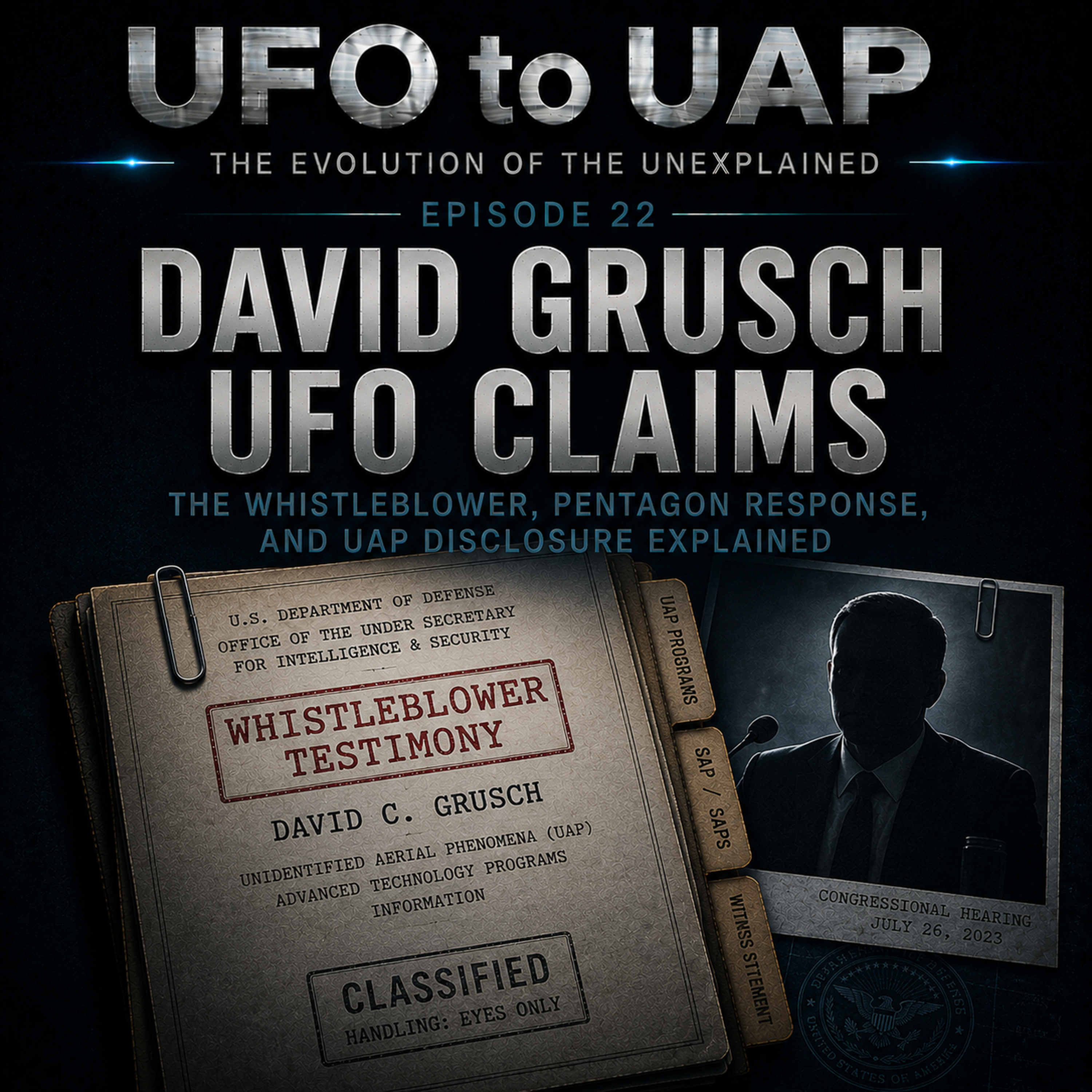
David Grusch and the UAP Extraterrestrial UFO Whistleblower Controversy
Tonight's Episode
What did David Grusch actually claim about UFOs, recovered craft and non-human intelligence—and why did his testimony force the US government to respond?
In this episode of UFO to UAP Explained, host Matt Tones examines the David Grusch whistleblower controversy and the difference between a credible allegation, an official investigation and publicly verified evidence. A former intelligence officer linked to the National Geospatial-Intelligence Agency, National Reconnaissance Office and UAP Task Force, Grusch alleged that secret crash-retrieval programmes possess non-human craft and biological material.
The episode follows his claims through protected whistleblower channels, the Intelligence Community Inspector General, congressional oversight and sworn public testimony. It explains why a complaint described as “credible and urgent” does not confirm extraterrestrial technology—it means the allegations met a procedural threshold for investigation.
Explore the role of Project Blue Book, AATIP, the UAP Task Force and AARO; the difference between direct evidence and second-hand knowledge; and the Department of Defence response that no verifiable evidence supports hidden retrieval programmes or extraterrestrial technology.
Is Grusch exposing a genuine legacy UAP programme, misinterpreting fragmented classified information or creating a story that may remain unresolved? This investigation separates credibility from proof and reveals how government systems manage extraordinary claims, secrecy and uncertainty.
Episode Timestamps
(0:00) When a UFO claim enters the system
(0:40) David Grusch alleges recovered non-human craft
(1:28) Whistleblower channels and congressional oversight
(2:50) The post-Project Blue Book environment
(5:05) Military sensors return UAPs to official attention
(6:05) AATIP, the UAP Task Force and AARO
(6:44) Grusch’s intelligence background
(8:05) Second-hand knowledge versus direct evidence
(9:27) Why Grusch used the official whistleblower process
(10:44) Alleged oversight failures
(11:30) The Inspector General process
(12:17) What “credible and urgent” actually means
(13:31) Congress becomes involved
(14:37) Sworn public testimony
(15:42) Claims of non-human craft
(16:48) Crash-retrieval programmes and biological material
(18:04) The Department of Defence and AARO response
(19:26) The gap between allegation and verification
(20:12) Media amplification and public polarisation
(22:25) Credibility is a gateway, not proof
(23:45) Four possible explanations
(25:06) What David Grusch’s claims actually changed
Sources:
U.S. House Oversight Committee — 2023 UAP hearing testimony;
David Grusch congressional testimony;
U.S. Department of Defense statements on UAP programs;
AARO Historical Record Report;
ODNI / DoD Annual UAP Reports;
UAP Disclosure Act / NDAA records on whistleblower protections and recovered technologies;
NASA UAP Independent Study Team Report.
Keywords:
David Grusch, David Grusch whistleblower, UAP whistleblower controversy, non-human craft claims, non-human intelligence, UFO crash retrieval programmes, recovered UFO technology, UAP Task Force, AARO, AATIP, Pentagon UFO investigation, congressional UAP hearing, Intelligence Community Inspector General, classified UAP programmes, UAP disclosure, government UFO secrecy, extraterrestrial evidence, UFO whistleblower testimony, unidentified anomalous phenomena, UFO to UAP Explained.
There are moments in history when something doesn't just
happen quietly. It doesn't remain A rumour.
It doesn't sit in the shadow. It doesn't fade into
speculation. Instead, it moves from
conversation to documentation to process.
And when it reaches that final stage, something changes.
Because once a claim enters a system, it is no longer just a
story. It becomes something that must
be acknowledged, processed, responded to.
And that shift is where the story begins.
In 2023, a man stepped forward. Not from the outside, not from
the fringe, not from the speculative edges of the UFO
community, but from inside the United States intelligence
system. His name was David Grusch and
what he claimed was not ambiguous.
It was not lights in the sky, unexplained movement, or
unidentified objects. It was something far more
structured. He claimed the United States
government possesses non human craft.
Recovered, studied, hidden. And in doing so, he didn't just
introduce a claim, he introduced a problem.
Because this time the claim did not remain contained.
It moved through official whistleblower channels, the
Inspector General, congressional oversight.
And once it reaches that level, it triggered something very
specific. Process.
Not belief. Not dismissal process.
So tonight we're not asking is David Gooch telling the truth,
We're asking something far more precise.
What happens when a claim becomes credible enough to enter
the system, but not verifiable enough to be confirmed?
Because once that threshold is crossed, the conversation
changes. It stops being about
speculation, belief or interpretation, and it becomes
about structure. And if you follow that structure
carefully, you'll begin to see something else, not just what is
being claimed, but how reality itself is negotiated inside
complex systems. Welcome back to UFO to UAP, the
disclosure report. I'm your host, Matt Tones.
Thank you for joining. Today's episode is titled David
Grouch, the Whistleblower, The Claims, and the System Response.
Before we examine David Grusch, we need to understand something
more the environment his claim entered.
Because no claim exists in isolation, it exists within a
context, and that context determines how it is received,
how it is processed, and ultimately how it is remembered.
The post Blue Book world. To understand this, we go back
not to Grouche, but to the system he entered, the system
shaped by decades of investigation, dismissal,
uncertainty. In 1969, Project Blue Book
ended. Its conclusion was precise.
No identified threat, no confirmed advanced technology,
no evidence of extraterrestrial vehicles.
And from that moment forward, the official position became
there is no confirmed anomaly requiring further investigation.
But what does that actually meant?
It does not mean nothing exists. It meant nothing has been
confirmed to the level required for action.
And that distinction matters because it created a vacuum, a
space where questions remained, data was incomplete, and
explanations were inconclusive. But the system moved on.
For decades after Project Blue Book, UFOs were not a central
focus. Reports continued, but quietly.
Investigation became fragmented, and something subtle happened.
The phenomenon didn't disappear, but the attention around it did.
Let's pause here, because this is important.
When a system investigates something, fails to confirm it,
and then deprioritizes it, that doesn't resolve the issue.
It simply reduces its visibility.
And when visibility drops, something else takes its place.
Narrative Fast forward decades later, something changes.
Not in the sky, but in the system.
Around the mid twenty 10s, Uaps re enter the conversation not
through civilians or fringe reports, but through military
encounters. Pilots begin reporting objects
with no visible propulsion, objects moving at extreme speed,
objects defying known flight characteristics.
And importantly, these encounters are recorded.
Infrared footage, radar data, multiple sensors.
This is no longer anecdotal. This is instrumented
observation. And that changes how the system
responds. U.S. government responds by
creating AATIP or the Advanced Aerospace Threat Identification
Programme. The UAP Task Force and later
Arrow, each with a similar goal, understand what is being
observed. But again, the framing is
consistent. Not what are these objects, but
do they represent a threat? From Blue Book to AATIP to
Arrow, the core question remains unchanged.
Read first, explanation second. Now we introduce the individual.
David Grusch is not an outsider. He operated within the National
Geospatial Intelligence Agency and the National Reconnaissance
Office. These are not abstract entities.
They are the eyes of the system, They're responsible for
satellite imagery, intelligence collection, global observation.
Grouche was connected to the UAP task force and this places him
inside the mechanism designed to analyse unknown aerial
phenomena, not observing from a distance, but participating in
data analysis, intelligence synthesis, internal reporting.
It establishes access. Not full access, but enough to
encounter information, identify patents and form conclusions.
Because credibility in this space is rare, most claims come
from indirect sources and unverifiable accounts.
Grouch crosses a threshold. He's credible enough to be taken
seriously by the system itself, and that changes everything.
Now we move into the emergence of the claim itself.
But again, we slow this down because claims of this scale do
not appear instantly. They develop through exposure,
interpretation and internal tension.
At some point, Gross reaches A conclusion, not based on a
single event or a single piece of data, but based on
accumulated information, and that accumulation leads to a
belief that something exists within the system that is not
being disclosed. This is where precision matters.
He has not claimed personal direct observation.
He claims knowledge of programmes, access to
information and conversations with individuals and from that
he constructs a conclusion. This is where many people
misunderstood the situation. Grouche is not saying I saw a
craft, he's saying based on what I have learned these programmes
exist, that this is a different kind of claim.
It is second order knowledge, not direct evidence.
So at this point, something changes because having belief in
what is one thing and acting on it is something else entirely
from someone inside the system. Coming forward carries
professional risk, legal risk, and reputational risk.
So the decision to act requires conviction.
Not necessarily truth, but conviction.
Instead of going to the media or speaking publicly, Gross chooses
the official pathway, the whistleblower process.
And this is important because it signals something very specific.
He's not trying to create a story, he's trying to trigger a
response inside the system. There is a moment in any complex
system where something crosses a line, not a physical line, a
procedural 1A threshold between internal belief and formal
action. For David Grusch, that moment
arrives when the claim is no longer something he carries
privately, it becomes something he is willing to submit to the
system itself. And this is a critical
transition because inciting any intelligence structure, belief
has no standing, only documentation, process and
traceability. So when Grousch decides to act,
he does not present a story. He presents a complaint, a
formal allegation that something within the system is not
functioning correctly. And importantly, this complaint
is not framed as aliens exist. It is framed as information is
being withheld from Congress. And this reframes everything.
The claim is no longer about extraterrestrial technology, it
becomes about oversight, failure.
And that is something the system is designed to respond to.
Let's pause and reinforce this What actually triggers action
here? Claims about unknown objects,
advanced technology, and unexplained phenomena do not
automatically trigger investigation.
But claims about failure of oversight do, because they
represent a structural risk. And that is something the system
takes very seriously. Now we move into one of the most
important components of this entire story, the Inspector
General. The Inspector General is within
government systems and exists to investigate internal issues,
ensure compliance and protect against misconduct.
It is a mechanism of accountability, not a truth to
fire authority, not a scientific body, but a process designed to
determine whether a claim warrants investigation.
Gru Schmitz, A complaint alleging that UAP related
information is being improperly withheld with from Congress.
And it's not framed as discovery, revelation, or
confirmation. It is framed as a procedural
violation. And that is key.
The complaint is reportedly assessed as credible and urgent.
This phrase has been widely misunderstood or misinterpreted.
Many assumed or assumed. It means the claims are true,
and it doesn't. It means the claimant met a
threshold for investigation. In this context, credible means
internally consistent, not obviously false and supported by
some level of information. Urgent means it relates to
oversight. It may require timely review.
It cannot be ignored procedurally.
So let's reinforce this clearly. Now.
What does this not mean? Credible and urgent does not
mean extraterrestrial craft confirmed, hidden programmes
verified, or biological material proven.
It means this complaint must be taken seriously enough to
investigate, and that is a procedural decision, not a
factual one. Once the complaint reaches this
threshold, it moves from internal review to congressional
awareness. Congress represents oversight
authority. It is responsible for funding,
accountability and awareness of programmes.
So if a claim suggests information is being withheld,
the Congress must be informed the transfer of the chain.
At this stage, the claim moves from internal concern to
institutional issue. And that shift is critical
because now the system must respond publicly, not
necessarily with answers, but with acknowledgement.
So again, let's step back. Before this point, the claim
existed inside one individual. Now it exists inside the system,
and that changes its status, not its truth, but its visibility.
Now we arrive at the moment most people focus on public
testimony. Gush testifies underoath before
Congress and alongside other witnesses, and this creates
public visibility. The claim is now recorded,
documented, and widely distributed.
Public testimony does not prove claims, but it does formalise
them. It places them into the official
record and once something enters the record, it becomes part of
institutional memory. There are constraints.
Classified information cannot be disclosed, details may be
withheld, and evidence may not be presented publicly.
So what we get is a structured claim without full supporting
detail. And this creates a powerful
effect because the audiences see a credible individual speaking
underoath within an official setting and that combination
feels like confirmation. But it is not.
It is formalised allegation. Now we go deeper into the claims
themselves. Claim one non human craft.
Khrushchev asserts the US government possesses non human
craft. Let's impact this slowly.
This implies physical objects exist.
They are not human made. They have been recovered.
Immediately questions arise. Where are these objects?
Who has access? How were they recovered?
What defines non human? These questions highlight
something important. The claim creates structure but
leaves gaps, and those gaps are where interpretation grows.
Grouche describes structured programmes responsible for
recovery and this suggests organisation, continuity and
intentional effort. Intentional effort, not random
discovery, but systematic activity, he suggests
Information is restricted, access is limited, and knowledge
is segmented. And this is plausible because
intelligence systems operate on compartmentalization.
But again, plausible does not equal proven claim for the
biological material. This is the most controversial
element because it implies not just technology but origin, and
that shifts the conversation entirely.
At this point, we pause the game because this is where most
discussions lose clarity. We now have a credible
individual making structured claims through official
channels, but we also have no public, verifiable evidence.
And that tension is where the story exists.
At some point, every claim reaches a moment not where it is
made, but where it is answered. For David Grusch, that moment
arrives after the claim has moved through the Inspector
General, into Congress and into the public domain.
And once it reaches that stage, the system must respond not
necessarily with detailed, but with position.
The official response is measured, carefully constructed
but also consistent. The Department of Defence states
there is no verifiable evidence supporting claims of non human
craft, hidden retrieval programmes or biological
material. At the same time, the old Domain
Anomaly Resolution Office arrow reinforces no evidence of
extraterrestrial technology, no evidence of undisclosed
programmes. This response should start to
feel familiar at this stage because it follows a pattern, a
pattern we've already seen. Project Blue Book concluded no
threat, no confirmed advanced technology, Arrow concludes no
evidence, no confirmed programmes.
Now what the system is actually saying here, let's just really
sort of slow it down a bit. The system is not saying this is
impossible, it is saying we have no verifiable evidence to
confirm it. That is a very different
statement because it leaves something open, not
confirmation, but possibility without validation.
Now we examine the space between what was claimed and how it was
answered. Because this is where the real
story exists. The structural gap.
On one side, a credible individual making structured
claims, on the other an institution providing structured
denial. Between them, no shared
evidence. And that creates a gap.
When evidence is absent, something else fills the space.
Interpretation, belief, narrative.
This is not unique to Uaps. This is how all complex,
unverifiable issues behave. Where access is limited,
information is restricted, and verification is difficult,
narrative becomes the dominant force.
Now we look at how the claim moves beyond the system into the
public. The first wave is amplification.
Initial reporting focuses on the scale of the claim, the
credibility of the individual and the novelty of the
situation. Headlines form around
whistleblower claims, Government has UFOs and the second wave is
interpretation. The story begins to split.
Some interpret it as confirmation, others frame it as
unproven allegation, and the third wave is polarisation.
Where positions harden. The conversation becomes belief
versus scepticism, disclosure versus denial.
In this process, something disappears.
The nuance, the careful distinction between claim
process and evidence is replaced by simplified positions because
complexity is difficult to explain and audiences seek
clarity, certainty and resolution.
And when those are not available, they create them.
Now we zoom out and look at the pattern across our series of
episodes so far because this is where things become powerful.
With our ancient episodes, we looked at Sitchin Chariots and
Vermonas. These shows humans interpreting
the unknown through culture. The modern claim episodes like
McKinnon and Immaculate Constellation.
They show humans interpreting the unknown through information
systems, and then institutional episodes like Blue Book and
Arrow. These show systems interpreting
the unknown through risk frameworks, and Grusha's episode
combines all three, a claim entering a system being
interpreted by both. Now this is the core insight.
The phenomena has not changed. What has changed is how it is
processed. Now let's apply our strongest
layer. Credibility is a gateway and not
a conclusion, and Crucia's credibility allowed entry into
the system, but it does not prove.
The claim process creates legitimacy and once a move or a
claim, sorry, moves through an Inspector General, Congress and
public testimony, it gains institutional legitimacy.
Not truth, but legitimacy. Information asymmetry is the
core, core constraint here. Most people cannot access
classified data and cannot verify these internal
programmes. So the system becomes a black
box and black boxes create narrative pressure.
The system cannot confirm what it cannot prove, but it also
cannot disclose what it cannot reveal.
So so its response becomes bounded and the real question
changes. At this stage the question is no
longer are UF OS real, it becomes what level of evidence
would be required for confirmation.
And that is a much harder question.
Now we explore final scenarios in depth.
Scenario one, full validity. If the claims are true, hidden
programmes exist, oversight gaps are real and information is
controlled at high levels. And implications of this are
institutional trust shifts. Disclosure becomes inevitable
and global impact is significant.
Scenario 2, Partial accuracy. If partially true, real systems
are misunderstood, information is fragmented, and conclusions
are incomplete versus series or scenario 3 misinterpretation.
If incorrect, complex systems are misread, Internal noise
creates false structure and scenario 4 narrative formation.
If it remains unresolved, the claim persist and becomes part
of cultural narratives. Let's step back one final time.
We have a credible individual, a structured claim, a formal
process and a controlled response, but we do not have
verifiable confirmation, and so the story remains unresolved.
David Grusch represents something important not because
of what he proves, but because of what he triggers.
He triggers process, and process reveals how systems handle
uncertainty not by confirming it, but by containing it.
Because in the end, this was never about a claim.
It was about a system being forced to respond to something
it cannot fully resolve. And once that happens, something
shifts. The claim doesn't disappear.
It remains. It circulates, it evolves and it
shapes the next question, not what is out there, but what do
we actually know? And and how do we decide what
counts as truth? This is UFO to UAP the
disclosure report. I'm Matt Tones, thank you for
listening. Please subscribe and share our
episode. And don't forget, sometimes the
most important signal is not the claim itself, it's how the
system responds to it. Music.
 Amazon Music
 Apple Podcasts
 Castbox
 Castro
 Goodpods
 iHeartRadio
 Overcast
 Pocket Casts
 Podbean
 Podcast Addict
 Spotify
 YouTube