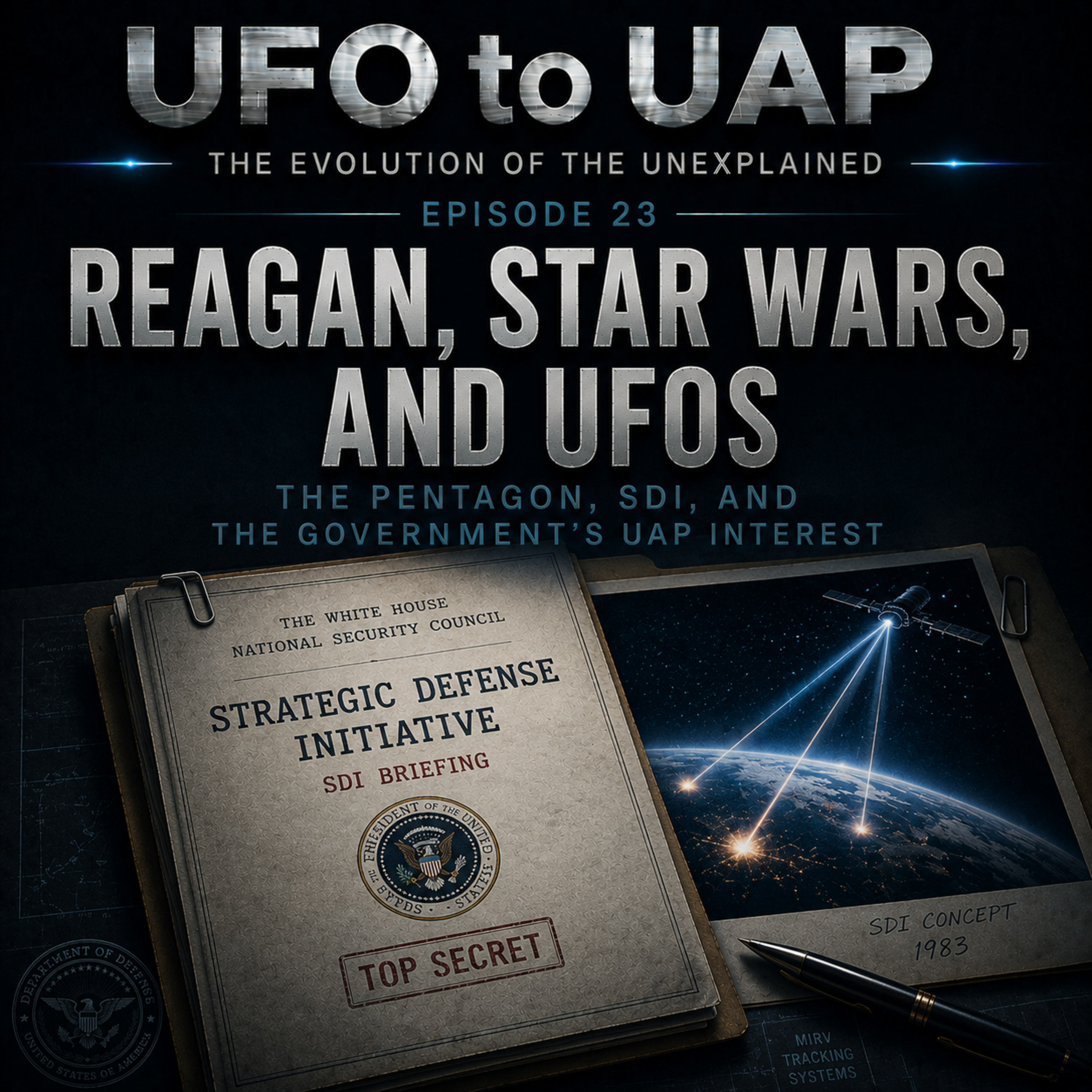
Cold War, Star Wars, and UAPs: Reagan's Space Defense Secrets
Tonight's Episode
How did Ronald Reagan’s Star Wars missile-defence programme help create the technological and political conditions behind the modern UAP era?
In this episode of UFO to UAP Explained, host Matt Tones examines the Cold War intersection of UFOs, space defence, military surveillance and strategic secrecy. The discussion begins with Reagan’s 1987 United Nations speech about an “alien threat” and asks whether the remark reflected hidden knowledge, political metaphor or a broader fear of the unknown.
Explore the Strategic Defense Initiative, known as SDI or Star Wars, and the radar, satellite and early-warning systems built to detect threats from space. As surveillance expanded, those systems also encountered anomalies: objects, signals and movements that did not match known patterns.
The episode investigates black programmes, stealth aircraft, classified testing, compartmentalisation and the possibility that advanced human technology can appear unidentified to pilots, radar operators and intelligence personnel. It also connects Cold War secrecy to modern UAP programmes, David Grusch’s claims and today’s multi-sensor detection networks.
Did Reagan know something about UFOs, or did his era simply build the systems that made modern UAP detection inevitable? Discover how power, perception and secrecy can transform incomplete data into enduring mystery.
Episode Timestamps
(0:00) The Cold War and a threat from beyond Earth
(1:20) Ronald Reagan and the UFO question
(1:39) Reagan’s 1987 United Nations speech
(2:33) Alien disclosure, speculation or metaphor?
(2:48) Nuclear tension and intelligence escalation
(3:21) Radar, satellites and early-warning networks
(3:35) The Strategic Defense Initiative and Star Wars
(4:12) Space surveillance begins detecting anomalies
(4:44) How UFOs became UAPs
(5:28) Close Encounters and Reagan’s alleged remark
(6:07) UFO narratives as strategic ambiguity
(7:13) Black programmes and hidden systems
(8:42) Stealth technology as an unexplained anomaly
(9:26) Classified testing in restricted airspace
(10:08) Compartmentalisation and internal uncertainty
(11:13) From unidentified objects to phenomena
(12:07) Cold War systems evolve into modern UAP programmes
(12:34) David Grusch and hidden programme claims
(13:13) Four explanations for UAP sightings
(14:24) The legacy narrative and intelligence frame
(15:32) Why more surveillance creates more anomalies
(16:12) From UFO objects to structured UAP analysis
(17:07) Reagan’s role in creating the modern context
(18:22) Intelligence systems manage threats, not truth
(19:14) From SDI and black programmes to modern UAPs
(19:41) Four possibilities behind the unknown
(20:42) What Reagan’s era actually changed
Sources:
Ronald Reagan Presidential Library — Strategic Defense Initiative records and Reagan UFO remarks;
National Security Archive — SDI / Star Wars documents;
U.S. Department of Defense historical records on the Strategic Defense Initiative;
CIA historical UFO records;
National Archives Project Blue Book records;
AARO Historical Record Report;
U.S. Department of Defense historical UAP reporting.
Keywords:
Ronald Reagan UFO speech, Reagan alien threat, Strategic Defense Initiative, SDI Star Wars programme, Cold War UFOs, Reagan UFO secrets, military space defence, satellite UAP detection, radar UFO evidence, black programmes, classified aerospace technology, stealth aircraft UFO sightings, compartmentalised intelligence, military surveillance systems, David Grusch claims, UAP national security, strategic ambiguity, government UFO secrecy, unidentified anomalous phenomena, UFO to UAP Explained.
There are moments in history when ideas exist quietly.
They circulate in books, in conversation, in speculation.
They are discussed but never acted upon.
And then something changes. The idea moves not into the
public, but into power. In the 1980's, the world was
divided. 2 superpowers, 2 ideologies, 2 systems locked in
a silent, permanent tension. This was the Cold War, a time
defined not by open conflict, but by anticipation of attack,
of escalation, of something that could arrive without warning.
And in that environment, one question began to take shape.
Not publicly, not formally, but quietly inside the thinking of
those at the highest levels. What if the threat didn't come
from Earth? Welcome back to UFODUAP, the
disclosure report. I'm your host, Matt Tones.
Thank you for listening in. Please subscribe and share the
episode, which is titled Reagan, Star Wars and the UFO Question,
Power, Perception and the Unknown.
To understand this episode, we begin with a man, Ronald Reagan,
President of the United States from 1981 to 1989, a former
actor, a communicator, A strategist, and importantly, a
leader. Operating at the height of Cold
War tension in 1987, Reagan addressed the United Nations.
And in that speech he said something unusual, something
that at first sounded hypothetical, but over time
would be revisited again and again.
He said perhaps we need some outside universal threat to make
us recognise this common bond. And then he made it explicit, I
occasionally think, how quickly our differences worldwide would
vanish if we were facing an alien threat from outside this
world. This was not a private comment,
not an offhand remark. This was a prepared statement
delivered to the world. What does this mean?
So this is where we're now going to slow down a little bit.
This moment is often misunderstood.
Was Reagan revealing knowledge, speculating or using a metaphor?
We really don't know. But what matters is not the
answer. What matters is the introduction
of the idea into the language of power.
To understand why this matters, we must understand the
environment Reagan operated in the 1980s were defined by
nuclear tension, rapid technological escalation,
constant intelligence activity. It was the Cold War reality.
At any moment the system had to be prepared for the unknown
missiles, new weapons, unexpected developments.
The central challenge was simple.
How do you detect something before it becomes a threat?
This led to massive investment in radar systems, satellite
surveillance and early warning networks, systems designed to
answer one question, what is out there?
In 1983, Reagan introduced one of the most ambiguous programmes
of the Cold War, the Strategic Defence Initiative, also
referred to as SDI and is often called Star Wars.
SDI was a proposal to create a space based defence system
designed to detect incoming missiles, track them and destroy
them before impact. SDI was not just the defence
programme, it was a redefinition of the battlefield from Earth to
space. Once you move defence into
space, you're no longer just tracking missiles and aircraft,
you're tracking everything. Anything that moves emits energy
and appears unexpectedly. Now this is where things begin
to shift, because once a system is built to detect threats, it
begins to detect anomalies. Objects that don't behave as
expected, don't match known profiles and don't follow
predictable patterns. This is the moment where UFOs
become Uaps, not unidentified objects, but unidentified
phenomena, something that is observed but not understood.
Now let's return to Reagan, because his comments must be
viewed in this context. A world where detection systems
are expanding, surveillance is increasing, and unknown signals
are possible. When Reagan speaks of an alien
threat, he may not be describing extraterrestrial beings.
He may be expressing something deeper, the fear of the unknown
entering the system. Now we introduce another layer
because Reagan was not just a president, he was a storyteller.
And this is where we enter the era of Close Encounters of the
Third Kind, A film that depicted government secrecy, showed UFO
contact, and suggested hidden knowledge.
Reagan reportedly watched this film at the White House and
after a statement is often attributed to him.
There are a number of people in this room who know that
everything in this film is absolutely true.
This quote is widely circulated but not formally verified.
But again, that is not the point.
The point is the overlap between perception and power.
During the Cold War, perception was everything.
Nations didn't just compete in weapons and technology.
They competed in narrative. In an if an adversary believes
you have advanced technology, unknown capabilities, and hidden
systems, that belief alone changes behaviour.
UFO narratives exist in a unique space.
They're difficult to verify, impossible to fully dissolve,
and highly adaptable, which makes them the perfect for
narrative ambiguity. Now we step back because by the
mid 1980's, the United States had built something
unprecedented. A system that could observe
globally, detect movement, track objects across space, not total
in the absolute sense, but moving toward comprehensive
awareness. When you build a system to see
everything, you'll eventually think, see things you cannot
explain. This is where we're going to
step into Part 2 of the episode, which I've put as the title,
Black programmes, Hidden systems and the Conditions for anomaly.
There is a version of history that is visible.
It is documented, it is discussed, it is recorded in
speeches, policy and public decision making.
But alongside it, there is another version, one that
operates quietly, hidden behind classification,
compartmentalisation and necessity.
This is the world of black programmes.
Programmes that exist without public acknowledgement, operate
without visibility and are known only to those with access.
They're not unusual, they're not anomalies.
They are a standard feature of national security systems
because some capabilities must be developed secretly, must be
tested without exposure, and must remain unknown to
adversaries. And during the Cold War, this
layer expanded dramatically. The Reagan era was not just
about policy. It was about acceleration and
technological pressure. The United States and Soviet
Union were competing in speed, altitude detection and stealth.
Each breakthrough created new unknowns, because every time a
new system was developed, it introduced new signatures, new
behaviours and new patterns of movement.
One of the most important developments was stealth
aircraft, designed to avoid radar, reduce visibility and
operate undetected. And stealth creates a bit of a
paradox to the system. Something is there, but it
cannot be fully tracked, clearly identified, or easily explained,
which means it appears as an anomaly.
And this is where perception begins to shift.
Advanced technology can look like unknown phenomena to
pilots, radar operators, and observers.
And when something cannot be explained, it enters a familiar
category, unidentified. Now we move deeper because
development is only one part of the equation.
The other is testing. When testing happens and
advanced systems are tested at night, in remote locations and
under controlled secrecy. Examples include desert ranges,
restricted airspace and classified facilities.
From the outside, observers see that these tests appear as
unusual lights, sudden movement, silent flight, and rapid
acceleration. The observers see something real
but does not know what it is. So the interpretation becomes
speculative and speculation feeds narrative.
Now we introduce one of the most important concepts in this
entire discussion, which is compartmentalization.
It means information is divided, access is limited.
Individuals know only what they need to know and only what
they're cleared to see. Even within the system, no
single individual sees everything, which creates
internal uncertainty. And this is critical because it
means anomalies are not just external, they are also
internal. An intelligence officer may
encounter data they cannot explain, systems are not aware
of, and information that appears incomplete and that creates
interpretive gaps. At this big point we begin to
see something new, a category forming, not formally but
functionally, the unknown objects of phenomena that are
detected, a real but cannot be identified as what I would say
defines the unknown. And this is the transition from
UFO object to UAP or phenomenon. Because now we're not just
asking what is that object, we're asking what system
produced this behaviour. Now we bring everything
together. Secrecy does not just hide
information, it shapes perception.
Observers outside the system see anomalies, unexplained events
and unusual behaviour. Without context these become
mysteries. But inside the system individual
see fragments, partial data and incomplete pictures.
Without full access, these become uncertainties.
Both groups face the same issue, lack of complete information,
but they interpret it differently.
And now we extend this forward to today because the systems
built during the Reagan era did not disappear, they evolved.
Today we have modern UAP programmes like Arrow, advanced
sensor networks and integrated surveillance systems, all built
on foundations created during the Cold War.
What we're seeing today may not be new, IT may be the
continuation of systems built decades ago.
Now let's look at how this connects to our previous
episodes, starting with David Grusch.
When Grusch claims hidden programmes exist, we must ask
when would such programmes have begun?
And the logical answer is, if they exist, they likely began
during periods of maximum secrecy and expansion.
Which brings us back to the Reagan area error.
We now see a pattern. Cold War led to system
expansion, Secrecy led to information gaps, advanced
technology led to anomalous observations, and the modern era
led to claims that are now emerging.
Now we explore what this means. Many UAP sightings maybe
advanced human systems seen without context.
That's scenario one and we'll label that misidentified
technology. Scenario two could be system
induced anomalies because complex systems produce
unexpected outputs which appear anomalous.
Scenario three could be hidden continuity programmes may have
begun in secrecy and continue today without public awareness.
Scenario four could be narrative convergence.
Different elements of technology, secrecy and
observation combined to create a unified narrative of the
unknown. Let's step back again.
We now have a system built to detect threats, technology
designed to evade detection, and secrecy limiting understanding.
Observers are interpreting incomplete data, and from that
we get anomalies. Not necessarily
extraterrestrial, not necessarily unknown, but
unresolved. And this is where we step into
Part 3, which I've given the title, Legacy narrative and the
intelligence frame. Systems do not end, they evolve.
Programmes are renamed, structures are reorganised,
technologies are replaced, but the underlying function remains.
The systems built during the Cold War did not disappear in
1989. That became the foundation of
modern intelligence infrastructure.
The goal remained unchanged. Detect, track and understand
that the capability has expanded from radar to satellites, multi
sensor systems and real time global awareness.
Today we have systems that can observe across the planet, track
objects in multiple domains and detect anomalies in real time,
which means that unknown is no longer rare, it is continuously
encountered. There is a paradox at the centre
of modern intelligence systems. The more you observe, the more
you detect, and the more you detect, the more anomalies you
find. In earlier decades, observation
was limited and anomalies were rare.
But today observation is constant, so anomalies are
frequent. And this is now a system that is
always encountering things that cannot immediately explain, not
because those things are extraordinary, but because the
system is now operating at scale.
Now we move into the public dimension because once system
evolves, so too does the narrative.
Stage 1, the object, and this is the 1940s through to the 1960s.
UFOs are described as objects in the sky and interpreted as
vehicles, craft, and possible extraterrestrial technology.
Stage 2 is the Silence era, the 1970s to the 1990s.
After Blue Book, official attention declines, public
interest continues. The narrative becomes
fragmented. Stage 3.
The system returns from the 2000s through the present.
With modern technology, observation increases and
anomalies reappear. The narrative shifts to UAP, not
objects but phenomenon. The phenomenon may be the same,
but the framework is different from speculation to structured
analysis. Now let's return to Reagan
because his role is not direct involvement but context
creation. Reagan represented a moment
where fear of the unknown was high, systems of detection were
expanding, and narrative was a strategic tool.
His alien threat statement revisited now takes on a
different meaning, not as literal belief but as a
reflection of systematic thinking, a system prepared for
any threat, even one it cannot define.
Now we reach one of the most important insights of this
episode. Narrative is not accidental.
It is a strategic component of power, and it matters because
perception influences behaviour, policy and response.
If something is perceived as unknown, it demands attention.
Is something as perceived as a threat, it demands action.
UFO narratives exist in a unique space.
They are persistent, adaptable, and difficult to resolve, which
makes them powerful. Now we apply the final layer,
the intelligence lens Systems are built for threat, not truth.
These intelligence systems do not exist to discover ultimate
truth, they exist to identify and manage risk.
When something cannot be explained, it is categorised,
not resolved. And secrecy now creates
structured gaps because information is limited,
compartmentalised and controlled, which means no one
sees everything. The more a system observes, the
more it encounters. Things cannot immediately sorry.
Things cannot immediately explain.
So narrative fills the space between data and understanding,
where data exists but explanation does not.
So now narrative emerges. Now we bring it all together.
From Reagan to SDI to black programmes to the modern UAP, we
see a continuous thread, a system designed to detect
threats, encountering anomalies which are interpreted through
narrative. This is not a story about
aliens, it is a story about how systems interact with the
unknown. So let's explore the final
possibilities here. Scenario one, the unknown is
technological. Advanced systems create
unexplained observations. Scenario 2.
The unknown is structural. The system itself produces
anomalies through complexities. Scenario 3.
The unknown is external. There are phenomena that do not
fit existing frameworks. Scenario 4.
The unknown is narrative, the combustion of observation,
secrecy and perception creating a sustained narrative of
mystery. So let's step back one final
time. We now have a system built to
see everything. Technology designed to evade
detection, secrecy limiting understanding and observers
interpreting incomplete data. And from that we get the
unknown. Not necessarily
extraterrestrial, not necessarily artificial, but
unresolved. Reagan did not confirm UFOs.
He did not reveal hidden programmes, but it existed at a
moment when the conditions for modern UAP narratives were
created. And those conditions persist
today. Because in the end, this is not
a story about one man, or one programme or one claim.
It is a story about a system built to protect itself from the
unknown. And in doing so, it created
something unexpected, a world where the more we see, the less
certain we become. And in that uncertainty,
something powerful emerges, not truth, but possibility.
This is UFO to UAP the disclosure report.
I'm Matt Tones. Sometimes the most important
question is not what is out there, but what happens when we
build systems that are capable of seeing it but not
understanding it. Thanks again.
Please share the episode and tell your mum about this.
Music.
 Amazon Music
 Apple Podcasts
 Castbox
 Castro
 Goodpods
 iHeartRadio
 Overcast
 Pocket Casts
 Podbean
 Podcast Addict
 Spotify
 YouTube