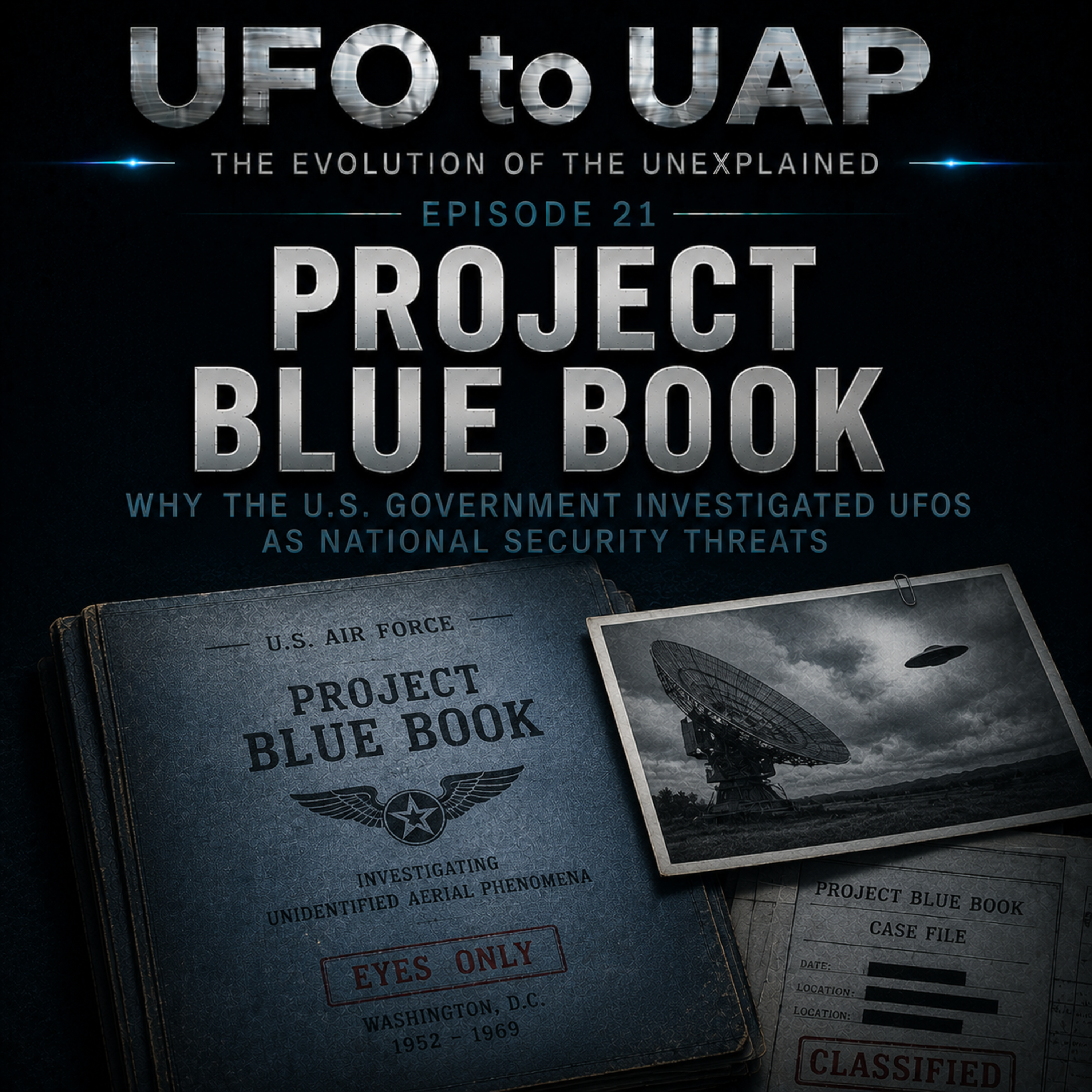
Project Blue Book: The Cold War Intelligence Mission for National Security
Tonight's Episode
Why was Project Blue Book created—and was the US Air Force investigating extraterrestrials or assessing Cold War threats?
In this episode of UFO to UAP Explained, host Matt Tones examines Project Blue Book as a national-security and intelligence programme rather than a search for alien life. As UFO sightings spread across American airspace after 1947, military officials faced a more immediate question: were unidentified objects Soviet aircraft, reconnaissance platforms, experimental technology or a threat to public confidence?
The episode traces the path from Project Sign and Project Grudge to Project Blue Book’s creation in 1952. It explores the programme’s three core missions: assess threats to national security, analyse UFO reports and explain sightings through known science. Across 12,618 investigated cases, most were attributed to aircraft, balloons, astronomical objects or atmospheric effects, while 701 remained unidentified.
Discover how understaffing, limited fieldwork and incomplete data shaped Blue Book’s conclusions; why “unidentified” did not mean extraterrestrial; and how the Condon Report helped end official investigation in 1969. Did Project Blue Book solve the UFO mystery, or did it only answer the narrower question of whether UFOs posed a confirmed threat?
Episode Timestamps
(0:00) The 1947 sighting that began the modern UFO era
(0:45) From curiosity to Cold War threat
(1:20) Project Blue Book was looking for threats
(2:00) The real mission behind the programme
(2:37) UFOs through the Cold War intelligence lens
(3:48) Project Sign and Project Grudge
(4:31) UFO sightings, media attention and public panic
(5:08) Project Blue Book’s three core goals
(5:46) How UFO reports were collected and classified
(6:12) 12,618 cases and 701 unidentified reports
(6:44) What “unidentified” actually means
(7:02) Rapid classification versus scientific investigation
(7:54) Project Blue Book’s 1969 conclusions
(8:53) The Condon Report and the end of official study
(9:22) How nuance became “nothing to see here”
(10:16) Mission defines outcome
(10:52) Was Project Blue Book correct or limited?
(11:09) Final assessment: intelligence, not alien research
(11:32) The UFO question Blue Book left open
Sources:
National Archives — Project Blue Book records;
U.S. Air Force historical records on Project Blue Book, Project Sign, and Project Grudge;
CIA historical material on Cold War UFO investigations;
University of Colorado / Condon Report;
AARO Historical Record Report;
U.S. Department of Defense historical UAP reporting.
Keywords:
Project Blue Book, Project Blue Book UFO investigation, US Air Force UFO programme, Cold War UFOs, Project Sign, Project Grudge, Condon Report, government UFO investigation, military UFO reports, UFO national security, UFO intelligence programme, 1947 UFO sightings, unidentified flying objects, UFO threat assessment, radar UFO reports, pilot UFO encounters, unexplained UFO cases, government UFO secrecy, UAP history, UFO to UAP Explained.
A pilot looks out across the sky over Washington state and sees
something he cannot explain. Not a weather balloon, not
another aircraft, not anything that fits within the limits of
known flight. He describes objects moving like
sources, skipping across water. And just like that, the modern
UFO era begins. Within weeks, sightings spread
across the United States, across military installations, across
civilian airspace. Reports came in from train
pilots, radar operators, ordinary people, or describing
something just outside of what should be possible.
At first, the question is simple.
What are we seeing? But very quickly, that question
evolves because it is not a time of curiosity.
This is a time of tension, a time of nuclear weapons emerging
missile technology had a rapidly escalating Cold War.
So the question changes from what is it to is it a threat?
Welcome back to UFO to UAP, the disclosure report.
I'm your host, Matt Tones. Thank you for listening.
Please subscribe and share. This episode, which is titled
Project Blue Book, wasn't looking for aliens, It was
looking for threats. That shift from what is it to is
it a threat? Changes everything.
Because when the United States Air Force creates A programme to
investigate these sightings, it's not asking if humanity is
alone. It is asking something far more
immediate. Are we under surveillance or
under test? That programme becomes known as
Project Blue Book, and over the next two decades it will
investigate more than 12,000 UFO sightings.
But here's where the story gets complicated.
Because most people believe Blue Book.
Sorry, Blue Book had one purpose, to determine whether
UFOs were extraterrestrial. But that's not what it was built
to do. Not even close.
So tonight, we're going to strip this back to the source.
Not the myth, not the simplified version, but the actual mission,
the actual conclusions, and the question that was never really
answered because Project Blue Book didn't close the UFO
question, it closed something else, the threat question.
To understand Project Blue Book, you have to understand the world
it came from, and that's looking at the Cold War lens.
The late 1940s and early 1950s were defined by one thing,
uncertainty. the United States had just entered the nuclear
age, seen the devastation of atomic weapons, and now faced A
geopolitical rival in the Soviet Union.
The Soviet Union was developing long range bombers, advanced
missile technology, and actively gathering intelligence.
The sky becomes strategic. Before this moment, the sky was
a frontier, a domain of exploration.
Now it becomes something else entirely, a potential vector of
attack. Unidentified objects in the sky
were no longer just curiosities. They were potential
reconnaissance platforms, experimental aircraft, or early
warning signs of technological breakthroughs.
So when UFO sightings begin to increase, the response is not
philosophical, it is operational.
Before Project Blue Book, there were two earlier efforts,
Project Sign in 1948 and Project Grudge in 1949.
Both were tasked with investigating UFO sightings.
Both attempted to answer are these objects foreign
technology? Project Sign reportedly
considered multiple possibilities, natural
phenomena, experimental US technology, Soviet technology,
and yes, extraterrestrial origins.
But crucially, extraterrestrial was treated as a hypothesis, not
a conclusion. Comparatively, Project Grudge
took a different turn. More sceptical, more dismissive,
focused on reducing public concern, explaining sightings
quickly. Because by now something else
had emerged. UFO sightings were not just
being reported, they were being amplified through newspapers,
radio and public speculation. And that created a new risk,
public panic. So now the problem becomes
twofold. What are these objects?
How do we prevent these from destabilising public confidence?
So if we now look at the mission in reality, you know, in 1952,
Project Blue Book was established and its mission is
clearly defined. Project Blue Book had three core
goals. Determine if UFOs posed a threat
to national security, analyse and evaluate UFO related data
and explain sightings using known scientific knowledge.
Now this is critical. You'll note there is no mandate
to prove extraterrestrial life or to disprove extraterrestrial
life. That was not the mission.
The structure of the programme had Project Blue Book operated
as a centralised reporting system, an investigative unit
and a classification mechanism. Reports would come in from
military personnel, radar operators, civilians and they
would then be analysed, categorised and either explained
or left unresolved. Now the scale of the data.
Over its lifetime there were 12,618 cases investigated.
This includes visual sightings, radar confirmations, pilot
encounters and multi witness events.
Most cases, however, were explained as aircraft, weather
balloons, astronomical objects or atmospheric phenomena, but
not all. There was 701 cases that
remained unidentified. Now, let's be be precise here.
Unidentified does not mean extraterrestrial, nor advanced
technology, nor unknown origin. It means insufficient
information to determine 'cause now we go deeper here and look
at the investigation process. Because how Blue Book operated
is just as important as what it concluded.
This is the deeper reality. Speed over death.
Depth. Blue Book was not designed for
deep scientific exploration, it was designed for rapid
classification. Why?
Because the priority was risk assessment and there were
resource constraints. The programme was understaffed,
underfunded and often overwhelmed and this meant
limited follow up, minimal field investigation and reliance on
incomplete data. The practical outcome saw that
many cases were quickly explained or left unresolved,
not because they were deeply studied, but because they could
not be resolved within operational constraints.
So the conclusion, what was actually said in 1969, Project
Blue Book ends and its conclusions are formally stated,
the three key findings and it's important we really focus on
what was said here. No UFO investigated indicated a
threat to national security. No evidence suggested technology
beyond known scientific capabilities.
No evidence indicated extraterrestrial vehicles.
And this is where everything gets misunderstood.
These conclusions abounded by the data and mission of the
programme. They do not say UFOs do not
exist, nor do they not say. They also do not say unexplained
phenomena are not real. What they say is within the
scope of investigation. No threat or advanced technology
was confirmed. At the same time, the US
government commissions an independent study known as the
Condon Report, conducted by the University of Colorado.
It's purpose to determine whether further study of UFOs
was scientifically valuable, and its conclusion was that further
study was unlikely to yield significant scientific
breakthroughs. And it's an important
distinction. This is not a statement about
truth, it's a statement about research value.
So the misinterpretation and and the public narrative, Let's look
at that. Over time, Blue Book's
conclusions have been simplified from nuance to sound bite.
The original no threat identified, no advanced
technology confirmed becomes nothing.
To see here why this happens? Because complex conclusions are
hard to communicate, they're very easy to simplify and often
reshaped by media. So what is the pattern here?
Let's zoom out from the micro details a little bit.
And if we look at the patterns across our last several
episodes, we've explored ancient texts as being at the
interpreted layer. We've seen global theories
constructed, and now we're seeing government programmes
simplified explanations. Project Blue Book fits perfectly
into this structure. So what is the intelligence lens
here? What's the deeper dive?
Mission defines outcome. Blue Book answered the question
it was designed to answer. Is this a threat?
An unknown does not equal threat.
An unidentified object is not automatically dangerous,
advanced, or even extraterrestrial.
Unresolved cases reflect limits of investigation, not proof of
phenomenon, and public understanding simplifies complex
findings. If Blue If Blue Book was
correct, then most sightings have conventional explanations
and identified cases are likely data gaps.
If Blue Book was limited, then some phenomena may not have been
fully investigated and important data may have been missed.
So my final assessment is this Project Blue Book was a Cold War
intelligence programme. It focused on risk.
It was designed for classification.
It was not a definitive study of UFOs or a search for
extraterrestrial life. Because the big, because the
question Blue Book answered was never are we alone?
It was are we at risk? And once that question was
resolved, the programme ended. But the other question remains
open. This is UFO to UAP the
disclosure report. I'm Matt Tones and sometimes
what a system is is designed to detect Matt is more than what it
never finds. Please subscribe, please share
the episode and don't forget to tell your mom about this one.
Music.
 Amazon Music
 Apple Podcasts
 Castbox
 Castro
 Goodpods
 iHeartRadio
 Overcast
 Pocket Casts
 Podbean
 Podcast Addict
 Spotify
 YouTube