Unveiling the Hidden UAP Program: Congressional Records and Pentagon Secrets
Tonight's Episode
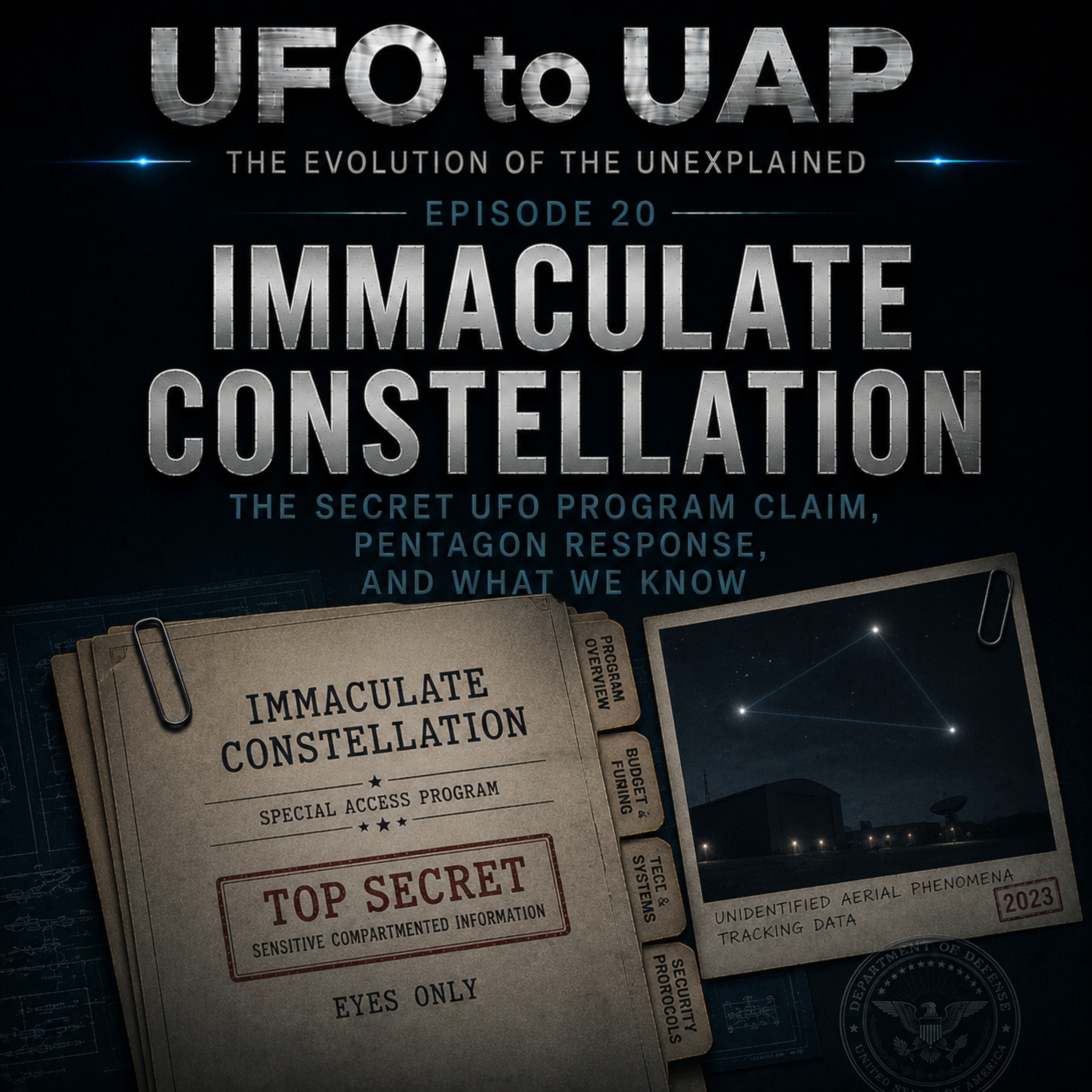
What is Immaculate Constellation—and could an alleged hidden UAP programme be collecting and filtering sensitive UFO data before it reaches wider intelligence systems or congressional oversight?
In this episode of UFO to UAP Explained, host Matt Tones investigates the controversial programme named in written testimony submitted during a November 2024 US House Oversight Committee hearing. The document describes a whistleblower account alleging that Immaculate Constellation is an unacknowledged special access programme created to gather UAP data from infrared sensors, FLIR imaging, satellites and full-motion video.
The most significant claim is not simply that the programme collects information, but that it may intercept and quarantine UAP evidence before it enters standard intelligence channels. If true, analysts and oversight bodies could be working with incomplete or filtered data. However, the episode separates the verified existence of the congressional testimony from the unverified existence of the alleged programme itself.
Explore the Pentagon’s denial, special access programmes, intelligence compartmentalisation, information control and four possible explanations: a genuine hidden programme, a misidentified data system, a classified simulation environment or a narrative gaining authority through official process. What evidence would be required to prove Immaculate Constellation is real?
Episode Timestamps
(0:00) The hidden UAP programme claim
(0:30) Immaculate Constellation enters the Congressional Record
(1:31) The November 2024 House Oversight testimony
(2:05) A whistleblower account enters official process
(2:36) The alleged unacknowledged special access programme
(3:23) Infrared, FLIR, satellite and video collection
(4:02) The claim that UAP data is intercepted
(4:31) Quarantining evidence and controlling distribution
(5:02) Verified testimony versus an unverified programme
(5:42) The Department of Defence denial
(6:15) What an official denial could mean
(6:37) Scenario one: a genuine hidden programme
(7:04) Scenario two: a misidentified intelligence system
(7:29) Scenario three: a classified simulation
(7:51) Scenario four: narrative formation
(8:20) How official process creates institutional weight
(8:43) Information asymmetry and classified systems
(9:12) What evidence would prove the programme exists?
(9:41) The space between claim, record and denial
(10:05) When a claim becomes official before proven
Sources:
U.S. House Oversight Committee UAP hearing records;
David Grusch congressional testimony;
UAP Disclosure Act / NDAA records on recovered technologies, whistleblower protections, SAPs, and contractor oversight;
AARO Historical Record Report;
U.S. Department of Defense statements on alleged hidden UAP programs;
ODNI / DoD Annual UAP Reports;
NASA UAP Independent Study Team Report.
Keywords:
Immaculate Constellation, hidden UAP programme, Congressional Record UAP claim, November 2024 UAP hearing, UAP whistleblower testimony, unacknowledged special access programme, USAP, Pentagon UFO secrets, Department of Defence denial, classified UAP data, FLIR UAP footage, satellite UAP surveillance, intelligence compartmentalisation, UAP data filtering, congressional UAP oversight, secret UFO programme, controlled disclosure, information management, government UFO secrecy, UFO to UAP Explained.
What if the most important UAP programme in existence is the
one that was never meant to be acknowledged?
Not hidden behind classification, but hidden
behind something more effective. Absence.
No budget line, no official record, no confirmed existence.
And yet a name appears. Not leaked in fragments, not
whispered through forums, but entered formally into the United
States Congressional Record Immaculate Constellation, a
programme described as collecting the most sensitive
UAP data ever captured. But not just collecting it,
controlling it, filtering what is seen and what is allowed to
be understood. And then almost immediately
comes the response. Clear, direct, unambiguous.
It does not exist. So tonight, we're not chasing
speculation. We're examining something far
more precise. A claim that entered the
official record, the structure that was described in detail,
and a denial that shut it down just as quickly.
Because in this case, the story is not just what was said, it's
where it was said and what happened next.
Welcome to UFODUAP, the disclosure report.
I'm your host Matt Tones, thank you for listening.
Please subscribe and share the episode which is titled
Immaculate Constellation. The claim, the record and the
denial. Let's start with what we can
confirm. On November 2024, during AUS
House Oversight Committee hearing on UA, PS journalist
Michael Shellenberger submitted written testimony.
This is not speculation. This document exists, is
publicly accessible, and is archived within official
congressional records. Inside that document is a
reference to a whistleblower account, and within that account
is the first formal mention of Immaculate Constellation.
This is where the story separates from most UAP claims.
This is not an anomalous leak, a second hand report or a media
rumour. This is a claim introduced
through official process and that gives it weight.
Not proof, but weight. According to the testimony, a
current or former U.S. government official provided
information to Congress describing an unacknowledged
special Access Programme, or USAP, allegedly established
around 2017 and operating outside standard reporting
structures and potentially outside congressional oversight.
The name, the programme is identified as Immaculate
Constellation, a name that carries a very specific tone.
Clean, precise, controlled. And that tone matters because it
suggests organisation, not anomaly.
Now we slow this down and let's look at the claim.
You know what was described because this is where the
episode becomes critical. We're going to walk through the
claim as it was presented. So the core function, according
to the whistleblower account, Immaculate Constellation was
designed to collect UAP related data from multiple intelligence
sources, including infrared systems, FLIR imaging, satellite
surveillance, and full motion video.
But this is not unusual. Many programmes collect
intelligence data. Or makes this difference is what
comes next. The key allocation is that the
programme did not just collect data, it intercepted it before
it entered broader intelligence systems.
Let's just let that land because this changes everything.
If true, this would mean UAP data is being segregated at the
source. Standard analysts may never see
the full data set and oversight bodies may be working with
filtered information. The whistleblower description
suggests the programme exists to detect UAP events, quarantine
sensitive data and then control distribution.
Not suppression, not denial, but something more structured.
Information management if accurate.
This is not just a problem, it is a system level philtre, A
mechanism that determines what becomes known all and what never
does. Now we stop because this is
where the most discussions lose discipline on the claim versus
reality. Let's separate what we actually
have. What is real.
The document exists, The testimony was submitted, the
claim is formally recorded. What is not confirmed, the
programme itself, any internal documentation and any supporting
evidence beyond the claim. And this is the line.
The existence of the claim is verified, the existence of the
programme is not. And that distinction is
everything. So let's now look at
institutional response, or the denial.
Shortly after the claims surfaced, the Department of
Defence responded and the response was simple.
No such programmes exist. No record, no SAP, no historical
reference. So why does this matter?
Because now we have a formal claim and a formal denial, both
within official channels. So what does the denial mean?
In intelligence terms, denial does not automatically equal
truth. It can mean the programme does
not exist, the programme exists under another name, the claim is
incorrect, the claim is misinterpreted, and at this
stage we cannot confirm which one is true.
So let's now explore alternative explanations from an expanded
analysis. And this is where we move deeper
because this is where the real investigation begins.
Scenario 1. The programme exists.
In this case, the whistleblower is accurate, the programme is
real, and it has remained outside traditional oversight.
This would imply extreme compartmentalization,
intentional control of UAP data and a structured gap in
accountability. Scenario 2.
Misidentified system The whistleblower encountered real
systems, real data pipelines, but misinterpreted their
function. Possibilities include sensor
fusion systems, classified intelligence workflows or data
prioritisation systems. Scenario three could be a
simulation environment. There is increasing discussion
that references like this may relate to classified wargaming
environments or scenario modelling frameworks where
hypothetical programmes are treated as real within a
simulation scenario 4. Narrative formulation.
And this is the most subtle possibility, that we are
witnessing A narrative forming inside official structures where
claims gain legitimacy through process rather than evidence.
Now let's zoom out and let's explore the pattern, because
this is where everything connects.
Across our recent episodes, we've seen ancient texts
interpreted, global theories constructed, constructed, modern
claims institutionalised, and now a claim entering official
record without proof. The pattern is consistent.
Humans observe, interpret, structure and formalise, and
once something is formalised, it gains weight.
Now let's apply our core intelligence lens on this and
dive a little bit deeper. Institutional gravity.
Once something enters Congress, official testimony or public
record, it becomes real in process, even if it's not real
in fact. Information asymmetry.
Most people cannot access classified systems and cannot
verify internal programmes. So narratives fill the gap
between what is said and what can be proven.
If a system like this existed, its purpose would not be
discovery, it would be control. Control of data, interpretation
and access. So what is the real question?
And this is where the episode sharpens.
The question is not is Immaculate Constellation real?
The question is what level of evidence would we need to prove
that it is real? So where does this leave us?
Immaculate Constellation is a documented claim introduced
through official channels describing a highly specific
structure, but it is not confirmed, verified, or
supported by independent evidence.
The truth sits here between claim record and denial, and
that space is where this entire story exists.
Because in the end, this is not just a story about a programme,
it's a story about process and what happens when a claim
becomes official before it becomes proven.
Because once something enters the record, it doesn't
disappear. It lingers, it evolves, and it
shapes the way we ask questions moving forward.
This is UAUFO to UAP the disclosure report.
I'm Matt Tones, and sometimes the most important thing isn't
what's hidden, it's what we think we've already found.
Thanks for listening. Please subscribe and don't
forget to tell your mom about the episode.
Music.
 Amazon Music
 Apple Podcasts
 Castbox
 Castro
 Goodpods
 iHeartRadio
 Overcast
 Pocket Casts
 Podbean
 Podcast Addict
 Spotify
 YouTube