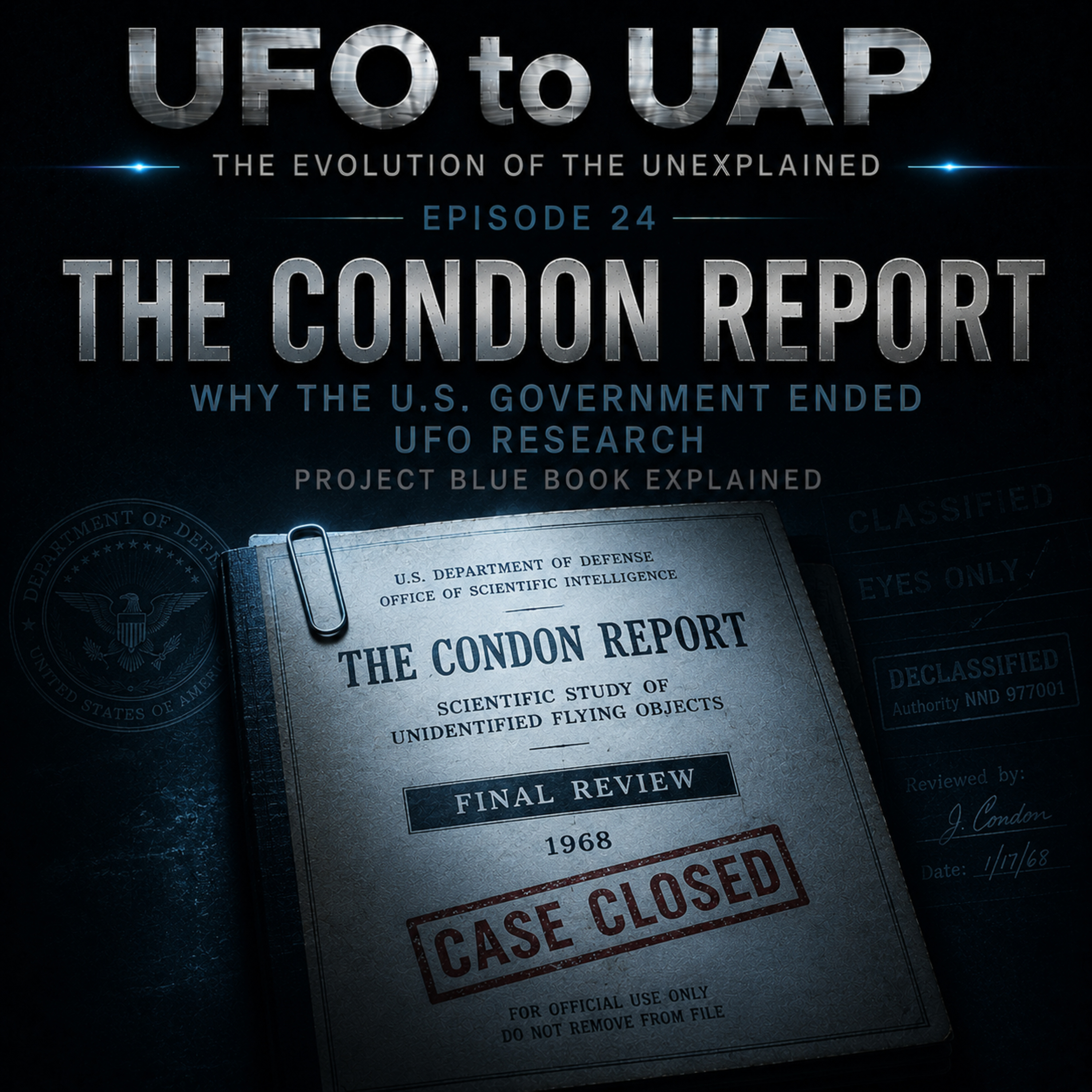
The Condon Report: How a Historic Study Ended Official UFO Investigations
Tonight's Episode
Why did the Condon Report help end official US UFO investigations—and did it resolve the mystery or simply close the door?
In this episode of UFO to UAP Explained, host Matt Tones examines the 1968 University of Colorado UFO study led by physicist Edward Condon. Commissioned by the US Air Force after Project Sign, Project Grudge and Project Blue Book failed to settle the UFO question, the study was intended to determine whether unidentified flying objects deserved further scientific investigation.
The episode explores the report’s central contradiction: many cases were explained, yet some remained genuinely unresolved, while the final conclusion argued that continued UFO research was unlikely to produce scientific value. It also examines the controversial Low Memorandum, internal disagreements, institutional expectations and how a summary can shape public policy more powerfully than the complex evidence inside a report.
After the Condon Report, Project Blue Book closed, mainstream scientific interest declined and UFO research became associated with stigma and reputational risk. Decades later, military radar, infrared footage and multi-sensor UAP encounters forced government institutions to reopen a question they had once declared unworthy of study.
Did the Condon Report scientifically disprove UFOs, or did it terminate an unresolved investigation? Discover how one historic study shaped decades of silence and the modern return of UAP research.
Episode Timestamps
(0:01) Why institutions demand definitive answers
(0:44) The UFO question facing America
(1:17) Project Sign, Project Grudge and Project Blue Book
(2:02) Unexplained cases keep the mystery alive
(3:26) The University of Colorado enters the investigation
(3:50) Edward Condon and scientific authority
(4:22) The real question behind the study
(5:43) How the Condon investigation was structured
(6:39) Unresolved cases inside the data
(7:23) Internal conflict within the project
(8:00) The controversial Low Memorandum
(8:43) The final report and its conclusion
(9:20) The contradiction between evidence and summary
(10:16) How the conclusion became the public narrative
(10:36) Project Blue Book closes
(11:04) The birth of scientific UFO stigma
(12:19) Resolution versus termination
(13:28) UFO research moves outside mainstream science
(15:17) Military UAP encounters reopen the question
(15:56) Why UFO became UAP
(16:21) Modern investigation in the report’s shadow
(17:16) When narrative overrides complex data
(17:55) UAP research as a system correction
(18:22) The lasting legacy of the Condon Report
Sources:
University of Colorado — Scientific Study of Unidentified Flying Objects / Condon Report;
National Archives — Project Blue Book records;
U.S. Air Force historical records on Project Blue Book;
CIA historical material on UFO investigations;
AARO Historical Record Report;
U.S. Department of Defense historical UAP reporting.
Keywords:
Condon Report, Edward Condon, University of Colorado UFO study, Project Blue Book, Project Sign, Project Grudge, Low Memorandum, official UFO investigations, US Air Force UFO study, UFO stigma, scientific UFO research, unresolved UFO cases, government UFO policy, UAP research, military UAP encounters, radar UFO evidence, infrared UAP footage, controlled closure, unidentified anomalous phenomena, UFO to UAP Explained.
There are questions that remain open, they are discussed, they
are debated, they are investigated, but they are never
resolved. And for a time, that is
acceptable, because uncertainty can be tolerated.
But only up to a point, Because eventually a question stops
being interesting and becomes a problem.
A problem for institutions, governments, and systems that
depend on certainty. And when that happens, the
question must be answered, not necessarily correctly, but
definitively. In the 1960's, the United States
faced exactly that problem. The question was simple, but its
implications were not. What are UFOs and more
importantly, do they represent something that must be taken
seriously? Welcome to USODUAP, the
disclosure report. I am your host, Matt Tones.
Thank you for joining. Please subscribe, share the
episode. And today's is titled the Condon
Report, the study that closed the door.
To understand the Condon Report, we must first understand the
environment that created it in the 1940s.
In the late 1940s, reports began to appear.
Pilots, civilian military personnel, all describing
objects in the sky that did not behave as expected.
These reports were frequent, inconsistent, and difficult to
explain. The US Air Force responded with
a series of investigations, Project Sign, Project Grudge,
and eventually Project Blue Book, each attempting to answer
the same question. What are we seeing?
By the early 1960s, Project Blue Book had been running for over a
decade. Thousands of cases had been
reviewed and yet no definitive conclusion had been reached.
Most cases were explained, attributed to natural
phenomenon, or misidentified, but a small percentage remained
unexplained. This created a structural issue
because even if 95% of cases were solved, the remaining 5%
kept the question alive, and as long as the question remained,
so did public interest. By the mid 1960s, UFOs were no
longer just a military concern, they had become a public issue.
Newspapers, television, public discussion, wide media
attention, all focused on the unexplained.
Scientists began to engage, some curious, some open to
investigation, but many others were sceptical and dismissive.
At this point, we see a divide forming between those who
believe the phenomenon deserves study and those who believe it
is does not. This is where everything changes
as the university enters the story, because the question is
no longer left to the military, it is handed to science.
University of Colorado Boulder, for example, the US Air Force
commissions a study, not internal but external,
independent, an academic study. At the centre of this study,
Edward Condon, a physicist, A respected scientist, chosen to
leave the investigation. So why was Condon selected?
Because he represented credibility, scientific
authority, and public trust. But this was not just an
investigation. It is a transfer of
responsibility from military uncertainty to scientific
authority. Now we arrive at something
critical, and that's the real question behind the study.
The stated purpose of the study was to determine whether UFOs
represent a scientific problem. But the deeper question was,
should this topic continue to be taken seriously?
This is not just about UFOs, it is about legitimacy, whether the
subject belongs in science, deserves funding and warrants
continued investigation. From the beginning, there was an
expectation, not necessarily stated but implied.
The study would resolve the issue and provide clarity,
direction and closure. And this matters because systems
cannot operate indefinitely under uncertainty.
At some point they must decide. By the late 1960's, the stage is
set, everything was in place. A long history of investigation,
public interest and pressure, scientific involvement and
institutional expectation, all leading to 1 moment, one report,
1 conclusion that would determine the future of UFO
research. Part 2.
The study. The conflict and the
contradiction When the study began, it did not begin as a
conclusion, it began as an investigation.
A structured effort to examine UFO reports, observational data,
and patterns across cases under the direction of Edward Condon
at the University of Colorado Boulder.
The structure of the study was a project that brought together
physicists, engineers, and analysts with the stated goal to
determine whether UFOs represent a phenomenon worthy of
scientific study. Now, what does this imply?
This is important. The goal was not what are UF OS.
It was are UF OS worth studying at all?
And that distinction shapes everything that follows.
As the study progressed, something begin to emerge.
Not a clear answer, but a patent.
Hundreds of UFO reports were examined.
Many were explained, but some remained unresolved.
And just like earlier investigations, most cases
explained a small percentage unexplained.
But here's where it becomes critical.
The unexplained cases were not dismissed.
They're acknowledged as genuinely puzzling.
And this mirrors Project Blue Ball.
This means the data did not eliminate the phenomenon.
It confirms something remains unexplained.
Now we move into the part most people never hear about, the
internal tension, because inside the study there was a
disagreement. Some researchers believe the
phenomena deserved further investigation, others believed
it did not. This core divide created a split
between data driven interpretation and institutional
expectation. And this matters because this is
the moment where science meets pressure.
Not necessarily external pressure, but expectation of
outcome. At one point, a document emerged
within the project known as the Low Memorandum.
Authored by project coordinator Robert Lowe, the memo indicated
that the study could be structured in a way that would
appear objective while still leading to a predetermined
conclusion. This is not proof of conspiracy,
and we need to be careful here, but it is evidence of strategic
thinking about how the study would be perceived, and this is
a key moment. Deception versus process because
it introduces perception as part of the outcome, not just the
findings, but how those findings are presented.
After years of work, the study produced its final report, a
large document detailed containing case analysis,
technical discussions, and observational breakdowns.
At the very front of the report was a summary, and that summary
stated UFOs do not represent a subject worthy of further
scientific studies. Now, this is the turning point
because this is the statement that matters, not the data, not
the cases, but the conclusion. And this is where we arrived at
the contradiction. And it's the most important
insight because when you look deeper into the report,
something becomes clear inside the report.
Some cases remain unexplained. Some are described as unusual,
difficult to interpret, lacking clear explanation.
But the conclusion states no scientific value.
We now have data that contains unresolved cases and a
conclusion that dismisses the entire subject.
This is not about whether UFOs are real, it is about how
decisions are made. In any large system.
Most people do not read the full report.
They read the summary. They read the conclusion, which
is why it matters more than the data.
The summary becomes the narrative.
It is what policy makers use media reports and institutions
respond to. The complexity of the data is
replaced by a simple conclusion and that conclusion becomes
reality. Following the report, the US Air
Force made a decision to end Project Blue Book and to state
UFOs do not require further investigation and this is the
impact. This was not just a decision, it
was closure. After the report, the scientific
community larger largely adopted its conclusion.
UFOs became a topic outside mainstream science.
And this is where we see the birth of a stigma.
This is where the stigma begins, not from ridicule, but from
institutional disinterest. So let's step back for a moment.
We now have a detailed study containing unresolved cases
producing A dismissive conclusion, which is accepted by
institutions and that leads to the end of official
investigations. This is where we're going to
step into Part 3 titled Stigma, Silence and the Return of the
Unknown. When the report was released,
something changed, not suddenly, not dramatically, but
decisively. The question of UFOs, which had
remained open for over 2 decades, was no longer treated
as unresolved, it was treated as closed.
Following the conclusions of Edwin Condon's study, we saw
that institutional shift. The United States Air Force
ended Project Blue, booked FEAST formal investigation, and
publicly stated no further study was required.
Closure does not mean the problem is solved, it means the
system has decided to stop looking now.
There is a difference, and this is critical because it
introduces A distinction between resolution and termination.
The UFO question was not resolved, it was terminated as
an area of active inquiry. Once the decision was made, the
effects began to spread. It was the creation of stigma,
not through policy but through culture.
After the Condon report, most scientists avoided the topic
entirely, not because it had been fully disproven, but
because it had been classed as an unworthy sorry.
It had been classified as unworthy of study.
And this creates something powerful.
It's a social mechanism, a condition where engaging with
the topic carries risk, not physical risk, but reputational
risk. Stigma does not require
censorship, enforcement or prohibition.
It only requires disincentive. The result?
UFO research moves out of universities, out of formal
science, and into the margins. From the late 1960s into the
70s, eighties and beyond, a pattern emerges.
There is no major government programme, scientific initiative
or institutional focus on UFOs. We've got official silence, but
there's public persistence because yet the reports
continue. Pilots, civilians, observers
still describing unexplained phenomenon.
Now we have a divide or disconnect between experience
and institutional response. The gap widens because the
system says this is not worth studying.
But observers say something is still happening.
When official channels close, something else happens.
The conversation moves. And this is where we see the
rise of alternative narratives. We see the movement from
institutions to culture, books, films, and media.
UFOs become a topic of fascination, a subject of
speculation, a foundation for storytelling.
Without formal study, structured analysis and institutional
engagement, the topic becomes uncontrolled.
Different interpretations emerge.
We see narrative expansion, extraterrestrial secret
technology and and conspiracy all existing simultaneously
without resolution. But decades later, something
changes, not in the phenomenon, but in the system.
In the 2000s and 2000 and 10s, military encounters begin to
surface. We see the re emergence of Uaps.
Pilots report objects moving at extreme speeds, objects without
visible propulsion, objects behaving unpredictably.
But this time there's a key difference.
This time the observations are recorded on infrared radar,
multi sensor systems. The system can no longer ignore
it because now there's data that exists within the system, so it
must be addressed. And this is where the language
changes from UFO Unidentified flying Object to UAP
Unidentified Aerial phenomenon. Why this matters is because the
shifts the focus from object to behaviour.
This allows the system to re engage, investigate and analyse
without reopening the stigma of the past.
Now we connect everything because the return of UAP
investigation did not happen in isolation.
It happened in the shadow of the condom report.
The condom report established that UFOs were not worth
studying. What that created was decades of
silence, stigma in science, absence of formal research.
But today we see a system that must now rebuild its
understanding after decades of disengagement.
Now let's apply our strongest layer, the intelligence lane.
Lens systems prioritise closure over uncertainty.
When faced with unresolved questions, systems preferred
definitive conclusions, even if those conclusions are
incomplete. Narratives can override data.
The Condon report demonstrates that a study sorry that a
summary can define reality even when the data is more complex.
And stigma is a structural outcome because once a topic is
dismissed, engagement decreases, not because the phenomenon
disappears, but because interest becomes costly.
Absence. A study does not equal absence
of phenomenon. And we saw that, you know, the
silence that followed did not eliminate reports, it only
eliminated formal investigation. And the return of UAP is a
system correction. Modern UAP programmes represent
a re engagement with something that was prematurely closed.
So let's step back one final time.
We now have a long history of observation, A decisive
institutional closure, decades of silence, and now a modern
return. And at the centre of it all, one
document, the Condon report. The Condon report did not prove
that UFOs are real. It did something more important.
It determined that the question itself was no longer worth
asking. And that decision shaped
everything that followed. Because in the end, this was
never just about UFOs. It was about how systems deal
with uncertainty. And when uncertainty becomes
inconvenient, the system does something very specific.
It closes the door, not because the question is answered, but
because it no longer wants to ask it.
And for decades, that door remained closed until something
forced it open again. This is UFO to UAP the
disclosure report. I'm your host, Matt Tones.
Thank you for listening. Please share the episode and
I'll leave you with one last thought.
Sometimes the most important question is not what we
discovered, but what we chose to stop looking for.
Music.
 Amazon Music
 Apple Podcasts
 Castbox
 Castro
 Goodpods
 iHeartRadio
 Overcast
 Pocket Casts
 Podbean
 Podcast Addict
 Spotify
 YouTube