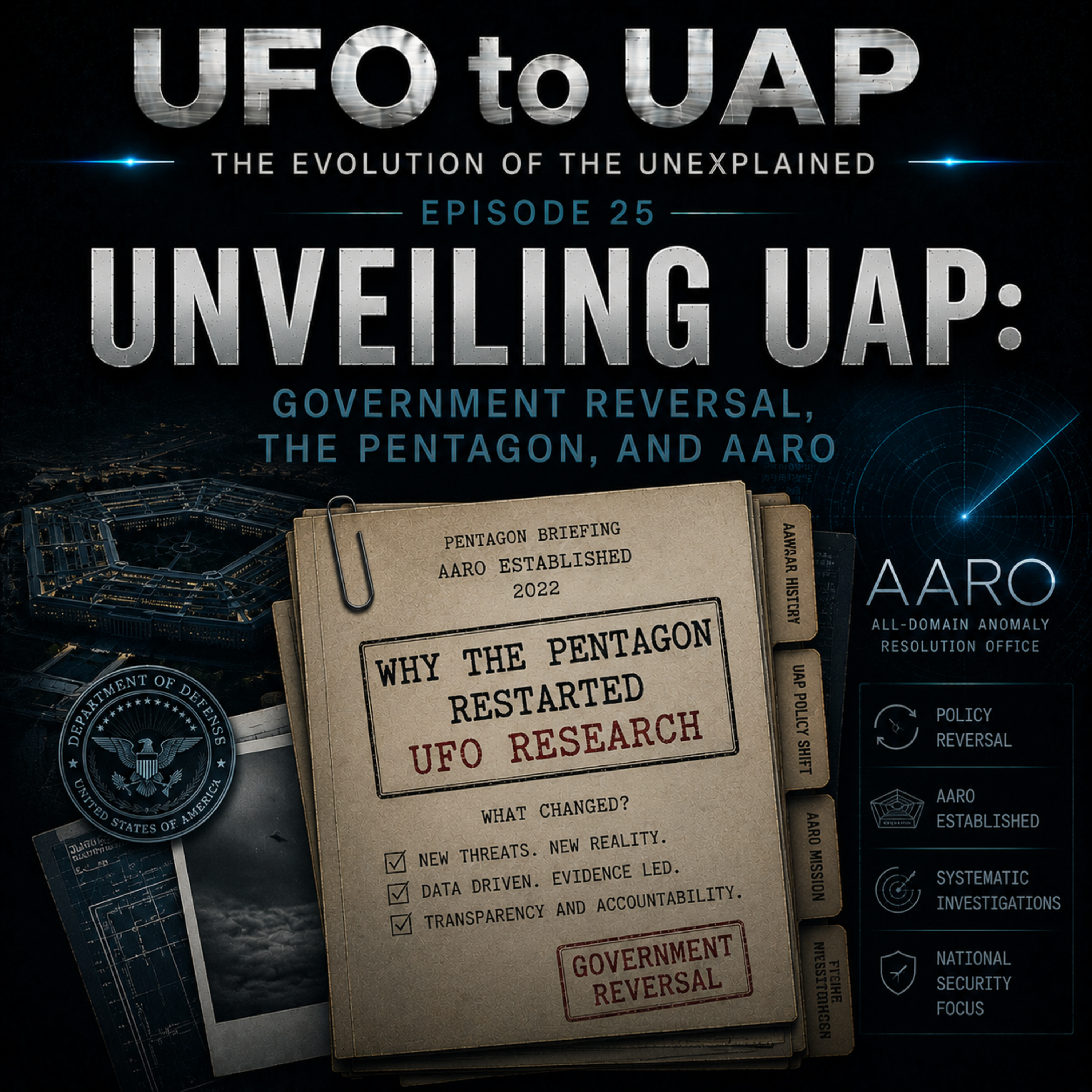
Unveiling UAP: Government Reversal, The Pentagon, and AARO
Tonight's Episode
Why did the US government stop investigating UFOs in 1969—then quietly reopen the question decades later through the Pentagon, AATIP, the UAP Task Force and AARO?
In this episode of UFO to UAP Explained, host Matt Tones investigates the government reversal that transformed UFOs from a dismissed cultural subject into a recognised national-security and intelligence concern. After Project Blue Book and the Condon Report, official investigation largely disappeared, but military pilots and radar operators continued reporting unexplained objects.
The episode explores how advanced radar, infrared systems and multi-sensor tracking changed the evidence landscape. Once unusual objects were repeatedly detected in controlled airspace, the question shifted from scientific curiosity to potential risk. That change helped drive the creation of the Advanced Aerospace Threat Identification Program, the UAP Task Force and the All-domain Anomaly Resolution Office, known as AARO.
Why did UFO become UAP? Was the release of Navy footage genuine transparency or controlled visibility? And is the government trying to solve the phenomenon—or simply manage an ongoing category of uncertainty? Discover why modern UAP research returned, how stigma was replaced by institutional process and why the Pentagon may never provide one final answer.
Episode Timestamps
(0:02) Why governments stop asking difficult questions
(0:32) Project Blue Book closes the UFO investigation
(1:20) Why the UAP question returned
(2:06) The silence after the Condon Report
(2:46) UFO reports continued without a formal system
(3:39) Military detection technology transforms the evidence
(4:33) Radar, infrared and multi-sensor UAP tracking
(5:27) The shift from curiosity to national-security risk
(6:21) AATIP quietly reopens the UFO question
(7:24) Persistent unexplained patterns emerge
(8:12) When anomalies become an intelligence problem
(9:12) Creation of the UAP Task Force
(9:58) Why UFO was rebranded as UAP
(10:16) Navy footage and Pentagon acknowledgement
(11:12) Disclosure versus controlled visibility
(12:14) AARO institutionalises UAP investigation
(13:13) Why improved sensors forced government action
(14:09) From isolated incidents to a recognised category
(14:59) How language controls the UAP debate
(15:50) Disclosure as a managed process
(16:43) Whistleblowers force official responses
(17:33) Managing the unknown instead of solving it
(18:28) The repeating cycle of UFO investigation
(19:22) Why the government could no longer look away
Sources:
U.S. Department of Defense — Historical Navy UAP Video Release;
ODNI — 2021 Preliminary Assessment on Unidentified Aerial Phenomena;
U.S. Department of Defense — UAP Task Force and AARO announcements;
AARO Historical Record Report;
U.S. Department of Defense / ODNI Annual UAP Reports;
NASA UAP Independent Study Team Report.
Keywords:
government UAP reversal, Pentagon UFO investigation, AARO, All-domain Anomaly Resolution Office, UAP Task Force, AATIP, Project Blue Book, Condon Report, Navy UFO footage, military UAP encounters, radar UFO evidence, infrared UAP detection, multi-sensor UAP data, UFO to UAP rebranding, controlled disclosure, government UFO secrecy, UAP national security, unidentified anomalous phenomena, scientific UFO investigation, UFO to UAP Explained.
There are questions that systems decide to stop asking.
Not because they've been answered, not because they've
been resolved, but because at some point, continuing to ask
them creates more problems than it solves.
And when that moment comes, the system does something very
specific. It closes the door quietly,
deliberately, and then it moves on.
That's exactly what happened in 1969.
After more than two decades of investigation, thousands of
reports and one final scientific review, the United States
government reached a conclusion UFOs did not represent a threat.
They did not require further investigation, and they did not
belong within serious scientific inquiry.
That decision was reinforced by the scientific community,
accepted by institutions and absorbed into the culture.
And just like that, the question disappeared, not from the sky,
but from the system. Because the sky didn't change,
the observations didn't stop, and whatever people were seeing
didn't go away. So tonight, we're not asking
what are UFOs, We're asking something far more important.
Why did the system come back to this question after decades of
silence? Because systems don't reopen
questions lightly, and when they do, it means something has
changed. Welcome back to UFODUAP, the
disclosure Report. I'm your host, Matt Tones.
Today's episode is titled Why UAP Research returned the
Pentagon Arrow and the New Question.
Please subscribe, Please share this episode.
It really does help us in an enormous way.
After the closure of Project Blue Book and the release of the
Condon report, a new phase began.
A phase defined by absence. No major programmes, no
structured investigation, no meaningful scientific
engagement. The official position was clear.
UFOs were not a threat, not scientifically valuable, and not
worthy of continued attention. And for decades that position
held. But here's the critical detail.
The absence of investigation is not the absence of phenomenon,
because while the system stopped looking, the reports never
stopped. Pilots continued to report
objects they couldn't identify. Military personnel logged
encounters. Civilians described lights and
movements that didn't match known behaviour.
And inside the system, these reports were not ignored.
They were contained, filed, observed, discussed in limited
circles. But without a formal framework,
they couldn't be escalated because escalation requires
structure, and structure had been removed.
So the system existed in a strange state, receiving data
without the authority to act on it.
And that created tension. While the conversation remained
quiet, something else was happening.
The system itself was changing. Not in policy, not in position,
but in capability. The tools used to observe the
world were evolving. In earlier decades, observation
was limited. A pilot sees something, a radar
picks up a signal. But those observations were
isolated, difficult to verify, easy to dismiss.
But by the early 2000s all that changed.
Now observation became multi layered.
An object could be tracked by radar, captured on infrared and
confirmed by multiple systems at the same time.
And this created a new reality. Now when something appeared, it
wasn't just seen. It was recorded, measured.
And once something is measured, it becomes much harder to
ignore. This is where the silence begins
to break. In the early 2000s, U.S.
Navy pilots began reporting encounters.
Objects that moved without visible propulsion, accelerated
in ways that define known limits and operated in controlled
airspace. These were not isolated
incidents. They were repeated, consistent,
and crucially, they were captured on advanced systems.
This is where everything changes, because now the system
is no longer dealing with stories, it is dealing with
data. At this point, something shifts.
The question changes. It is no longer what are these
objects. It becomes, do these objects
represent a threat? And that shift is everything,
because curiosity can be ignored, threats cannot.
Systems are not built to satisfy curiosity, they're built to
manage risk. And once something is framed as
risk, the system is forced to respond, even if it does not
understand what it is seeing. So the system does what it
always does. It re engages quietly, without
announcement, without attention. The Advanced Aerospace Threat
Identification Programme is created small, controlled and
limited in scope. Its purpose is not disclosure.
Its purpose is analysis to examine anomalous aerial
phenomena through the lens of national security.
This is the first time since the closure of of Blue Book that the
system formally reopens the question, but it does so
carefully, not under the label of UFOs, but under something far
more acceptable aerospace threat.
Once AATAP begins its work, something familiar starts to
emerge. Not clarity, not resolution, a
pattern. Most cases can be explained,
misidentifications, environmental effects, sensor
anomalies. But some cannot.
And that alone is not unusual. Every complex systems produces
noise. Every data set contains
outliers. But here's the difference.
These outliers are not isolated. They are repeated, observed
across multiple platforms and consistent in their behaviour.
Which means the system is now facing something it hasn't
before. Not a single unexplained event,
but a persistent category of the unexplained.
And when something becomes persistent, it becomes a
problem. At first, anomalies are
tolerated, they are expected. But patterns are different.
Patterns suggest structure, and structure implies something real
is happening, even if it is not understood.
As these patterns became clearer, they begin to move
upward from analysis to command structures, from isolated
reports to aggregated concern. And this is where the system
starts to shift again, because once something reaches this
level, it is no longer just an observation problem, it becomes
an intelligence problem. AATIP is no longer enough.
It was designed as a small exploratory programme, but the
scale of the issue is growing. So the system evolves, it
creates something more structured, the UAP Task Force,
and this is a significant step because it's signals commitment,
not full commitment, but enough to say this is now a recognised
category of concern. The task force begins to
standardise how reports are collected, centralise analysis
and track patterns across the system.
This is no longer about isolated events, this is about system
level awareness. At this point the terminology
itself begins to change. UFO becomes UAP Unidentified
Aerial phenomena. This is not cosmetic, it is
strategic, because the term UFO carries stigma, assumptions and
cultural baggage. But UAP is neutral, clinical,
analytical. It allows the system to engage
with the problem without inheriting the narrative.
Now something unusual happens. The system begins to move out of
the shadows, Not completely, but enough to be noticed.
Footage captured by Navy pilots is released.
The Pentagon becomes visible video showing objects that move
in ways that defy conventional understanding, lack visible
propulsion, and interact with military systems.
And for the first time in decades, the Pentagon
acknowledges something publicly. Not that these objects are
extraterrestrial, not that they are advanced technology, but
something far more precise. They are real, and they are
unexplained. This is where we need to slow
down, because this moment is often misunderstood.
This is not Full disclosure. It is controlled visibility.
The system is choosing what to release, how to frame it, and
when to present it, because uncontrolled information creates
instability, but controlled information creates narrative.
Once the footage is released, the public responds immediately.
Headlines spread, Pentagon confirms UFOs, unknown objects
tracked by Navy pilots, and the narrative expands rapidly.
But here's the critical distinction.
The public sees mystery. The system sees data it cannot
yet resolve, and that gap between deception and process is
where most confusion lives. Now we reach the most important
structural shift, the creation of the Old Domain Anomaly
Resolution Office. I'll say that again, The Old
Domain Anomaly Resolution offers known as ARROW, which is AA RO.
This is not a temporary programme, it is not
experimental, it is institutionalised.
ARROW is designed to collect reports across all domains,
analyse patterns and provide ongoing assessment.
Air, Sea, space and beyond. This is the full return of the
system, but under a completely different framework.
Not what are these objects, but do these phenomena represent a
threat we cannot identify? And that is the modern UAP
question. At this point, we need to step
back because the return of UAP research was not a decision made
out of curiosity, It wasn't driven by belief, and it wasn't
a reversal of past conclusions. It was something much simpler.
The system ran out of options because the data didn't stop,
the observations didn't slow down, and the technology
continued to improve. Which meant one thing.
The system was now seeing more, not less.
In earlier decades, anomaly could be ignored.
It could be dismissed, written off as misidentification or
instrument error or human perception.
But now the scale has changed. The system is no longer dealing
with isolated events. It is dealing with continuous
detection. And that creates a new problem.
Because at scale, anomaly stop being exceptions.
They become categories. And once something becomes a
category, it demands structure. This is the most important
transformation in the entire story, the shift from curiosity
to risk. Because curiosity is optional.
You can ignore it, you can dismiss it, you can walk away
from it. But risk is different.
Risk demands attention. Risk demands reason, sorry,
response. And the system is not built to
explore curiosity, it is built to manage risk.
So the question is no longer what are we seeing?
It becomes, does this matter? This is why language matters,
because language defines how a problem is understood and how it
is handled. UFO is a cultural term.
It it carries with it assumptions, associations, and
decades of narrative. But UAP is something else
entirely. It is neutral, analytical,
controllable. It allows the system to engage
without committing to a conclusion.
It allows investigation without reopening stigma.
And most importantly, it allows uncertainty to exist inside a
structured framework. Now we arrive at one of the most
misunderstood aspects of this entire topic, disclosure.
People assume disclosure is an event, a moment where everything
is revealed. But in reality, disclosure is a
process, and more specifically, a controlled process.
Information is released selectively, gradually and
strategically, not to provide answers but to manage
perception, because full transparency creates its
stability, and instability is something the system avoids at
all costs. So instead, it gives just
enough. Enough to acknowledge the
problem, but not enough to resolve it.
Now we've returned to something we've already seen.
Because alongside official channels, another force exists.
Whistleblowers, individuals who operate between the system and
the public. They introduce claims, they
challenge structure, and they force response.
But the system doesn't respond with confirmation and it doesn't
respond with denial. It responds with something far
more consistent process investigations, statements,
reviews. And in doing so it maintains
control. Now we look forward because the
system has reopened the question, but it has not
resolved it. And that tells us something
important. The system is not trying to
reach a final answer, it is trying to manage an ongoing
condition, which means data will continue to be collected,
analysis will continue to evolve, and conclusions will
remain limited. Because this may not be a single
phenomenon, it may be multiple categories of the unknown, each
requiring its own explanation. And that complexity means the
question is unlikely to ever fully close again.
Now we connect everything because this is not a new story.
It is a repeating pattern. Blue Book, The system looked.
Condom, The system closed the question.
Reagan era systems, The system expanded its capabilities.
Grouche, the system was challenged.
UAP return The system reopened the question.
This is not linear, it is cyclical.
Investigate, close, evolve, reopen.
And that cycle tells us something fundamental.
The system is not designed to solve the unknown, it is
designed to manage it. So we step back one final time.
We now have a system built to detect threats, technology
capable of revealing anomalies, secrecy that limits
understanding and data that cannot be ignored.
And from that combination we get the modern UAP question.
Not a question of belief, not a question of speculation, but a
question of system behaviour. UAP research did not return
because the system changed its mind.
It returned because the system could no longer ignore what it
was seeing. Because in the end, this was
never just about UFOs, or aliens, or even technology.
It is a story about a system designed to protect itself from
the unknown. And what happens when that
system is forced to confront something it cannot fully
understand? The question doesn't disappear.
It doesn't result resolve. It returns again and again and
again. This is UFO to UAP the
disclosure report. I'm Matt Tones and I'll leave
you with one final thought. Sometimes the most important
question is not what are we seeing, but why are we being
forced to look Again, Thank you for listening.
Please subscribe, share the podcast, and don't forget to
tell your mom about this episode.
The.
 Amazon Music
 Apple Podcasts
 Castbox
 Castro
 Goodpods
 iHeartRadio
 Overcast
 Pocket Casts
 Podbean
 Podcast Addict
 Spotify
 YouTube