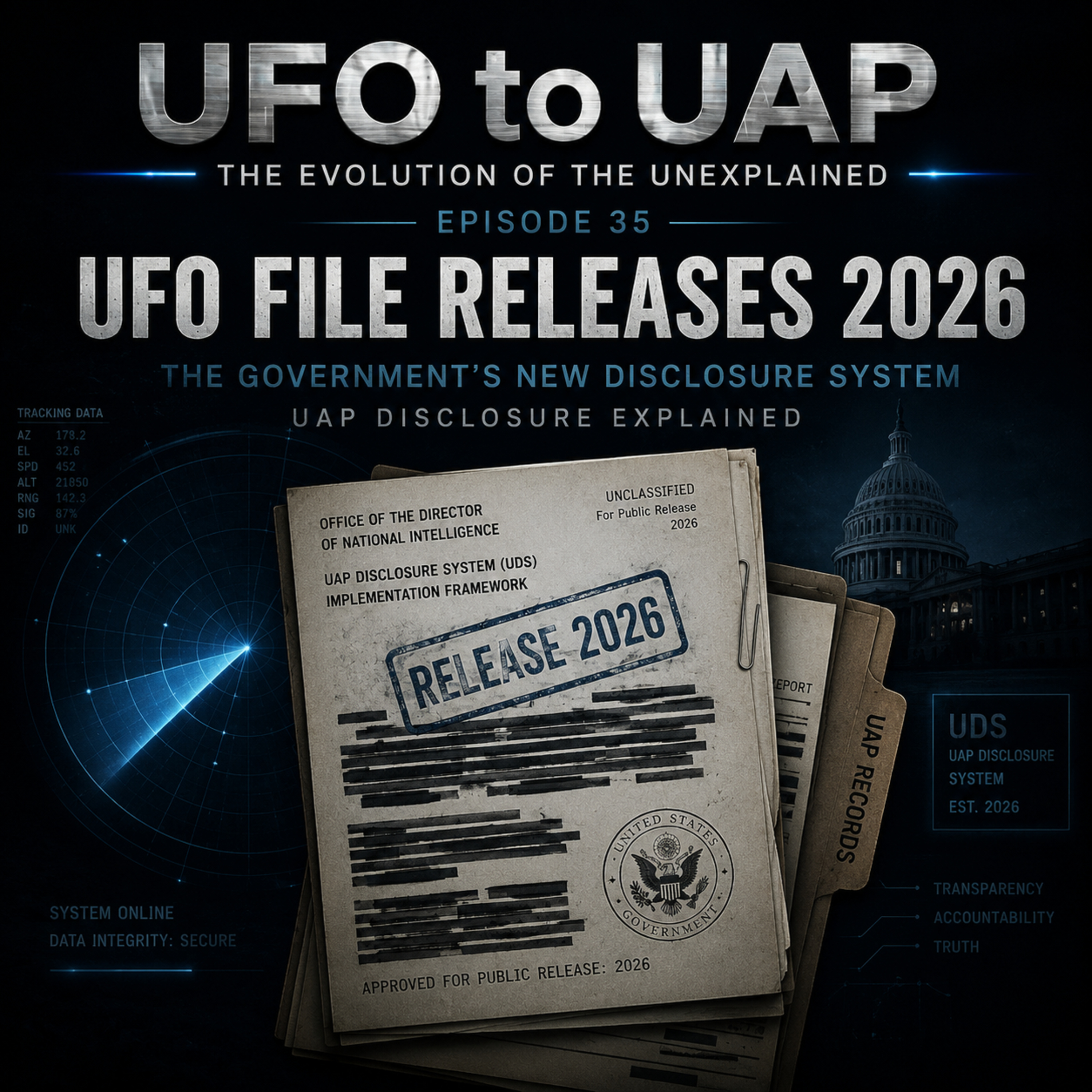
The 2026 UFO Rollout: Inside the Government’s Declassified Portal
Tonight's Episode
What does the reported 2026 government UFO disclosure portal actually reveal—and is it genuine transparency, controlled disclosure or a carefully managed information strategy?
In this episode of UFO to UAP Explained, host Matt Tones investigates the May 2026 UFO rollout and the architecture behind a government-branded archive of declassified documents, images, videos and incident reports. Rather than focusing only on whether one file proves extraterrestrial visitation, the episode asks why officials are building a permanent system for releasing and framing UAP information.
Explore the portal’s interactive design, references to hidden assets and future releases, the “17 pages” theory, government messaging and the role of online investigators analysing metadata, source code and archive structures. The episode also examines how military videos, congressional hearings, whistleblower testimony, AARO investigations and the shift from UFO to UAP have gradually normalised the subject.
Could the rollout be public acclimatisation, institutional trust-building, strategic ambiguity or a mask for classified aerospace technology? No released file provides conclusive proof of non-human intelligence, but the organised infrastructure may signal a major change in how governments manage UFO information, public attention and national-security narratives.
Episode Timestamps
(0:00) A government UFO disclosure portal appears
(1:25) Inside the May 2026 UFO rollout
(2:41) Why this release feels different
(3:23) The portal’s interactive archive design
(4:58) Government wording and rolling disclosure
(6:20) Disclosure becomes a controlled process
(7:01) Gradual public acclimatisation
(8:00) The mystery of the alleged 17 pages
(9:17) What the released evidence actually proves
(10:26) UFOs move inside official institutions
(11:20) Alternative motives behind the portal
(12:18) The psychology of controlled disclosure
(15:22) Social media drives modern UFO investigation
(16:49) Controlled uncertainty keeps the mystery alive
(17:55) Has UFO disclosure become entertainment?
(18:58) Classified aerospace technology theories
(20:00) The impact of confirmed non-human intelligence
(21:10) The UFO topic crosses a threshold
(22:01) What happens next?
(22:51) Why government behaviour matters
(23:40) The architecture of modern disclosure
Sources:
WAR.GOV/UFO — Presidential Unsealing and Reporting System for UAP Encounters (PURSUE);
Department of War — PURSUE UAP file releases;
Department of War announcement on declassified and historical UAP files;
National Archives — UFO / Project Blue Book records;
AARO Historical Record Report;
NASA UAP Independent Study Team Report;
Washington Post and Guardian reporting on the 2026 UAP file rollout.
Keywords:
2026 UFO disclosure, government UFO portal, declassified UFO archive, UAP disclosure, controlled disclosure, UFO acclimatisation, government transparency, hidden UFO files, 17 pages UFO portal, AARO, congressional UAP hearings, military UFO videos, UAP whistleblowers, UFO information control, classified aerospace technology, strategic ambiguity, non-human intelligence, unidentified anomalous phenomena, Pentagon UFO investigation, UFO to UAP Explained.
Tonight, the United States government has done something
that only a few years ago would have sounded impossible.
A real disclosure portal now exists.
A government branded UFO archive, A dedicated release
system, official domains, declassified files, images,
videos, incident reports, and language that sounds less like
ordinary bureaucracy and more like the opening phase of
something much larger. But here's the question nobody
seems able to answer. What exactly is this?
Is this genuine transparency, a controlled intelligence
operation, a psychological acclimation campaign, or the
beginning of the most significant information release
in modern history? Because when you step back and
stop focusing only on whether any single file proves aliens,
the real story becomes something far stranger.
The government hasn't simply released UFO material, it has
constructed an entire UFO disclosure architecture.
And tonight we're going deep into what that actually means.
Welcome to UFO to UAP, the disclosure report.
I am Matt Tones, your host, and tonight we investigate the
emerging UFO disclosure infrastructure now appearing
across government linked systems, military narratives,
public archive releases and media channels connected to the
May 2026 disclosure roll out. We'll examine the strange
structure of the release portal, the hidden architecture behind
the archive system, why the release process resembles
intelligence staging, what the PDFs, images and videos actually
reveal, why online investigators believe more files may exist
beneath the public layer, and why the government may be
preparing the public for a much larger long term disclosure
strategy. Because this story is no longer
just about UFOs. It's about information control
itself. For decades, UFO disclosure was
treated like fantasy. Something always coming soon,
always promised, never arriving. Every few years, leaked
documents, blurry military footage, whistleblower
interviews, congressional statements, classified rumours.
And every time, the same cycle repeated excitement, speculation
and ambiguity. But May 2026 feels different,
not necessarily because of what has been revealed, but because
of how it is being revealed. That distinction matters
enormously because for the first time we're not simply seeing
leaked files, we're seeing an organised release mechanism, a
system, a branded structure, an official pipeline that changes
the psychology completely. This is no longer someone leaks
something. This is the government built a
framework for releasing UFO information, and once that
framework exists, everything changes.
When investigators first began exploring the new UFO disclosure
site, many expected a simple archive page, maybe a few PDFs,
some scanned documents, basic government formatting.
Instead, the portal looks strangely modern, almost
cinematic. It included interactive
interfaces, image viewers, release categories, media
integration, navigation systems, modal windows, archival style
layouts, embedded content structures.
And immediately online, researchers noticed something
unusual. The site appeared larger than
the publicly visible content. People began finding references
to hidden assets, image parts, unreleased media, placeholder
structures, non indexed directories, inactive archive
references, and suddenly the Internet started behaving
exactly the way disclosure architects would expect.
Crowd source investigation exploded.
People started digging, searching, mapping directories,
looking for hidden releases, and whether intentional or not, the
system itself became part of the story.
That's important because modern information systems are not
passive. They are designed experiences,
and this a portal, appears designed to generate
anticipation, investigation, speculation, engagement, and
viral participation. In other words, the structure
itself may be psychologically strategic.
Now let's talk about the wording, because the language
used across this rollout is incredibly important.
Terms appearing throughout the release architecture include
historic undertaking, rolling disclosure, unprecedented
transparency, presidential release authority archive,
incident materials, public accountability, ongoing
releases, unresolved phenomena. This is not accidental wording.
Government communication is obsessively engineered.
Every phrase is reviewed, every sentence calibrated.
And what makes this different is that the language feels
intentionally transitional, not case closed.
But something is beginning that creates A fascinating
psychological effect. The public starts expecting
escalation, future revelations, additional phases, more
evidence, and once expectation is created, attention becomes
permanent. This may be the most important
development of all because the government may not need to
reveal extraordinary evidence immediately.
It may only need to establish credibility, continuity,
expectation, infrastructure. That alone changes public
consciousness. Now this is where things become
deeply interesting, because disclosure is no longer a single
event. It's becoming a process, and
processes can be controlled, paced, managed, narratively
guided. Historically, intelligence
agencies understood something critical.
Large scale public revelations cannot simply appear overnight,
especially if they fundamentally alter trust, geopolitics,
religion, science, national security and historical
narratives, societies to stabilise and sudden paradigm
shifts. So if disclosure were ever to
happen, it would likely occur gradually, incrementally,
psychologically. And that's exactly what many
researchers believe we may now be witnessing.
Not Full disclosure, but acclimatisation.
Acclimatisation. Gosh, I said that terribly.
A slow normalisation campaign. Notice the sequence.
Military videos normalise UFO discussion.
Congress normalises hearings. Whistleblowers normalised inside
a testimony. Arrow normalised investigation.
Mainstream media normalised coverage.
Now archive portals normalise government transparency.
Each stage reduces stigma, each stage moves the public slightly
further until eventually the idea itself no longer feels
impossible. That may be the real operation
here. Now let's discuss one of the
strangest aspects of the release, the so called 17 pages.
Many users exploring the portal reported references to multiple
pages, hidden navigation systems, asset directories,
inaccessible media content layers.
Beyond the visible archive, some believe additional files are
waiting to activate. Others think the site structure
references future releases not yet public.
And some researchers argue the entire architecture may have
been intentionally designed to encourage digital exploration.
That matters because mystery drives engagement, and
engagement drives amplification. If people believe there may be
more hidden beneath the surface, they keep searching, they keep
talking, they keep posting the disclosure narrative itself.
Sorry, the disclosure narrative sustains itself.
And whether intentional or not, that's exactly what has
happened. Social media exploded with
archive analysis, hidden file hunts, source code inspection,
metadata speculation, image enhancement attempts, timeline
theories. The disclosure system became
interactive, and that may be unprecedented.
Now here's the critical reality check.
Despite the enormous excitement, there is still no publicly
released file that conclusively proves extraterrestrial
visitation. That's important because
emotionally, many people want the release to be definitive,
but analytically, the evidence remains ambiguous.
What we mostly see are incident summaries, radar references,
pilot testimony, anomalous observations, military
reporting, language tracking, anomalies, unresolved aerial
encounters. That alone is still historically
significant, but it is not yet proof of aliens.
And honestly, that ambiguity may be deliberate, because ambiguity
keeps the conversation alive. Absolute proof ends debate, but
unresolved mystery creates endless engagement.
That's why the structure itself may matter more than any single
document. The government may not yet be
trying to convince the public of extraterrestrials.
It may simply be normalising. There are genuine, unexplained
phenomena. That distinction changes
everything. For decades, UFO culture existed
outside institutions. Now institutions themselves are
participating. That's the difference.
Congress talks about UA PS Military pilots discuss
encounters publicly. Defence officials acknowledge
unknown objects, intelligence figures discuss retrieval
rumours, and now government linked disclosure architecture
exists online. That cumulative effect is
psychologically enormous because humans trust patterns, and when
multiple institutions slowly align around a topic, public
perception changes permanently. Even without definitive
evidence, the phenomenon becomes socially real, and when
something becomes socially real, it begins reshaping culture
itself. There's another possibility
here. 1 rarely discussed. What if the disclosure
architecture isn't actually about aliens at all?
What if the objective is institutional trust?
Rebuilding Strategic ambiguity? Adversarial signalling?
Advanced aerospace masking, psychological operations, or
information dominance. Remember, UFO narratives have
enormous geopolitical utility. They create uncertainty,
fascination, fear, distraction, technological mystique.
And historically, states have always understood the power of
mystery. So the real question may not be
are aliens real? But why are governments choosing
this moment to build public UFO disclosure systems?
That question may ultimately matter more.
Now we go deeper into the intelligence psychology behind
controlled disclosure, the role of social media amplification,
whether disclosure is becoming a permanent information ecosystem,
how UFO narratives now intersect with politics, technology, and
national security, and why the modern disclosure era may
fundamentally change public consciousness.
Even without definitive proof, let's assume for a moment that
this disclosure process is intentional.
Not accidental, not chaotic, but strategically designed.
If it were true, what would it actually look like?
Ironically, probably exactly like this, because intelligence
operations rarely work through sudden revelation.
They work through conditioning, pacing, repetition, emotional
normalisation, narrative shaping.
You introduce an idea slowly, you reduce stigma gradually, you
let the public acclimatise over time, and eventually the once
unthinkable becomes ordinary. That's one reason this modern
disclosure era feels so different from earlier decades.
Because earlier UFO waves were chaotic.
Now everything feels coordinated.
Not necessarily coordinated by one single organisation, but by
converging institutional forces. Congressional hearings, Pentagon
statements, whistleblower testimony, archive systems,
media coverage, academic discussion, all moving together.
That creates a very different psychological environment.
One of the strangest things about the UFO phenomena is that
it never disappears. Even after ridicule, even after
debunking waves, even after public scepticism, the topic
always returns. Why?
Because unresolved mystery is psychologically irresistible,
especially when tied to national security.
Secret technology, hidden knowledge, existential
questions, government secrecy. UFOs sit at the intersection of
all of them. And now, for the first time in
history, governments themselves are participating in the
mythology that changes everything.
Because once institutions validate the legitimacy of
investigation, the conversation permanently evolves.
Notice the shift in terminology for decades.
UFO now UA PS That change wasn't cosmetic, it was strategic.
UFO carried cultural baggage. Science fiction, conspiracy,
culture, ridicule, UAP sounds technical, scientific, military,
institutional. The terminology reframed the
phenomena in itself, and that reframing opened the door for
mainstream legitimacy. Now let's discuss the real
engine behind modern disclosure. Not government.
Not the military. Not intelligence agencies.
Social media. Because disclosure today no
longer operates through newspapers or television alone.
It moves through TikTok X or Twitter, YouTube, Reddit,
Discord, live stream analysis, AI enhanced image breakdowns,
Viral speculation cycles. And that changes the rules
entirely. Information no longer moves top
down, it moves horizontally. Millions of people become
investigators simultaneously. The moment the portal launched,
the Internet immediately began dissecting everything people
analyse. Source code metadata, hidden
file paths, image compression, time stamps, government domain
registrations, and archive inconsistencies.
The crowd became part of the disclosure process that may be
historically unprecedented. And governments understand this,
which means the release architecture itself may have
been designed knowing the public would behave this way.
That's a crucial point because in modern information warfare,
participation creates investment.
If the public helps discover the the narrative, they emotionally
own the narrative. There's another important
concept here, controlled uncertainty.
The files released so far are fascinating but incomplete,
suggestive but inclusive, so inconclusive that creates a
perfect psychological state. People remain engaged because
they believe answers may still come.
The mystery remains unresolved. Future releases feel possible.
That's powerful. And intelligence systems have
historically understood something critical.
People become obsessed not with certainty, but with unresolved
patterns. That's why conspiracy ecosystems
become self sustaining. The uncertainty itself fuels
attention, and the current disclosure system may
unintentionally or intentionally operate exactly this way.
Every release generates new questions, new theories, new
investigations, new debates, meaning the narrative never
stabilises, it continuously evolves.
Now here's the uncomfortable question.
Has disclosure become entertainment?
Because the modern UFO ecosystem now contains podcasts like this
one. Documentaries influences
monetized channels, reaction videos, live streams, premium
content, viral clips, and importantly, governments
understand media ecosystems extremely well.
Modern information campaigns do not operate separately from
entertainment, they merge with it.
And UFOs are uniquely powerful because they trigger all fear,
curiosity, existential wonder. Very few topics generate that
emotional combination which makes UFO disclosure one of the
most powerful narrative engines imaginable.
The challenge becomes, how do you separate genuine
investigation from narrative amplification?
That line is becoming increasingly difficult to
identify. Another possibility cannot be
ignored. What if at least part of this
disclosure movement concerns advanced terrestrial technology?
Because historically classified aerospace programmes have often
appeared alien decades before public disclosure.
Stealth aircraft once looked impossible.
Hypersonic systems once sounded absurd.
Advanced drone technology once seemed futuristic, so some
analysts argue the UFO narrative may partially function as a
masking layer for classified technological development.
And if true, that creates fascinating strategic advantages
because ambiguity itself becomes protection.
Adversaries remain uncertain. The public remains distracted.
Capabilities remain obscured. Now that does not explain every
UFO report, but it may explain why governments tolerate certain
narratives, sometimes even encourage them indirectly.
Because uncertainty can itself be strategically useful.
Now we enter dangerous territory.
Because disclosure doesn't just affect politics, it affects
world view itself. If human, sorry if humanity were
ever presented with undeniable evidence.
Of non human intelligence. The consequences would be
enormous. Not just scientifically,
spiritually, philosophically, civilizationally.
Questions immediately emerge. What are humans?
Are religions incomplete? Where ancient encounters
misunderstood? Does consciousness extend beyond
current models? Are we alone?
Have we ever been alone? And perhaps most importantly,
how would billions of people psychologically process that
realisation? That's why some researchers
argue disclosure, if real, could never occur instantly.
The implications would be too destabilising.
So gradual normalisation becomes essential.
And again, that's exactly what many believe we are now
witnessing. Whether 1 believes in
extraterrestrials or not, something undeniable has
changed. The UFO topic has crossed a
threshold. It is now permanently embedded
inside government discussion, defence analysis, public
consciousness, media ecosystems, online culture, political
discourse. That alone is historically
extraordinary. Because 20 years ago, serious
public discussions of UFOs could destroy Koreas.
Today, senators discuss Uaps openly, military pilots testify
publicly, major newspapers cover disclosure seriously, and
governments build archive systems around the phenomenon.
That is not normal. Something fundamental is
shifted. Now here's the question everyone
is asking. What happens next?
Will additional files appear? More videos, better imagery,
Whistleblower confirmations? Recovery programme evidence?
Or does the process stall here? Nobody knows, but the structure
suggests continuation because the portal itself feels
expandable, almost modular, like phase one.
And if that's true, future releases may not simply be
random disclosures. They may follow a carefully
placed escalation model. If so, this may not be the end
of disclosure. It may be just the beginning.
Ultimately, the biggest mystery may not be what are UFOs?
But why are governments changing their behaviour around UFOs?
That question matters enormously because even without definitive
evidence, institutional behaviour itself tells a story.
Governments do not accidentally normalise topics, build
infrastructure, change language, coordinate messaging, release
archives and encourage investigation.
Those decisions happen deliberately, and whatever the
ultimate explanation may be, we are clearing and clearly
entering a new phase of the phenomena, a phase where UFOs
are no longer confined to conspiracy culture but are
becoming integrated into official reality itself.
Tonight we explored more than just files.
We explored the architecture of modern disclosure itself.
And maybe that's the true revelation.
Not a single video, not a single image, Not a single leaked
document, but the realisation that governments are now
constructing systems designed to keep the UFO question
permanently alive. And once that happens, the world
changes forever because disclosure is no longer
hypothetical, it's operational. This is UFO to UAP the
disclosure report. I am Matt Tones and I'll see you
in the next file. If you'd like to have a look at
the release, go to war.gov Forward slash UFO forward slash.
Let me know your thoughts. Music.
 Amazon Music
 Apple Podcasts
 Castbox
 Castro
 Goodpods
 iHeartRadio
 Overcast
 Pocket Casts
 Podbean
 Podcast Addict
 Spotify
 YouTube