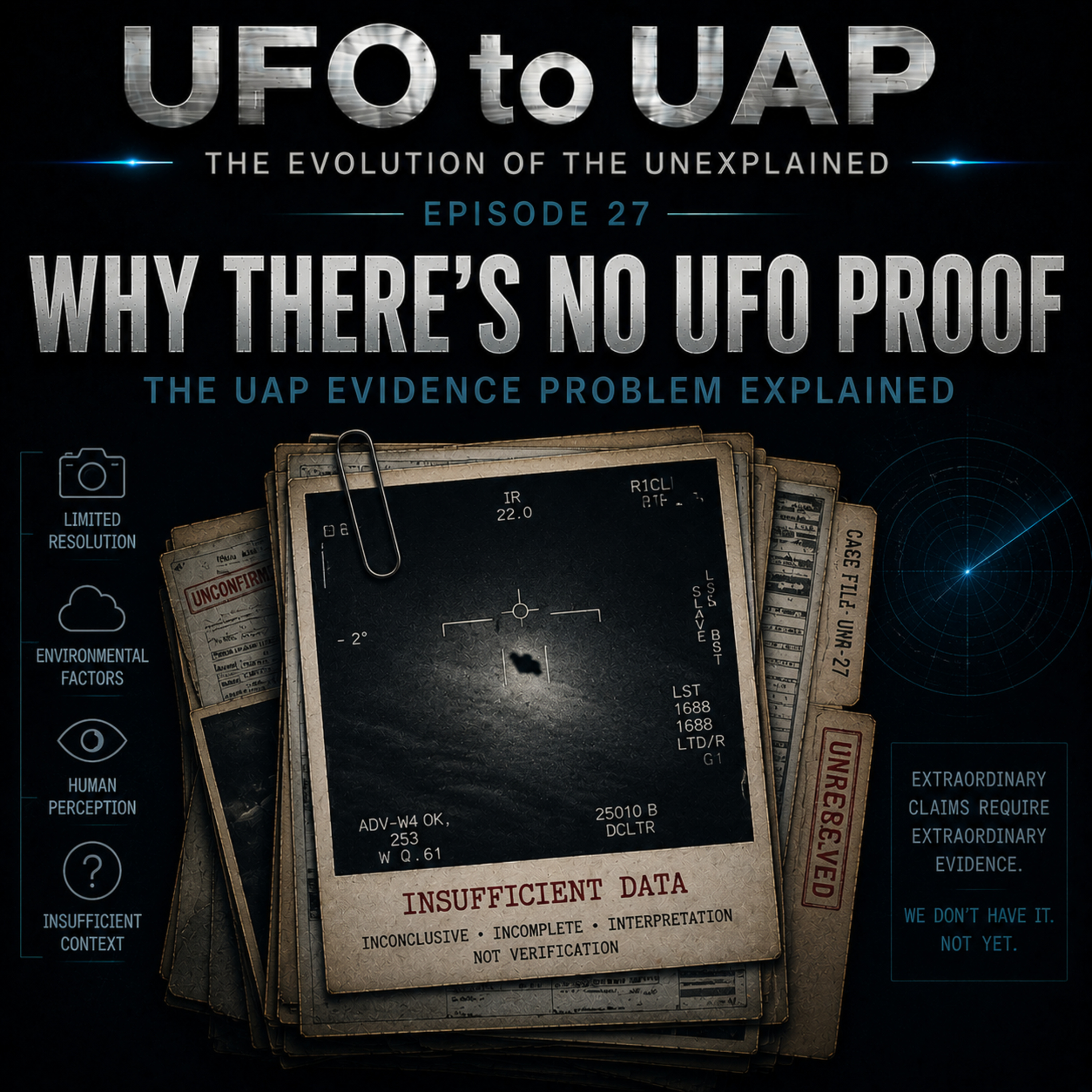
Unveiling UFOs: Military Secrets, Scientific Investigations & UAP Evidence Challenges
Tonight's Episode
Where is the definitive proof of UFOs and UAPs—and why do decades of military reports, sensor data and government investigations still produce uncertainty instead of answers?
In this episode of UFO to UAP Explained, host Matt Tones investigates the UAP evidence problem and the difference between detecting an anomaly and proving what it is. The episode examines radar tracks, infrared signatures, pilot testimony and multi-sensor encounters, explaining why individually compelling data rarely becomes publicly verifiable proof.
Explore how classification, national-security restrictions, fragmented government systems and need-to-know access prevent evidence from being assembled into one complete picture. The discussion also examines whistleblower testimony, scientific limitations, the sensor paradox and why improved technology may detect more anomalies without identifying their cause.
Could governments possess internal conclusions they cannot demonstrate publicly? Is evidence deliberately hidden, or does the defence system simply manage risk rather than pursue scientific certainty? Discover why UAP investigations may produce permanent ambiguity—and why the public’s expectation of a final UFO revelation may not match how classified institutions actually operate.
Episode Timestamps
(0:00) Where is the proof of UFOs and UAPs?
(1:31) What definitive evidence would look like
(2:43) Why traditional proof standards fail
(3:02) UAP evidence inside closed systems
(3:36) Radar, infrared and pilot data
(4:12) Why data does not automatically become proof
(5:02) National security versus scientific truth
(5:41) Compartmentalisation and restricted access
(6:08) Why whistleblowers provide signals, not proof
(6:38) Public expectations versus system reality
(7:18) Decades of unresolved UFO investigations
(8:28) The scientific method and UAP limitations
(9:21) The sensor paradox
(10:08) Multi-sensor evidence and missing context
(10:45) Fragmented data across agencies
(11:12) Would definitive evidence be released?
(12:16) Why ambiguity is structural
(12:59) The difference between truth and proof
(14:07) Managing risk without understanding
(15:07) The structure of permanent uncertainty
(16:02) Why disclosure may remain controlled
(16:54) Evidence, certainty and the final assessment
Sources:
NASA UAP Independent Study Team Report;
NASA Science UAP overview;
AARO Historical Record Report;
ODNI / U.S. Department of Defense UAP reports;
U.S. House Oversight Committee UAP hearings;
National Archives Project Blue Book records;
arXiv research on UAP sensors, metadata, multimodal observatories, anomaly detection, and evidence standards.
Keywords:
UAP evidence problem, UFO proof, unidentified anomalous phenomena, military UFO evidence, radar UAP data, infrared UFO footage, pilot UFO testimony, multi-sensor UAP encounters, classified UAP data, government UFO secrecy, national security classification, UAP whistleblowers, scientific UAP research, sensor paradox, fragmented intelligence, Pentagon UFO investigation, controlled disclosure, UFO disclosure, government UAP investigations, UFO to UAP Explained.
There is one question that sits at the centre of everything.
It doesn't matter whether you're sceptical.
It doesn't matter whether you're convinced.
It doesn't matter how many reports you've read or how many
videos you've seen. Eventually everyone arrives at
the same point and the question is simple.
Where's the proof? Not speculation, not testimony,
not analysis. Proof.
Something clear, something undeniable, something that ends
the conversation because that's what we used to in science, in
law, in everyday life. When something is real, there is
evidence, and when there is evidence, it can be shown.
So why, after decades of sightings, reports, programmes
and now official investigations, does that proof never arrive?
Why is it always just out of reach?
Why does it always feel like we're close but never quite
there? Because the problem isn't just
what we're looking at. The problem is how we expect
proof to exist. Welcome back to UFO to UAP, the
disclosure report. I am your host, Matt Tones.
Thank you for joining. Please subscribe on Spotify and
share the episode. Today's is titled the evidence
problem. Why proof never arrives.
When people say they want proof, they usually imagine something
very specific. A physical object.
Something that can be touched, examined, tested, verified, or
something equally definitive. A clear image, a piece of
technology, a document that confirms everything.
Something that removes doubt, Something that ends debate,
something that forces agreement. Because that's how evidence
works in most areas of life. If a crime is committed, you
look for physical evidence, eyewitness testimony, forensic
analysis, and eventually a conclusion is reached.
If a scientific discovery is made, you expect repeatable
results, peer reviewed validation, measurable outcomes,
and once those standards are met, the question is settled.
So naturally people expect the same thing here.
A craft, a body, a definitive signal, something that proves
beyond any doubt that what we're dealing with is real.
Now we need to pause, because this is where the
misunderstanding begins. The expectation of proof is
based on systems that are open, repeatable, and observable.
But the UAP problem exists inside a system that is none of
those things. It exists inside classified
environments, restricted access and fragmented data, which means
the conditions required for traditional proof don't exist
now. This is critical.
You cannot expect open system evidence from a closed system,
and that single mismatch explains almost everything that
follows. Instead of proof, the system
produces something else. Not objects, not definitive
artefacts. It produces data.
Sensor data, radar tracks, infrared signatures, pilot
reports. Individually none of these are
conclusive, but collectively they form patterns.
Patterns that suggest something is happening, but do not fully
explain what that something is. So instead of proof, the system
produces persistent ambiguity. Now we go deeper, because even
when data exists, it doesn't automatically become proof.
For data to become proof, it must be accessible, verifiable,
and repeatable. And in this case, those
conditions are really met. The first reason is
classification. Much of the data is classified,
which means it cannot be shared. Reason 2 is context.
Data without context is incomplete and context itself is
often restricted. Reason 3 Fragmentation.
No single data set tells the full story.
Everything exists in pieces for the result.
Even when data exists, it cannot be assembled into a complete
picture. Now we arrive at the core
constraint, national security, because the system handling UAP
is not a scientific institution, it is a defence system and
defence systems operate differently.
Their priority is not truth, it is risk management, which means
information is controlled, capabilities are protected and
exposure is limited. Even if definitive evidence
existed, it would not necessarily be released because
releasing it could expose technologies, reveal
capabilities, and create vulnerability.
Now, if we look at the compartmentalization problem,
and we've touched on this before, but now we expand it
inside the system, information is divided.
No single person has full visibility, which means analysts
see data, pilot see encounters, and official see summaries, but
no one sees everything. What this creates is a situation
where the full picture may exist, but no individual can
present it, and this connects directly to our last episode.
When insiders come forward, they bring credibility but not proof
because they are bound by classification, legal
constraints and incomplete access.
So whistle blowers provide signals, not definitive
evidence. Now we see the gap clearly.
The public expects clear proof, but the system produces
fragmented data, and that mismatch creates frustration.
People assume evidence is being hidden when in reality evidence
may not exist in the form they expect.
So now we arrive at the core issue, not lack of evidence, but
misalignment of expectations. The system is not designed to
produce proof. It is designed to manage
uncertainty. And that means the outcome is
not resolution, but ongoing ambiguity.
Now, if we go back not to the present but to the beginning of
this story, we see something that hasn't changed since the
late 1940s. There have been reports, not
one, not ten thousands. Pilots, military personnel,
civilians, all describing objects that didn't behave as
expected. And from the very start, the
same question followed. Where's the proof?
So investigation began. Projects were created, efforts
were made to understand what was being seen.
And what did they find. They found patterns.
They found unexplained cases, they found observations that
didn't fully resolve, and they did not find definitive proof.
And that pattern repeats across decades, across programmes,
across technologies. No matter how much data is
collected, no matter how advanced the systems become, the
result is always the same. Something is observed, something
is recorded, but nothing is fully explained.
Now let's step into science, because this is where people
expect answers. Science is designed to observe,
test, repeat, verify, and under those conditions it works
exceptionally well. But the UAP problem doesn't
exist under those conditions. It is not controlled, it is not
repeatable, and it is not consistently observable.
You cannot bring the UAP into a laboratory, you cannot trigger
an encounter on demand, you cannot run controlled
experiments, and without those conditions, science cannot
produce definitive conclusions. This doesn't mean nothing is
happening, it means the phenomenon does not behave in a
way that fits scientific method. Now we move into something even
more important, the sensor paradox.
Because while science struggles, technology improves.
Sensors become more advanced, systems become more capable, and
you would expect that better technology would lead to better
answers. But instead something unexpected
happens. The better the sensors become,
the more anomalies they detect. Not fewer, but more.
And this is the sensor paradox. Improved observation does not
eliminate the unknown, it expands it, because now the
system is capable of seeing things it couldn't see before.
And not all those things are understood.
Even when something is detected, there is another problem.
Context data on its own is incomplete.
A radar return shows movement and infrared image shows heat.
A pilot report describes behaviour.
But none of these on their own tell the full story.
And when you try to combine them, you run into limitations
because each data set is collected differently, processed
differently and often restricted.
So even when multiple sources, you still don't get a complete
picture. Everything exists in pieces.
This is the fragmentation problem.
Different agencies hold different data, different
systems capture different aspects, different
classifications limit access. So instead of 1 clear data set,
you now have fragments. Fragments that cannot always be
combined. And without combination there is
no synthesis. And without synthesis there is
no proof. Now we need to consider
something uncomfortable here. What if definitive evidence did
exist? Would it be released?
Not necessarily, because definitive evidence would have
consequences. It could reveal technological
gaps, expose system limitations and create geopolitical
instability. And systems are designed to
avoid instability, so even in a scenario where something is
confirmed, the response would not automatically be Full
disclosure. And this leads to a critical
distinction. There is a difference between
knowing something internally and proving it externally.
The system may reach internal conclusions, but those
conclusions rely on classified data, depend on restricted
context, and cannot be publicly demonstrated.
So even if understanding exists, it does not translate into
public proof. At this point we can see why
ambiguity is not an accident, it is structural.
Ambiguity exists because data is incomplete, access is
restricted, systems are fragmented, and disclosure is
controlled, and all those factors combine to produce the
same outcome. Not definitive proof, but also
no definitive dismissal. So what does the system produce?
Not answers, not conclusions. It produces ongoing analysis,
continuous observation, and incremental understanding, but
never final resolution. At this point, we need to
separate 2 ideas that are often treated as the same, but they're
not. Truth and proof.
Truth is something that exists whether it can demonstrate it or
not. Proof is something that can be
shown, something that can be verified, something that can be
accepted by others. And in most areas of life, those
two things align. If something is true, we can
prove it. But in this case, they may not.
There may be truths that cannot be proven publicly, not because
they aren't real, but because the conditions required for
proof don't exist. This is where the system
operates differently from the public.
The public wants proof, clarity, and resolution.
The system does not, because the system's objective is not to
prove what something is, it's to demonstrate whether it matters.
If something poses no threat, it can be deprioritized.
If something cannot be understood, it can still be
monitored. Proof is not required for
action. Now, Action without
understanding. This is uncomfortable because it
challenges how we think about knowledge.
We assume that understanding comes first and action follows.
But in complex systems, that's not always true.
Sometimes action comes first. Observation, tracking,
monitoring, all happening without full understanding.
And that's exactly what we're seeing from the outside.
This creates a constant expectation.
People believe proof is coming that one day there will be a
definitive reveal, a confirmed explanation, a final answer.
But that expectation is based on a system that doesn't exist
here, because the UAP problem does not move toward closure, it
moves toward management. And now we arrive at something
deeper, the structure of permanent uncertainty.
This may not be a problem that can be solved.
It may be a condition that must be managed, a condition where
observations continue, data accumulates, and understanding
evolves but never fully resolves because the inputs are
inconsistent, unpredictable, and incomplete.
And that creates something unusual, a system that is
permanently engaged without ever reaching a final answer.
Now we consider the alternative. What if proof did arrive?
Clear, definitive, undeniable? It would change everything, not
just the conversation, but scientific priorities,
geopolitical dynamics and public perception.
And systems do not handle sudden change well.
So even in a scenario where clarity exists, it would likely
be introduced slowly, controlled, managed, which means
even proof would not appear as proof.
Now we step back and look at the pattern again, the reoccurring
pattern. The system observes anomalies,
attempts to understand them, encounters limitations, produces
data, maintains ambiguity. The public demands proof,
interprets signals, fills the gaps and continues to ask
questions. And the cycle continues, not
once, but repeatedly, across decades, across programmes and
across technologies. So we return to the question we
started with where is the proof? And the answer is not hidden and
it is not withheld in the way people imagine.
The answer is this proof, as we expected, is not being produced,
not because nothing exists, but because the system does not
generate that kind of proof. So let's step back one final
time. We're not dealing with a lack of
evidence. We're dealing with a mismatch
between expectation and reality. The public expects certainty.
The system produces ambiguity. The public expects answers.
The system produces ongoing analysis.
And in between those two is the tension that drives everything.
So the final assessment is that the evidence problem is not a
failure of data. It is a structural outcome of
how the system operates. And until that structure
changes, the result will remain the same.
No definitive proof, but also no definitive resolution.
Because in the end, this is not just a story about Uaps.
It's a story about how we understand reality and what
happens when reality doesn't behave the way we expect it to.
The question doesn't go away. It doesn't get answered.
It stays open. And that may be the most
important insight of all. This is UFO to UAP the
disclosure report. I'm your host, Matt Tones, and
I'd like to leave you with one last thought.
Sometimes the most important question is not what is the
proof, but what if proof was never the outcome to begin with.
Please subscribe and share this episode and tell your mom.
 Amazon Music
 Apple Podcasts
 Castbox
 Castro
 Goodpods
 iHeartRadio
 Overcast
 Pocket Casts
 Podbean
 Podcast Addict
 Spotify
 YouTube