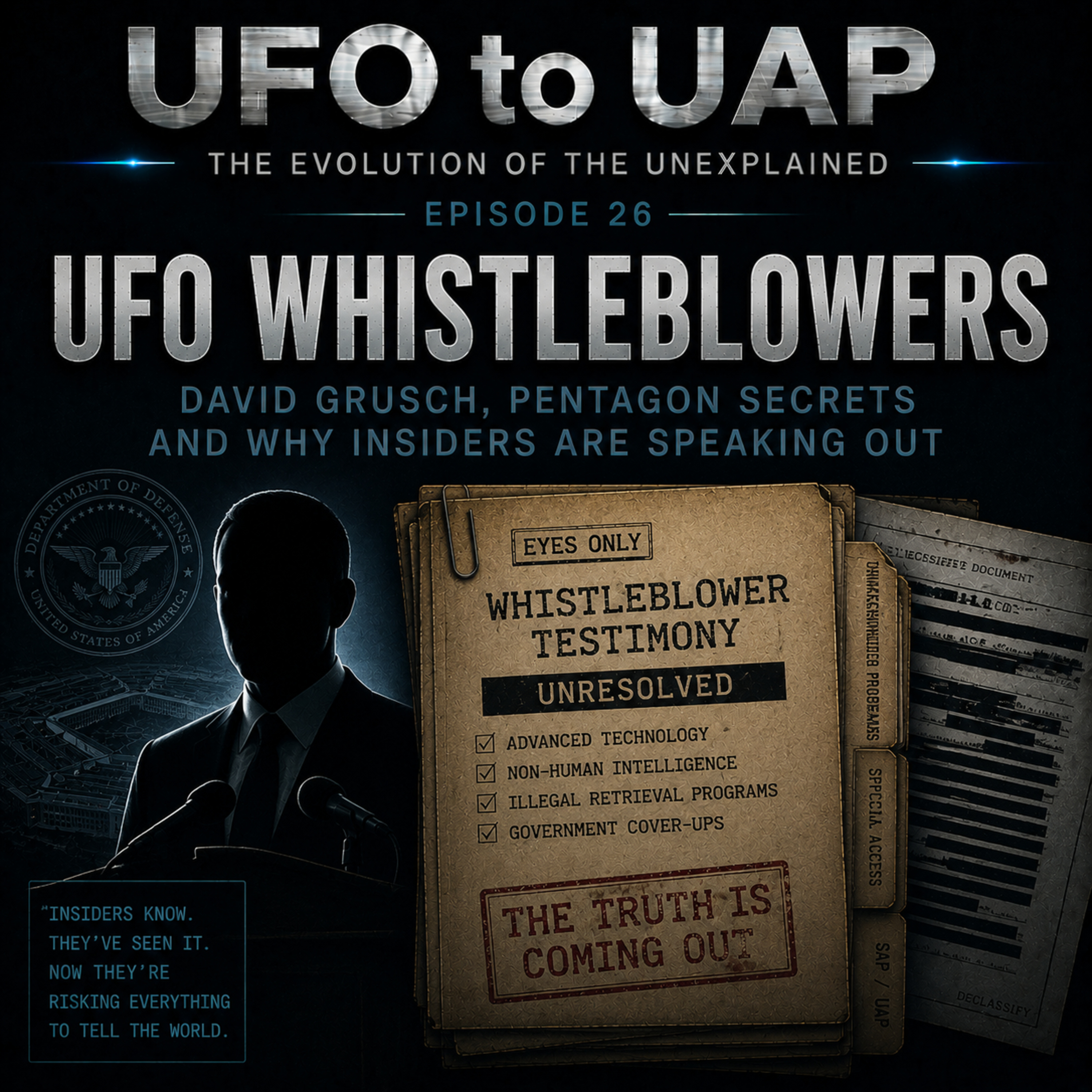
The UFO Whistleblower Pattern: Insights into UAP Disclosures from Military Insiders
Tonight's Episode
Why are military and intelligence insiders coming forward about UFOs and UAPs—and what does the repeating whistleblower pattern reveal about the system behind disclosure?
In this episode of UFO to UAP Explained, host Matt Tones examines why figures such as David Grusch, Luis Elizondo and Christopher Mellon have brought UAP claims into public view. Rather than treating whistleblower testimony as definitive proof, the episode explores it as a signal of internal pressure within government, defence and intelligence institutions.
Discover how classification, compartmentalisation, need-to-know access, legal restrictions and professional stigma limit what insiders can see and publicly reveal. The discussion explains why credible witnesses may still lack verifiable evidence, how new reporting channels allow claims to enter official processes, and why investigations often produce reviews and hearings instead of clear answers.
Are whistleblowers exposing secret UFO programs, reflecting disagreement inside the national-security system, or participating in controlled disclosure? This episode investigates the recurring cycle of insider claims, government procedure and controlled ambiguity—and asks why these voices are emerging now.
Episode Timestamps
(0:03) The difference between outside stories and insider knowledge
(0:44) Whistleblowers as signals, not proof
(1:08) Why military insiders are coming forward now
(1:33) Understanding the whistleblower pattern
(2:20) Classification and compartmentalised information
(3:05) Career risk, legal pressure and UFO stigma
(3:49) Why isolated insiders were easy to dismiss
(4:15) David Grusch, Luis Elizondo and Christopher Mellon
(4:44) Three reasons the pressure is increasing
(5:30) Legal pathways for UAP whistleblowers
(6:11) How government responds through process
(6:42) The repeating disclosure cycle
(7:21) Why credibility is not definitive evidence
(7:58) What classification allows insiders to say
(8:35) UAP claims as national-security risk
(8:54) Consistent themes across whistleblower testimony
(9:20) Internal disagreement and institutional pressure
(9:48) Controlled ambiguity instead of confirmation
(10:25) What whistleblowers reveal about the system
(11:01) Why the pattern will continue
(11:36) Why are these revelations happening now?
Sources:
U.S. House Oversight Committee — 2023 UAP hearing testimony;
David Grusch congressional testimony;
Ryan Graves and Cmdr. David Fravor testimony;
UAP Disclosure Act / NDAA records on whistleblower protections;
AARO Historical Record Report;
ODNI / U.S. Department of Defense UAP reports;
NASA UAP Independent Study Team Report.
Keywords:
UAP whistleblowers, UFO whistleblower pattern, military UFO insiders, intelligence community UAP claims, David Grusch, Luis Elizondo, Christopher Mellon, UAP disclosure, UFO disclosure, secret UFO programs, classified UAP information, government compartmentalisation, need-to-know access, UAP whistleblower testimony, military insider testimony, controlled disclosure, controlled ambiguity, Pentagon UFO investigation, national-security UAP risk, UFO reporting stigma, government UAP hearings, unidentified anomalous phenomena, UFO to UAP Explained.
There is a difference between a story told from the outside and
a story told from within. From the outside you see
fragments, reports, videos, statements, pieces of
information that don't quite connect.
But from the inside, the picture is different.
Not necessarily clearer, but closer.
Because the people inside the system don't just observe it,
they operate within it. They understand its rules, its
limits, its boundaries. And sometimes they reach a point
where they decide they can't stay silent anymore.
That's where whistleblowers come in.
Not as proof, not as confirmation, but as signals.
Signals that something inside the system is under pressure.
So tonight we're not asking our whistleblowers telling the
truth. We're asking something far more
important. Why our insiders coming forward
now and why does it keep happening?
Welcome back to UFO to UAP, the disclosure report.
I am your host Matt Tones. Thank you for listening.
Please remember to subscribe on Spotify Share the episode and
today's title is the Whistleblower Pattern.
Why Insiders keep coming forward.
When something repeats, it stops being about individuals and
starts being about the system. A whistleblower is often
misunderstood. They're not random voices.
They're not outsiders. They're not disconnected
observers. They are people with proximity
to information, people who have worked inside government,
intelligence, military systems and who at some point decide to
speak. But here's the key detail.
A whistleblower doesn't exist to prove something.
They exist to introduce pressure into a system because once a
claim is made publicly, the system is forced to respond, not
necessarily with answers, but with process.
To understand whistleblowers you have to understand the system
they come from because this is not an open environment.
It is built on classification, compartmentalisation, restricted
access. Information is divided.
No single person sees everything.
Access is granted based on need to know, which means even
insiders operate with incomplete information.
So when someone comes forward, they're not revealing the full
picture, they're revealing their part of it.
And that matters because before we understand why people speak,
we need to understand why they don't.
The system is designed to discourage disclosure.
Speaking out carries risk. Career risk, reputational risk,
legal risk. And beyond that, there's
something less visible Stigma. The fear of being dismissed,
ignored or discredited. So most people inside the system
remain silent, even when they have questions, even when they
have concerns. Historically, there have always
been individuals who who spoke out, but they were isolated,
disconnected, easy to dismiss because the system could absorb
them, treat them as anomalies and move on.
But something changed. Now we're seeing multiple
insiders emerge within a short period of time, people like
David Grouch, Louis Elizondo, Christopher Mallon, different
roles, different access points, but similar themes.
And that changes the equation because this is no longer
isolated, it's structured, and that makes it harder to ignore.
So the question becomes, why now?
Why are insiders coming forward at this moment?
The first reason is that the system has reopened the
question. UAP research has returned,
programmes exist again, data is being collected and once the
system begins looking again, pressure increases internally.
The second reason is data. The system is now encountering
persistent anomalies, not one of events, but patents, repeated
observations that don't fully resolve and that creates
tension. The third reason is internal
disagreement. Different parts of the system do
not see the same picture, they don't interpret the data the
same way, and they don't agree on how to respond.
And when systems lack alignment, pressure builds and pressure
finds a way out through people. Even now, speaking out isn't
easy. Whistleblowers face scrutiny,
they face scepticism, they face investigation.
But something has changed. They now have channels, legal
pathways, structured ways to present claims.
And that tells us something important.
The system is allowing pressure to be released in a controlled
way. When a whistleblower speaks, the
system responds in a predictable way, not with confirmation, not
with denial, but with process investigations, statements,
reviews. This allows the system to
maintain control while still acknowledging that the claim
exists. Now we reach something critical
because at this point a patent becomes visible.
This is not random, it is repeatable.
Insiders come forward, claims are introduced, the system
responds with process, and the question remains open.
When a claim enters a system, it becomes something else.
Not truth, not fiction, but a problem to be processed.
And the system doesn't operate on belief, it operates on
procedure. So claims are logged, reviewed,
assessed, but not necessarily resolved.
This is where people get confused, because credibility is
not proof. A whistleblower can be credible,
qualified, experienced and still not provide definitive evidence
because of the system itself. Information is
compartmentalised, access is restricted and even insiders
only see part of the picture. So what they provide are
signals, not full answers. And those signals are shaped by
legal constraints, by classification and what they are
allowed to say, Which means what reaches the public is not the
full claim, it is the claim that can be safely made.
And that creates a gap between what is known and what is said.
The system responds internally while the public reacts
externally. The public asks, is this true?
Is this disclosure? Is this confirmation?
But the system is asking something different.
What risk does this claim create and how do we manage it?
Because the claim itself can be a threat, not because of what it
proves, but because of what it introduces.
Uncertainty. As more insiders come forward,
that pattern becomes harder to ignore.
Not identical claims, but consistent themes.
Unexplained phenomena, restricted information, national
security, framing and consistency is more powerful
than any single statement because it suggests structure.
At this point we begin to see something deeper, not just
claims, but tension inside the system.
Different groups, different data, different interpretations,
no single unified position. And when that happens, pressure
builds. So why doesn't the system simply
confirm or deny? Because it can't.
Confirmation creates consequences.
Denial may contradict internal data, so instead the system
chooses something else. Controlled ambiguity.
Enough information to acknowledge the issue, but not
enough to define it. And that ambiguity is not a
flaw, it is a strategy. Now we step back.
Because what we're seeing is not just individuals speaking out,
it is a system under pressure. Pressure created by data that
doesn't resolve internal disagreement and external
attention. And when pressure builds, it
doesn't stay contained. It emerges through people,
through claims, through moments like this.
Whistleblowers are not proof. They are signals.
Signals that something inside the system is unresolved.
They don't tell us what is happening in the sky, they tell
us what is happening inside the system and route.
Right now that system is processing, adapting,
responding, but not resolving because the question is still
open. As long as it remains open, the
pattern will continue. More voices, more claims, more
process and no final answer. Because in the end, this was
never just about UFOs or hidden programmes or extraordinary
claims. It is a story about pressure and
what happens when that pressure can no longer be contained.
This is UFO to UAP the disclosure report.
I'm Matt Tones and I'd like to leave you with just one last
thought. Sometimes the most important
signal is not what is being revealed, but why it's being
revealed now. Please share, please subscribe
and tell your mom about this episode.
The.
 Amazon Music
 Apple Podcasts
 Castbox
 Castro
 Goodpods
 iHeartRadio
 Overcast
 Pocket Casts
 Podbean
 Podcast Addict
 Spotify
 YouTube